 Written by
Muscle made creatine famous. But the brain may be where it matters most.
It all comes down to energy. Just as muscles need a steady fuel supply to perform, neurons rely on a constant flow of ATP, the body’s cellular energy currency. The brain accounts for only 2% of body weight, but it burns through about 20% of our resting energy — making it the hungriest tissue in the entire human body [1].
Here’s the problem: during the aging process, the cellular power plants that generate this ATP — the mitochondria — start to slow down. They produce less energy and leak more reactive oxygen species, a kind of internal “rust” that eats away at the machinery. In the brain’s high-voltage network, that’s a double blow: more dips in cellular energy when neurons need it most, and more wear and tear that accumulates over time [2].
That makes creatine an intriguing candidate for cognition and aging. If it can buffer energy supply in muscle, could it also support mental energy to keep the brain focused and adaptable under stress? That’s the question scientists have begun to ask, and one that inspired an illuminating long-term experiment in mice.
How Creatine Works in Energy Metabolism
Athletes and weightlifters prize creatine because it reliably enhances high-intensity performance, a fact backed by hundreds of studies. For instance, one meta-analysis found ~7% faster repeated sprints, ~8% stronger bench presses, and ~14% stronger squats compared to placebo [3].
Why? Because creatine plugs directly into biology’s most basic energy cycle. Every cell runs on ATP (adenosine triphosphate). When you push hard, muscles break ATP apart, snapping off one of its three phosphates to release energy. What’s left is ADP (adenosine diphosphate).
But here’s the problem: your ATP stores are tiny. Go all-out for a few seconds, and they’re gone. That’s why fatigue hits so fast.
Creatine solves this by acting as a phosphate donor. Stored in muscles as phosphocreatine, it hands off phosphate groups via the enzyme creatine kinase whenever ATP runs low, rapidly recharging energy. This is why supplementation is so powerful for physical performance: it’s a direct buffer for the cell’s core energy process. For those focused on athletic performance, questions often arise about whether to take creatine before or after workout sessions, particularly when trying to optimize strength, recovery, and cellular energy availability.
And the same system operates in the brain. Only here, the stakes are even higher.
Gram for gram, brain tissue is ten times more metabolically expensive than muscle [1], and about 80% of that energy is devoted to neurons firing, recycling neurotransmitters, and keeping circuits charged. In this sense, neurons are always "on," coordinating a vast, energy-hungry web of communication with zero downtime.
Like muscle cells, neurons stockpile phosphocreatine, leaning on it whenever energy demand spikes [4]. Supplementation has been shown to elevate brain creatine levels by 5–15% [5], which in turn expands its high-energy phosphate pool [6].
In practical terms, this suggests that the same molecule that helps an athlete squeeze out one more rep could also help your brain maintain clarity amid its round-the-clock activity.
But does it necessarily work that way in a living brain? To find out, researchers turned to mice.
Creatine, Aging, and Cognitive Function
The story starts with a cohort of one-year-old female mice. Middle age in mouse terms, about the equivalent of a forty-something human.
Half stuck with their usual chow.
The others got chow spiked with a secret ingredient: creatine, making up about 1% of every bite (scaled to a 150 lb human, that’s roughly 8–9 grams per day).
From then on, their lives looked identical. They ate, nested, scurried — doing ordinary mouse things under the watchful eyes of lab techs.
When each rodent reached the ripe old age of two (70s in mouse years), they faced a round of “check-ups.” These included the Object Recognition Test, a measure of everyday memory and curiosity, as well as the Modified Hole Board Test, which gauges initiative and willingness to explore.
From there, it was a waiting game. Each mouse was followed until natural death or until serious illness forced an early farewell. Only then did the scientists crack open the black box, examining brain tissue for traces of how creatine had shaped the aging process.
Can Creatine Enhance Memory with Age?
Memory is far more than a filing cabinet of facts. It’s the thread that ties our identity together, and keeps our relationships coherent. When it frays, we lose continuity with ourselves and those close to us.
The Object Recognition Test shows this dynamic in miniature. A mouse explores two identical objects. Later, one is swapped out for something new. Younger animals tend to explore the new object, guided by their memory of the original. Older ones often lose that anchor and treat both objects the same. In essence, new and old blur together, and curiosity evaporates.
In human terms, this is sort of like an older relative retelling the same story without realizing it, or settling in to watch a TV episode they’ve already seen as if it were new. Each lapse may seem small, but together they erode the scaffolding of identity and connection.
In this experiment, the rodents that had been fed creatine were more likely to gravitate toward the novel object. In other words, they acted more like younger mice.
Can Creatine Help You Stay Motivated And Engaged With Age?
If memory anchors us to the past, initiative pulls us into the future. And with age, that pull weakens. We shy away from the unfamiliar, sticking to routine, preferring security to the open field of possibility.
Scientists capture this in the Modified Hole Board Test: a bare arena dotted with small openings that beg for exploration. Younger mice will dart forward, dipping their noses into hole after hole. Older ones are more likely to freeze, reluctant to venture out. Here again, creatine-fed mice defied the norm: they stepped out sooner and explored more.
In aging research, hesitation in a new environment is a marker of initiative slipping away, a sign that the drive to engage with the world is fading.
The human parallels are obvious: older adults who resist smartphones or new apps, who return again and again to the same restaurant. Who always choose the comfort of routine over the challenge of something new. If you’ve watched relatives grow more set in their ways, you’ve seen the same arc that aging writes in both mice and humans.
Put together, aging can feel like time closing in from both directions. The past doesn’t anchor as firmly, and the future doesn’t invite as strongly. Creatine, in this study, seemed to stretch that space back open.
And that dual effect, collectively, connects directly to the idea of healthspan: not just longer survival, but longer life with continuity and engagement.
Creatine: Extending Healthspan, Not Just Lifespan
Adding time to life is one thing. Adding time that still feels like real living is another. And that is where creatine made its mark.
On average, mice given creatine chow enjoyed about 50 extra days of good health, translating to a 9% increase in healthspan. In the compressed calendar of a mouse’s life, that’s a substantial margin.
Let's apply the same percentage to humans. On an 80-year lifespan, 9% works out to roughly seven extra years of vitality. Not seven years of decline, tacked on at the end, but seven extra years when memory is reliable and new adventures are still ahead of you.
In other words, creatine added years that really count.
The next question is why? To find out, scientists had to look inside the heads of the rodents — literally.
How Creatine Fights Oxidative Stress
As the brain ages, its mitochondria struggle to keep up. ATP is made less reliably, and every dip in energy reverberates outward: synapses lose flexibility, metabolic waste accumulates, and stray electrons spill out as reactive oxygen species that scar proteins and membranes.
Over time, that damage leaves a visible trace. Neurons accumulate lipofuscin, a brownish pigment made of oxidized proteins and fats [7]. Because neurons never divide, they can’t shed the buildup. Year after year, the pigment spreads like biological rust across the aging brain.
In the creatine-fed mice, that rust was lighter. Their hippocampal neurons carried less of the pigment, hinting that the tissue had resisted one of the classic signatures of brain aging. By serving as a backup supply of high-energy phosphate, creatine smoothes out those energy dips and blunts the oxidative spillover creating this “rust.”
But the scientists didn’t stop at surface damage. They also examined whether creatine changed the script written inside the cells.
How Creatine Influences Gene Expression and Brain Plasticity
Gene expression is the control panel of the brain. Some switches govern energy, others regulate adaptability. With age, that panel usually drifts toward settings that leave cells sluggish and rigid.
In the creatine-fed mice, the drift was different. Two switches stood out here.
First, the power grid. Genes tied to mitochondrial function and energy metabolism were more active, as if the brain’s generators were humming with steadier current. That fits with creatine’s role as an energy buffer.
Second, the circuit board. Here the issue isn’t raw power, but how adaptable the circuits remain, meaning whether they can re-route, strengthen, or prune connections as needed. Two key genes lit up here.
BDNF (brain-derived neurotrophic factor) rose by about 1.27-fold. BDNF is often called “fertilizer for the brain” because it encourages neurons to sprout new branches and strengthen their connections (neurogenesis) [8]. It is a key driver of the cognitive benefits of exercise, linking physical activity to improved learning and memory, as well as mental resilience.
Alongside it was Slc1a3, which builds transporter proteins that clear away excess glutamate, the brain’s primary excitatory signal. Too much glutamate is like static on the board, corroding communication instead of sharpening it. By boosting Slc1a3, creatine-fed brains kept those lines clear and ready for the next signal.
Together, these changes suggested synapses tuned for adaptability; circuits with both the current to run and the wiring to flex.
But the obvious question is: does any of this apply to us?
What Human Research Says About Creatine and Memory
Rodents give us clean answers. Control their diet and environment, and within a couple of years you see an entire life unfold. Humans are trickier. We live for decades, resist lab precision, and won’t stick to standardized chow or identical living spaces.
That makes long-term studies of brain aging harder to pull off. But the human evidence for creatine is taking shape.
A recent meta-analysis pulled together every randomized trial of creatine and memory in healthy adults (eight studies with 225 total participants). Across all ages, creatine produced a modest but real memory boost (effect size 0.29). But in older adults, the effect tripled, hitting 0.88. Statisticians call that a “large” effect size. In human terms, it means that creatine vaulted older adults from the middle of the pack to outperforming four out of five of their peers [9].
To put it into perspective, let’s stack it against a known heavyweight for preserving brain performance: exercise. A 2025 meta-analysis of 29 randomized trials in older adults found that regular aerobic training produced a moderate improvement in memory, with an effect size ~0.42 [10].
Now, the creatine data come from fewer trials, so the evidence isn’t as firm as it is for exercise. Still, the signal was hard for us to ignore.
And that promise has led us to take a hard look at creatine itself, and ask how it could be made better. The result is a formula that carries forward decades of science, fine-tuned for the way people actually use it.
Qualia Creatine+ For Strength, Brain Health, and Aging*
The undeniable research led us to take a hard look at creatine itself, and ask how it could be made better. The result is Qualia Creatine+, a formula that carries forward decades of science, fine-tuned for the way people actually use it.
Finally, for a deeper look at how creatine interacts with recovery and sleep, see our detailed breakdown of how creatine helps with sleep.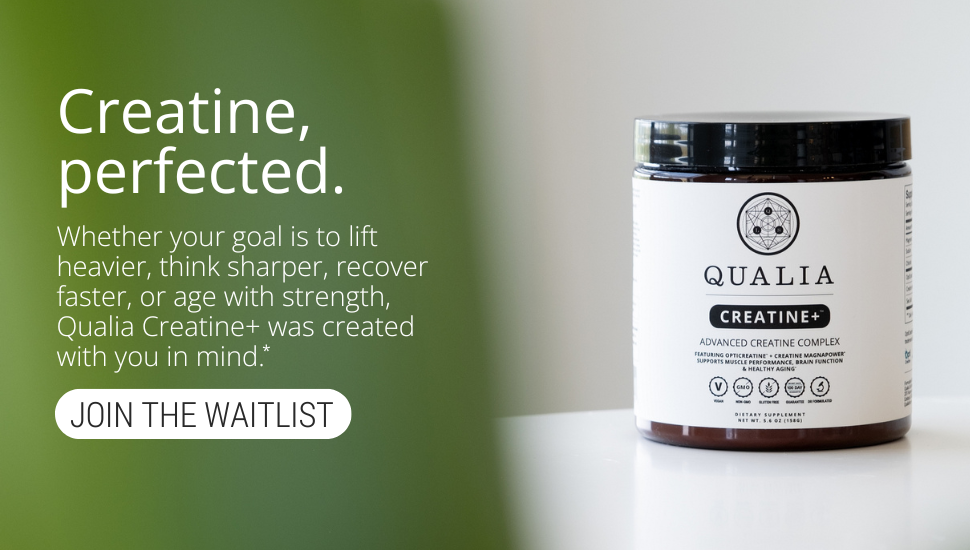
*These statements have not been evaluated by the Food and Drug Administration. This product is not intended to diagnose, treat, cure, or prevent any disease.
References
[1] V. Balasubramanian, Proc. Natl. Acad. Sci. U.S.A. 118 (2021) e2107022118.
[2] S. Giordano, V. Darley-Usmar, J. Zhang, Redox Biol. 2 (2014) 82–90.
[3] R.B. Kreider, D.S. Kalman, J. Antonio, T.N. Ziegenfuss, R. Wildman, R. Collins, D.G. Candow, S.M. Kleiner, A.L. Almada, H.L. Lopez, J. Int. Soc. Sports Nutr. 14 (2017) 18.
[4] E. Dolan, B. Gualano, E.S. Rawson, Eur. J. Sport Sci. 19 (2019) 1–14.
[5] I.K. Lyoo, S.W. Kong, S.M. Sung, F. Hirashima, A. Parow, J. Hennen, B.M. Cohen, P.F. Renshaw, Psychiatry Res. 123 (2003) 87–100.
[6] P. Dechent, P.J. Pouwels, B. Wilken, F. Hanefeld, J. Frahm, Am. J. Physiol. 277 (1999) R698–R704.
[7] A. Terman, U.T. Brunk, Int. J. Biochem. Cell Biol. 36 (2004) 1400–1404.
[8] F. Ribeiro, S.C. Forbes, D.G. Candow, P. Perim, F.S. Lira, A.H. Lancha Jr, J.C. Rosa Neto, Front. Nutr. 12 (2025) 1579204.
[9] K. Prokopidis, P. Giannos, K.K. Triantafyllidis, K.S. Kechagias, S.C. Forbes, D.G. Candow, Nutr. Rev. 81 (2023) 416–427.
[10] H. Han, J. Zhang, F. Zhang, F. Li, Z. Wu, Front. Aging Neurosci. 17 (2025) 1510773.