Written by

Most people need about 7–9 hours of sleep. But let’s be honest, you already know how much sleep you need. The issue is that modern life has made hitting that target elusive.
It wasn’t always like this.
In 1942, nearly 60% of U.S. adults slept eight hours or more each night. Today only about a quarter still do. And 20% of Americans get just five hours of sleep or less per night.
The problem is that chronic sleep loss can trick you. Sleep debt numbs its own warning signals, while dragging down physical performance and mental acuity. You might feel perfectly functional while your brain and body are operating far below your true potential.
In this article, we’ll explain how much sleep you need to perform at your best — and how to tell whether your current sleep is actually enough.
How Many Hours Of Sleep Do You Need?
The optimal amount of sleep for most adults is 7–9 hours per night, according to the National Sleep Foundation (NSF) [1].
Large analyses involving more than 4 million people show this range is linked to the best health outcomes and the lowest long-term mortality risk [2].
Chronic short sleep carries a hidden cumulative cost. In controlled studies, adults sleeping 6 hours per night show steady declines in cognitive performance, eventually performing at levels seen after one to two nights without sleep [3].
Worse still, participants didn’t perceive the impairment.
So if you think you function great on just six hours, the data suggests otherwise. Your brain may have just stopped sending the warning signals.
What Are The Stages of Sleep?
Sleep has four stages that cycle throughout the night: three stages of non-REM (NREM) sleep and one stage of rapid eye movement (REM) sleep.
N1 (NREM Stage 1): Light, transitional sleep.
N2 (NREM Stage 2): Onset of true sleep; heart rate and temperature drop.
N3 (NREM Stage 3 and 4 (slow-wave sleep): Deep, restorative sleep.
REM Sleep: Dreaming stage; supports memory and emotional processing.
A full sleep cycle lasts about 90 minutes, and adults complete 4–6 cycles per night [4].
The balance of these stages evolves across the night. Early in the night, your brain front-loads deep slow-wave sleep. Later cycles stretch into longer REM periods [5].
That distribution shapes the consequences of sleep loss.
Cutting sleep early in the night is more likely to reduce deep slow-wave sleep, while losing sleep late disproportionately cuts REM sleep [6–7].
So two nights may have similar total hours, but the biological programs that are completed — or skipped — may be very different.

How Much Deep Sleep Do You Need?
Young adults typically get about 60–100 minutes of deep slow-wave sleep (N3) per night — roughly 15–20% of total sleep. This is the stage that does the real restoration: tissue repair, immune recalibration, and metabolic reset.
Deep sleep also plays a central role in the early stages of memory consolidation — the period when the brain replays new information and begins stabilizing it for long-term storage [8].
How Much REM Sleep Should You Get?
Most young-to-middle aged adults need about 90–120 minutes of REM sleep per night — roughly 20–25% of total sleep time. You should hit that range when getting a consistent 7–9 hours of quality sleep.
But REM is not spread out evenly. It progressively elongates over the night, with the longest and most intense REM periods occurring just before waking [12]. That means early wakeups disproportionately erase REM.
This has been demonstrated in controlled sleep experiments.
People who slept only the first half of the night (11 pm–3:30 am) spent 15% of their sleep in REM, while those who slept 3am–7:30am spent 24% in REM. Same number of hours, but totally different sleep architecture [13].
During REM, the brain takes the memories that were stabilized during deep sleep and turns them into insight, weaving them into broader connections and creative breakthroughs.* In creativity tests, only REM improved performance — 40% stronger associations — while NREM and quiet rest failed to move the needle [14].
Do Women Need More Sleep Than Men?
There is no strong evidence that women have a higher biological sleep requirement. Indeed, women tend to sleep slightly longer — about 10 to 20 minutes more in laboratory studies. They also show greater sleep efficiency and often get more slow wave sleep on polysomnography [15].
So why do women feel like they sleep worse?
Because the issue isn’t how long they sleep, it’s how easily that sleep is disrupted. Hormonal shifts across the menstrual cycle, pregnancy, and menopause make women’s sleep more fragile, even when the total minutes are the same.
Sleep may look intact in the lab, yet feel less restorative due to subtle fragmentation [16].
Women don’t necessarily need more sleep. They need fewer disruptions to the sleep they’re already getting.
How to Know If You’re Getting Enough Sleep
You can’t just rely on how rested you feel. The brain adapts to sleep loss by dulling the very signals that should warn you you’re under-slept.
Self-assessment fails for two reasons.
You probably overestimate how much you sleep. And the worse your sleep, the bigger the overestimation [17].
You stop noticing the impairment. Chronic short sleep resets your baseline downward, which is why people running on six hours swear they’re fine while performing like they’ve pulled an all-nighter [3].
Since intuition is misleading, the best indicators come from daytime function and sleep stability. You're probably getting enough sleep if:
You fall asleep in 10–20 minutes (not instantly, not after an hour).
Your alertness stays steady without an afternoon crash.
You can maintain focus during boring or low-stimulation tasks.
You wake at a consistent time and don’t need weekend catch-up sleep.
Caffeine is optional, not a prosthetic for basic functioning.
Workouts feel normal: rising resting HR, lower HRV, and higher perceived effort often signal you're under-slept.
If your body is compensating all day, you’re probably not sleeping enough, even if you think you are.
Sleep Hygiene Checklist
Sleep hygiene targets the levers your biology responds to before sleep: light, temperature, stimulation, and timing. These habits have the strongest evidence for improving nightly sleep quality [18–24].
Stop caffeine at least 8 hours before bed. Caffeine blocks adenosine, the chemical that builds sleep pressure. In lab studies, a dose six hours before bed cut total sleep by more than an hour.
Limit alcohol in the evening. It knocks you out fast, but flattens REM. Even 2–3 drinks can reduce REM by 10–20%.
Avoid large meals 2–3 hours before bed. Digestion raises core body temperature and can trigger reflux, both of which disrupt sleep.
Skip late night hard workouts. Hard exercise right before bed spikes adrenaline and body heat, making it harder to flip into sleep mode.
Dim lights 1–2 hours before bed. Even standard room lighting — under 200 lux — suppresses melatonin’s window by~90 minutes.
Put away bright screens. Blue-rich screens deliver a “daytime” signal to the brain. Evening tablet use suppressed melatonin ~55% and trimmed ~12 minutes of REM.
Take a warm shower or bath 1–2 hours before bed. Heating the skin helps your core temperature drop afterward — a cue your body uses to fall asleep.
Keep your bedroom cool (60 to 67°F , or 16 to 19°C). A cool room reinforces the body temperature dip your brain needs for stable sleep.
Make your bedroom dark and quiet. Light and noise activate arousal circuits that chip away at sleep, especially deep (slow wave) stages.
Reserve the bed for sleep. Your brain likes clear signals. If you use the bed for waking activities, it stops being a strong cue for sleep.
Keep your schedule consistent (weekends included). Circadian rhythm is timing-based. Even with enough sleep minutes, irregular timing worsens metabolic and cognitive outcomes.
Get bright morning light exposure. Morning light anchors your internal clock and sets up a stronger sleep drive for the night.

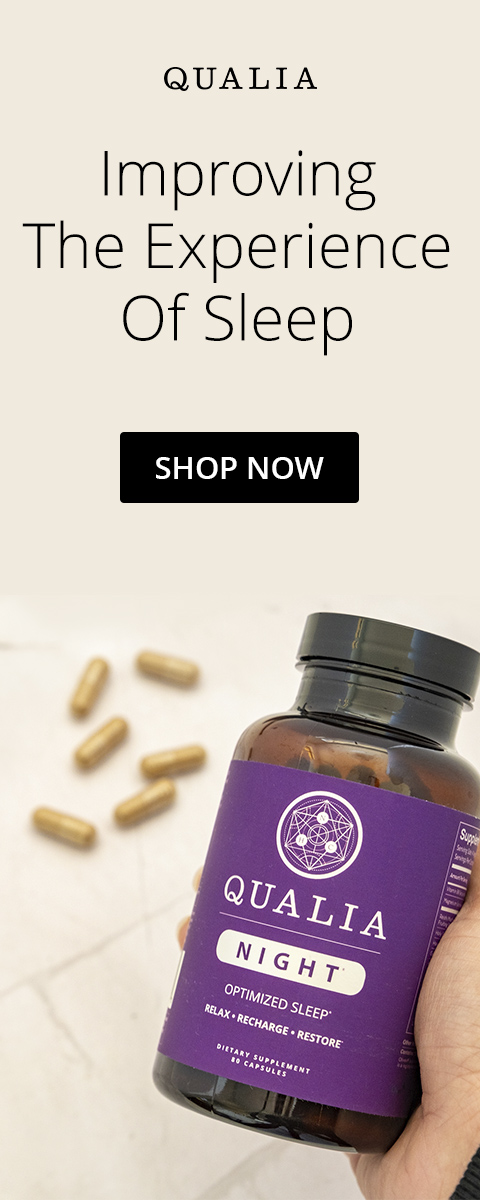
Support Deep Sleep and Overnight Recovery with Qualia Night
Sleep habits set the stage, but chemistry still runs the show.
Slow-wave sleep only emerges when multiple systems align: cortisol drops, GABA signaling rises, melatonin builds on schedule, and mitochondrial output triggers the ATP shift that launches the first deep sleep cycle. If even one link falls short, the restorative machinery never fully turns on.
Qualia Night was designed to support those bottlenecks — without sedation.*
Magnesium glycinate supports GABA signaling, melatonin rhythm, and the ATP processes that shape slow-wave sleep.*
L-tryptophan supplies the precursor for serotonin → melatonin, which helps improve sleep depth.*
KSM-66 Ashwagandha supports a healthier nighttime cortisol curve so the nervous system actually powers down.*
Reishi mushroom promotes deeper sleep without the next-day grogginess that comes from blunting your arousal systems.*
Gotu Kola: support GABA and adenosine signaling and boost BDNF.*
Taken in the evening, Qualia Night primes the transition into the first deep-sleep cycle, where growth hormone spikes, tissue repair ramps up, and next-day brain performance is set into motion.*
Frequently Asked Questions
How Long Can You Go Without Sleep?
Humans don’t have a known “fatal limit” for sleeplessness, but the brain taps out fast. Measurable cognitive and psychological harm shows up within 24 hours, and it only gets weirder from there.
After 24 hours awake, your performance looks like a BAC of 0.10% — legally drunk in most places [25].
At 48 hours, the wheels really come off. Hallucinations are virtually guaranteed, reported in 20 of 21 controlled studies [26]. In one study [27], a participant became convinced a newspaper headline was a message from aliens inviting him to help create “a new order.”
The longest scientifically documented stretch is 11 days, set by Randy Gardner in 1964 under supervision from sleep researcher William Dement [28]. That’s a record that no one is trying to break.
Even Guinness won’t track sleep-deprivation attempts anymore for safety reasons.
Does Magnesium Help You Sleep?
Magnesium won’t knock you out, but it does help the brain drop into deeper sleep.* In one placebo-controlled crossover study, three weeks of magnesium increased slow-wave sleep by about 65% [29].
Magnesium in the brain works by dialing down stress signaling, which slow-wave sleep is especially sensitive to [30]. Even normal life stuff, like dreading work tomorrow, has been shown to chip away at deep sleep [31]. Magnesium makes it easier for the nervous system to power down so slow-wave sleep can unfold.*
For most people, 200–300 mg of a well-absorbed form (like glycinate) works well. Take it 1–2 hours before bed, so rising magnesium levels overlap with the first sleep cycle, when slow-wave sleep naturally peaks [32].*
Should You Use Mouth Tape For Sleep?
Mouth taping keeps going viral, but the evidence behind it is thin and for many people it will make sleep worse.
On paper, it makes sense: seal your mouth closed so that you're forced to breathe through your nose. But large analyses don’t back it up.
A systematic review of 10 studies found no consistent benefit and real risks. In one observational study, a third of participants actually got worse, seeing drops in oxygen levels [33].
And here’s the scary part that social media never mentions: almost all of these studies excluded the people most likely to try mouth taping — those with nasal blockage, enlarged tonsils, allergies, or nighttime breathing issues.
Bottom line: If your airflow at night is anything less than perfect, taping your only backup route shut is not the move.
*These statements have not been evaluated by the Food and Drug Administration. This product is not intended to diagnose, treat, cure, or prevent any disease.