 Written by

What if the secret to aging well and maintaining a youthful, resilient body was already inside you—hidden in your stem cells? In this deep-dive episode, Dan Pardi and Kevin English go beyond typical health hacks and explore the fascinating science that drives true longevity. We're talking about the body’s master repair system and how understanding stem cell supplements is key to rejuvenating and repairing your body as you age. For a growing number of people, the idea that Stem Cell Supplements revive your body's repair isn’t just marketing language, but a practical way of describing how targeted nutrients can help support the internal environment stem cells need to keep tissues resilient as we get older. Dan, the Chief Health Officer at Qualia Life, translates this cutting-edge research into simple, actionable strategies.
Listen to the podcast here
Unlock The Secrets To Aging Well: Stem Cells, Longevity, And The Power Of Behavior Change
Alright folks, so here's the truth. All of us, every single one of us wants to feel younger. We want to move better, we want to live longer. Very few people actually understand what's happening inside their bodies as they age. We are going to change that. In this episode, we're going to dive deep into the fascinating world of stem cells and longevity, the cutting-edge science that's helping us better understand how the body repairs regenerates and rejuvenates as we age. My guest is Dr. Dan Pardi. He is the Chief health Officer over at Qualia Life Sciences and he has spent his entire career studying human performance, behavior change, sleep and health span optimization.
Dan has an incredible gift for translating complex science into simple actionable strategies that help you live at younger, longer. In this episode, we're going to cover what stem cells are, how they work, why they matter for aging, and most importantly, how you can naturally support your body's regenerative capacity through lifestyle, mindset and the right supplementation.
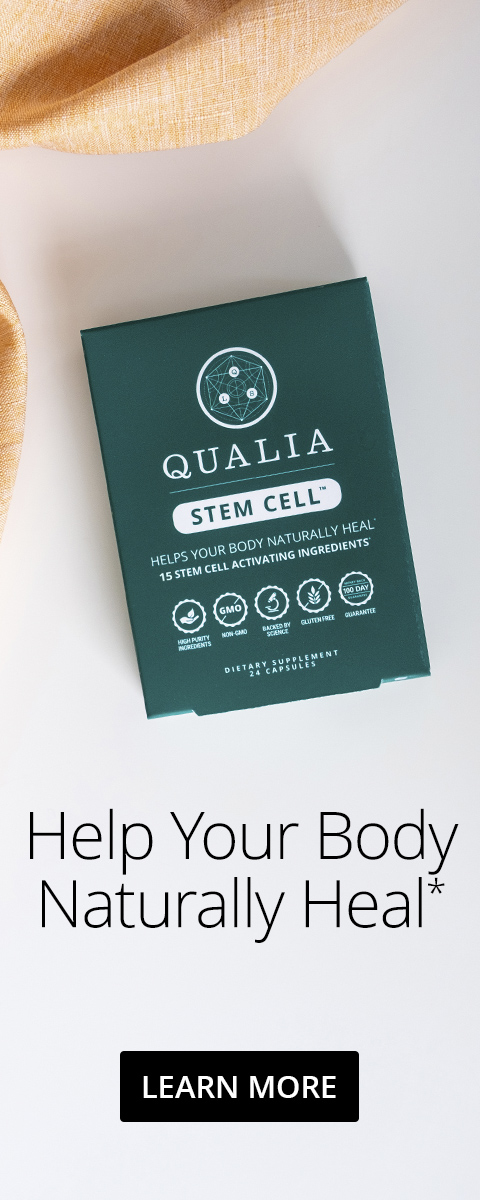
Alright, now folks, before we jump into this episode, we are going to talk about one of Qualia's products. It is called Qualia Stem Cell. I have been doing this now for a couple of months. This is a supplement. If you guys are interested in checking this out, certainly if you're in my age demographic, 50s, 60s, 70s, and you are interested in longevity and being optimally healthy, I certainly strongly recommend you check it out. Read on and decide whether you think that's appropriate for you. If you decide you want to try out their Stem Cell product, you can save 15% off by using coupon code Silver Edge at checkout. Alright folks, enough of that. Let's jump into it. Whip up your protein smoothies and let's learn about stem cells.

Dan's Background & Motivations
I think it stems back to when I was in high school. I was an athlete. I was really motivated to perform well at the various sports that I played and I got injured, which in a way was a gift because it probably was a critical factor in doing what I do now because I was forced to think about my body in a different way. When you have everything working perfectly, you don't have to think about it. That is an amazing blessing. In my case, I twisted my ankle. Some jerk drove across like the soccer field and did a bunch of donuts and it left a lot of these tracks in the soccer field. I turned my ankle over and then I had ankle issues for the rest of high school. I had to try to fix that.
That led into me reading about all sorts of ways in which I could get myself back into the things that I loved, which then led to me looking at other ways that I could increase my performance. I became the default performance coach for my teammates. They would come to me and ask questions because they knew that I loved it. I read a lot about it. That led into me making a more serious investment in college.
I still didn't know what I wanted to do. All of it was interesting. I did a double major, double minor, basically taking every type of class that I could around exercise science and sports medicine, which then led to me doing a Master's degree in Exercise Physiology at Florida State. I went to that program because they had a dual program in Sports Nutrition and in Exercise Physiology.
It's the only place in the country that had that. It was a great experience. I went on to do other things too. I did cancer research after I graduated, looking at how a multifactorial lifestyle program, meaning like more than just one thing, so stress management, interpersonal communication with one spouse, exercise, diet, all had an impact on prostate cancer. This was through the Preventative Medicine Research Institute that is affiliated with UCSF in San Francisco.
That was a really formative experience for me. I went on in my career and did other things, but I always remembered the work that was trying to tie together all the different aspects of lifestyle to try to create a better outcome for a group of people, in this case, specifically with a condition. I loved that idea. I went on to work in bioinformatics with a company, looking to sequence the human genome for the first time. This was early 2000s.
I then went into the pharmaceutical industry through a contact there, working specifically with a rare disease, narcolepsy and sleep. I knew nothing about sleep, but that ignited a passion in me about that topic. I was there for about a decade. I founded their medical affairs department, which does education in the therapeutic area and on the compound that you're working on after the drug has been approved. A really awesome experience.

Narcolepsy is less than 200,000 people and so it's a rare disease and at that time. It's not really usually large enough for a pharmaceutical company to want to invest in it. The Orphan Drug program gave funding and more of like a rapid process to how to get a medication to those people. That was a really great experience for me. I had my own questions. I left the company and I did my own PhD. I did a collaboration with Leiden University in the Netherlands, one of the oldest universities in the world, and Stanford.
I was asking about ecologically relevant amounts of sleep loss. Not just missing an entire night, like how a lot of sleep studies are conducted, but what if we just miss a couple of hours? That's a lot more relevant to how people typically lose sleep and how does that have an impact on eating behavior, cognitive cognition. That was really an interesting time for me as well. I always was remembering about the work I did with the Preventative Medicine Research Institute. How do we tie all of these things together? How do we understand human behavior to get people to take part in the various determinants of health? That has led to what I'm doing now. That's my background.
You certainly have a diverse background. I love how you started. You said that performance, that sports performance, especially then into other areas of research, deep diving into sleep, which is one of my favorite things to nerd out about. I think that is the foundation of probably human health in general. We can certainly go there a little bit.
You had mentioned there towards the end, you're just fascinated by how do we get people to make these behavior modifications in order to have optimal health? That's really the million-dollar question, isn't it? We're going to nerd out. We're going to talk about supplements and we're going to talk about hacks and we're going to talk about stem cells. Really, without behavior change, a lot of that, it's just not enough.
We have to embrace honoring our bodies and making these healthy behavior change. In your experience, what's the linchpin there? What's the key? As a nutrition coach, as a personal trainer, certainly, you can relate to this as a performance guy, it's the easy part. The table stakes is here's your macros and here's your workout. That's really simple. It's that behavior part, that mindset part. How do I get you to become the person who falls in love with this new lifestyle, this new worldview of being healthy? I'd love to hear your thoughts on that before we just really geek out a little bit.
The Loop Behavior Model
I'd love to share them. I had a really fortunate situation with my PhD. I had four people who were my guides, if you will. Two in the Netherlands, 1 of the head of diabetes at the hospital, another neurologist, and then 2 at Stanford. The second, director of the Stanford Sleep Clinic, and then Jamie Zeitzer, who is the head of the Zeitzer Circadian Biology Lab. I told them, “Even though I'm doing my PhD, I don't think I want to become a sleep researcher. I want to work more in public health.” As a result, you need to understand what drives human behavior. They were so supportive. I took the first six months of my PhD and I dissected all a variety of very well-known behavior models down to these discreet ideas that are contained within those models.
I built my own behavior model called the Loop model to adopt and sustain health behaviors, which I then presented at Stanford Medicine X and Health 2.0 and some other conferences. The idea is very simple. By the way, a behavior model can describe why behavior changes. It can predict when it's going to change or it can serve as a model that you can apply to try to actually help people make behavior change.
My model is one where it looks at four different ideas. Why should you do it? How do you do it? Are you doing it and is it working? You can see that each one of those buckets is mutually exclusive, that you cannot understand if you're doing it or not just by telling people more about why it's good for them. Each one of those is going to reinforce a person who actually can make some change over a period of time.
The why is very important. It's hard for us to set our direction without really knowing why we're doing it. Now people can adopt something without really knowing a lot about it, just because other people are doing it and it's popular, but it's hard to sustain that long-term unless you really understand the concept. Not necessarily all the details, but the concept of why we're doing it.
Lastly, is it working? That's where I think we can facilitate belief. I don't believe belief is a binary concept that when you now see that something has worked for you because you've applied it in your life and you have before and after data to show that it's working, even if that is experiential, meaning like subjectively, you just feel better, so you feel that it's worked for you, you can generate faith that this is a good method to employ for, let's say, a particular outcome.

Now, those ideas, that model is really the basis of a company that I'd worked on over the last few years, HumanOS, and that's like a digital health coach. It's all the ways in which we can take every single determinant of our health. Whether it's light, circadian rhythms, sleep, diet, etc., how do we understand those better so that we can set our own direction for how to go about our 24-hour period of a day. That is our platform, that's our canvas that we have to work with, if you will. The one thing I would say to your audience is that in society, we don't give it enough respect, that changing behavior is actually quite hard, but you have a lifetime to identify things that are effective and then to exploit those for your benefit.
Think about how exciting it is to identify something that is actually useful and good for you. Now you have decades to benefit from that knowledge. Working in sleep, there are so many things that, once you hear them, you're like, “That makes so much sense.” I get them, but you wouldn't automatically know that. That's how we treat health in society. We know everything and all we need is tips and nudges to get there.
Tips and nudges can help, but they help reinforce something that you already understand more than they are an adequate for sufficient behavior change to then extract all the benefits from that subject. Be patient, you have a lifetime to work on your practice, which is your approach to health. Kudos for you for listening to subjects like this to figure out ways in which you can do better for your own body.
I love absolutely all of that. I love these more long form conversations because the types of things we're talking about are nuanced. You mentioned tips and tricks and things like that. We all want that. That's probably just either affirming your confirmation bias or you're rejecting it outright because again, of a confirmation bias, we have this, “I want something in a ten-second Instagram, TikTok format.” It's tough to go very deep in that. I'd love this idea of this behavior model of why we have to understand why, and certainly every coach has learned that, we’ve got to know your why. Ask the five whys and then why is that important? Getting to that root cause for long-term adherence.
The how. We have to know how to do it. We have to have a roadmap or a framework. The, are you doing it, we have to apply this. You end up with, is it working? That piece is the linchpin, really, because if it's not working, we're not going to keep doing it. Motivation or determination or grid or willpower only going to get us so far. Those are wonderful for building some momentum. Not so much for lifelong sustainability, but I think we refill that motivation bucket.
For example, I'm exercising, well now I'm getting stronger and my sleep is getting better and I’ve noticed I have more energy. That just builds on itself. I absolutely love that we start there with behavior. Speaking of behavior and moving into performance, you had mentioned, “I was interested in performance, I was interested in sports performance and later sleep performance.” You are also obviously very interested in cellular aging longevity. Can I make the case that when I increase human performance, I increase longevity? Are those two causal or related? What's the relationship between optimal performance as a human machine and by actual longevity, the amount of chronological years I'm going to be here?
Performance Vs. Healthspan Vs. Longevity
There is a term that I use even to describe some of the products at Qualia Life Sciences, which is where I work now as their Chief Health Officer. We have health span products. What is health span? The easy way to think of it is, of course, extending a higher level of health farther into the lifespan. That is a topic that the term was introduced a couple of decades ago, and has slowly started to build traction to where it's now become something that is on the minds.
People have heard it, they understand it. I am writing a book and I have a chapter specifically on what health span means and addressing some of its shortcomings, like it's hard to measure. While the general topic of health span is something we can intuitively understand, we really have an innumerable amount of health spans. They can be defined by various areas. If you're somebody who's focusing on eye health, you can have your eye health span. If you are looking at your career span, how long can you work effectively, how long does health support your ability to perform effectively in your career?
You can have independent living span. It is up to a huge variety of different types of professionals to then create these ideas around the health span concept, create markers that would measure against that, that are then validated, which the validation process takes a while. It's a great subject. The question is, how well does performance correspond with health span?
I'd like to talk a little bit about performance first. Another term that I like to use is health performance. It is the ability of your health to support a performance goal. Lebron James is an example that I use in my book. He is somebody who is, if you are unfamiliar with basketball, what's unique about him is that he has performed at a extraordinary high level, has been one of the best players in basketball for many years.
He's now into his 40s and he's still able to run up and down the court at a level of somebody who is 20 years younger. What he has demonstrated is that he's been able to sustain a high enough level of health that has put him in a bracket for being able to perform in this extraordinarily demanding sport. Not only is the physical necessities of a single game highly demanding, most people can't accomplish them.

You also have a very grueling schedule, which means that he's recovering very well in order to play 3 or 4 games in a week. That's one thing that we do see as we get older. Our ability to recover from a very stressful event like exercise starts to prolong. When you're younger, you might have done some hard workout and you would be back either the next day or a couple of days, and you could be back to full function.
Where that same workout, even with maintaining your fitness, might take another day, 2 or 3 to get back to full function. It is a reflection of our health and what's happening in the backdrop. Your health is now able to recover and respond and get you back to full functioning. There are some interesting ways that this differentiates. Does peak performance ha correspond with peak longevity?
The answer there is no, not quite. There's a term called antagonistic pleiotropy, which is created by Michael Rose. It's comes from evolutionary biology, and it's this idea that if you are making trade-offs, so if you put a tremendous amount of energy into something very difficult, like you're an ultra-marathon runner when you're younger, that might actually burn the fuse faster in your total lifespan.
You are favoring maintaining a very high level of fitness at the expense of living longer later. Where this gets a little bit confusing is, does that mean I shouldn't try to be very, very fit? No, I think fitness is a great way to sustain your health across the lifespan. Cardiorespiratory fitness is the number one predictor of how long we will live. We're talking really about extraordinary, competitive level amounts of energy allocation early in the lifespan, possibly being a tradeoff to long-term existence.
What confounds this question is we have a very low level of fitness in our society. Only 22% of the United States maintains the national guidelines for physical activity within a week. That means as adults, we're not getting nearly enough physical activity. That's a more full answer. I wouldn't worry about trying to be very fit as shortening your lifespan, but I would say it's great to pursue a high level of fitness throughout life. That's probably going to confer a higher level of health span at any decade and very possibly a reduction in premature mortality. The bigger problem that we're facing is not we're exercising way too much. We're not exercising enough.
It's certainly not in our age demo and by age demographic. That resonates. I’ve seen this illustrated as a triangle, the triangle performance, specifically in advanced nutrition strategies. I could have aesthetics in one corner of my triangle, and then I can have performance, and then I can have longevity. The way I fuel train set up my lifestyle for those three might be different. The further I move towards that extreme, elite performance, let's say, the further away I get from longevity, just length of years.
Same with aesthetics. The extreme case there would be bodybuilders. The males in that sport get giant. They take a bunch of drugs and they get down to 3% body fat. There is nothing healthy or longevity. I suppose for those of us that are just mere mortals, we want to be fit, we want to be strong, we want to be capable, we want to be mobile and have balance, and we want to eat healthy foods.
We're looking for that. What you're talking about that balance. I want that fitness and I want longevity, but really, what I want is health span. I want to live as many years as I possibly can as a healthy, functional person. I want to jump in and talk about stem cells. Before we get there, let's talk about just what are the basics here that we can do?
I think we know where we're going to go with this, but what are the basic lifestyle things that every one of us should do? What are the table stakes before we start talking about supplements and other things, what is it incumbent upon those of us listening to this to do, to eat, to move to rest, recover, manage, stress, toxins, all that? What do I need to be doing there in this day and age to ensure that health span, from a behavior standpoint?
Foundational Lifestyle Pillars
We get very excited about the new innovation that might have a positive impact on this global question about health and health span. Sometimes, the foundational guidance sounds like it's less sophisticated, less interesting, less meaningful, less potent. We know that's not the case. A really innovative supplement, for example, or pharmaceutical that comes into existence, at least for now, it's not going to obviate the need to get good sleep or to have an aligned circadian rhythm or to have a diet that is sufficient in nutrients and does not contain a lot of health impairing factors that are novel to our body that we don't do very well with.
These things are something that matter every day, every year, every decade of your life. We want get them right, because when we are out of alignment with those forces, which have been shaped by our evolutionary past, if we think about what are all of our needs, a lot of those go back to how has our biology been shaped by the evolutionary forces for not only homosapien development, but even for cellular development that precedes human specific development.
These factors really do matter. While that can seem daunting, “There's a lot of them. I can't get it right. It's hard to get them all right all the time,” what I would say is your investment in understanding these things is really wise, and you're going to get a disproportionate amount of benefit. One thing that happens as we get older is that our bodies become a more sensitive vessel to the things that are healthy.
 We feel the things that are unhealthy differently and more acutely than we did when we were younger. Our health is somewhat protected from healthy pairing forces when we're younger. That, again, has to do with evolutionary biology and the ability to allocate resources, to maintain peak health in order to attract mates. Whether you are caring to do that or not, your biology cares to do that.
Once you then get past the average first age of reproduction in your population, you're going to start to feel decade by decade more whether or not something is truly healthy for you. The bad news is that you feel it more when you're not doing it right. The good news is that when you start to do it right, you actually can really feel that it's good for you. We can be surprisingly healthy, well into the eighth decade of life. You can really maintain robust function when you're doing things well.
We look at people who look like complete outliers, and it's probably not genetics that is leading them to have such high level of health. It's that they figured out a way to have a pattern of living that is providing the necessary inputs in order to keep sustain their health at a higher level than what's average for their cohort.
I’ve not heard that put that way, that as we age, obviously, I think it's very obvious to all of us that we don't recover as fast. We feel hangovers different. Those negative effects are magnified. We're sensitive to that. I hadn't really thought about the inverse of that being true as well. That the positive things were sensitive to those as well, more sensitive to those. Certainly, looking back at my life, my story is in my mid-40s, late 40s, I just crashed and burned health. I had a big health scare. That's what turned my life around. That's why I am sitting in this seat having these conversations. What my experience was, I went from being very metabolically sick and not really knowing it.
That was my baseline. That's all I knew. I just thought that's what people felt like. I thought that's what mid-40s felt like. I went from sick to not sick. I thought, “This is fabulous.” As I got from not sick to healthy, I thought, “This is amazing.” There are these levels and I kept leveling up or spiraling up. I suppose what I was experiencing there is exactly that phenomenon you're describing. I was sensitive to these health optimizing behaviors. It's all the things. I was not drinking daily. I was eating real food instead of garbage. I wasn't sedentary, I was moving my body. I overcame insomnia and I was actually sleeping, and I managed my stress.
I cleaned up the toxins. I did all the things right. As each step along that journey, I began to feel a little more superhuman. It's really got me excited about what, what life has to offer at this stage. I'm 61 and I’ve got this very public declaration that I want this to be the best decade of my life. For that to be true, because there's a lot of holistic facets to that, the underlying piece of that must be that I'm healthy. My physical physiological health is optimized for the rest of my for this to be the best decade in my life.
With that being our backdrop, I want to live and I want this to be the best decade of my life. I want to set myself up for a wonderful 70s and a magnificent 80s. If I'm blessed enough to be in 80s and 90s, I want to get there. We hear a lot, those of us that are lay people, about stem cells and longevity. Could you talk to us about what the heck are stem cells? Why do we care what's happening to our stem cells? What is stem cells’ relationship to mortality? Is that why we can't just live to be 200 because their batteries running out? What's going on there?
Geroscience & The Hallmarks Of Aging
I love how we've started this conversation with like the bigger picture and the factors that matter and the way that health changes decade by decade, and how you can feel that both positively and negatively. This idea of health span, which we talked about earlier, became a term that was used more commonly around another movement in society called geroscience.
Gerontology is the study of older people and how they age and how things change as we go from decade to decade. A gerontologist works specifically with older people to make sure they have what they're need and a good quality of life. Geroscience is actually looking specifically at what are the different factors that we can observe that are either driving or occur reliably as we get older? Can we now use our scientific method of inquiry and evaluation to understand if there are opportunities for us to intervene, that would then change, again, our health span, create a higher level of health farther into the lifespan.
Both of those ideas are really exciting. They've generated a lot of movement and discussion. There's before this, by the way, the study of aging itself was not considered a serious inquiry in science. It was thought to be something that we did not have any control over. Why study it? Of course, there's been interest in this since the dawn of humanity, at least in terms of written history. We can find all the way back to the times of Aristotle looking at how can we age better, age differently. Now with the scientific method, this is being invested in both by very sharp minds and also by resources.
For an example, there's a company called out Altos Labs. Their first round of funding, they raised $3 billion. One of their investors was Jeff Bezos. What they've done is they've actually been able to take some Nobel Prize winning recipients and other great researchers that have very high credibility to say, “How can we intervene in the aging process in a way where we might be able to regenerate a person to a state twenty years younger than they are now?”
What Stem Cells Are & How They Work
I'm using that as an example to say there's legitimate science and resources that are being applied to this now. It's a very exciting place to be. It's a very exciting place to work. The other thing that makes it exciting, going back to human behavior is that what I’ve noticed is that health span is a motivating topic for your average person. We get it, it makes sense. It's something that we want to learn more about and invest in personally.
What are the things I can do? Stem cells has become one of those subjects. Back in 2013, there was a paper that was published in the journal Cell. It's now been cited over 17,000 times, making it one of the most referenced pieces. It really changed the space. It was on this idea of the hallmarks of aging, which some people have misinterpreted as these are the causes of aging. They're probably not the cause of aging, but they are more likely reliable consequences that we see when a person does age.
These are things like stem cell exhaustion. That's one of the hallmarks of aging. These stem cells, which I'm going to dive into next, it's an area that we reliably see changes so that the whole stem cell function on our body becomes less functional. Genomic instability, your ability for your genome in every cell, it becomes unstable. You can't make proteins as well as you could before. There's a lack of proteostasis, which is a balance of how we make and degrade proteins in the body.
Anyway, there was nine of these that were first listed. A decade later, they introduced 3 more, making it 12. The reality is there's probably way more than that even. It did create a model for geroscientists to think about and say, “Can we intervene here? Can we study these and figure out a way to maintain a higher level of function longer?” Stem cells has been one of those areas.
What are stem cells? Stem cells have a couple of very unique characteristics. They are a cell that can make a copy of themselves and so there's two daughter cells that are created. One of them is a duplicate of the original stem cell. The other one is destined to become a specific type of tissue. Stem cells are a major part of the body's repair system. When you're born, you have cells that will be replaced over the lifespan and the stem cells are a major part of that.
We have different reservoirs of stem cells around the body. In our bone marrow, in our fat tissue. You have even things like progenitor cells, which are like partially differentiated. I’ll explain this because this differentiation is really key. Think of like a stem cell as like a lump of clay that can become anything. It can become any cell type. Differentiation is taking that lump of clay.
In our analogy, it's like it's making a copy. You're now molding the clay into something that could become anything into something very specific. Analogous to the clay motif is that once that dries, you can't turn it back into the lump of clay for it to become anything else. Once it hardens, it is what it is. That is very apropos for the stem cell analogy.
We have these different stem cells throughout the body. They're replacing tissue that has basically died for a variety of reasons. It's come to the end of its cellular lifespan. Now we need to replace those tissues and those cells. Another important term here is potency. The potency is describing just how many different cell types that particular stem cell can become.
An analogy that I like to use here is we have like totipotent and pluripotent cells. These are cells that can become anything in the body, just about. Imagine that as being a college freshman that doesn't know what it wants to do for its career. It can become anything. It has to make some decisions about what courses it should take. As you advance in your academic career and you've now taken certain classes and you've elected a major that is a different level of potency.
Let's say you've been doing classes in medicine or science, you're now going to become a doctor. What kind of doctor can you become? You can become many. That's this analogy is freshman year you can become anything. By junior year, you've now made some choices and you can become less. We have this range of potency of stem cells that determine can they become anything, or now that they've made some choices, they can only become certain things.
That certain things you have is like a multi potent or a unipotent cell. That means that it's going to either become one of several things or one of one thing. It can only become one tissue type. I’ll stop there because that was a lot. It's the part of our repair system and there's different reservoirs of these stem cells in the body, and these different stem cells can become different types of tissue. That's the main synthesis there.
Is it fair to say then this is our fountain of youth, especially some of these more diverse types of stem cells that can become anything? I need to obviously get the coding to it to tell it what to do. Two questions. One is, I want stem cells for as long as possible because that's going to keep me repairing, recovering. Am I aging because I'm losing stem cells, I'm losing stem cell power? What is the role? How instrumental is the stem cell piece? We often hear stem cell and longevity. Certainly in the lay vocabulary, those two things are one in the same. You're aging because you're losing your stem cells or they're running out of gas there. Is that fair?
Yeah, it is fair. There is no singular cause of aging, but the ability for stem cells to do their job is a major driver in why we are degrading slightly decade by decade. Imagine a person in their twenties with all their youth and vitality that they represent and express, and now somebody in their 90s, the distinct differences in terms of what those two beings look like at different parts of the lifespan.
Part of the reason is why we are constantly doing damage in the course of living to our bodies and we need to replace that tissue. When that equation is a net zero, it's netting out where the damage is fully replaced, then you have a maintenance of the body in its full form. Over time, the damage starts to outpace our ability to recover, which leads to visible signs of wrinkling. Sometimes even a shortened overall height, less tissue, less muscle mass, less functional organs. All of those things are in part described by a less effective stem cell pool or a less effective stem cell job. We'll call it that.
I got a question here that I think we have to address here. The cause for that less effective stem cell pool, how much of that is chronological? I'm 61. You just can't expect these things to go on forever. How much of that is just this my lifestyle of crappy food choices, crappy sleep? I'm stressed all the time, I'm drinking, whatever. That's a tough question, but to be sure, it's multifactorial. We've already addressed that. For example, I know that if I just do everything from a health perspective correctly, let's just say for lack of a better word, I'm still not going to live forever. What's happening here?
It's a super important point because it's not like if we lived perfectly and ate perfectly and exercised perfectly, that we will completely obviate the process. We are going to age.
The end is the same.
Yes. That is baked in the life history of a human. How long we live is a part of the life history of humans. Every organism on the face of the earth has its own life history, which is a term used by evolutionary biologists. What evolution cares about is that you survive and reproduce. The goal of evolution is not to create organisms that last indefinitely, but to create a germline, which is you passing down genes over multiple generations.
Just like cells have this renewal process, so do humans. That's what evolution cares about. I always follow that up immediately by saying that doesn't have to be your goals in your life. If you don't even want to have kids, that is up to you. We’ve got to choose that. There is no moral imperative to fulfill what your genes want from you.
We get to choose how we live and what's important to us, but it is also important to recognize that our genes and the process of evolution is trying to replicate a new healthier body. The reason we live as long as we did even after our post reproductive window is probably because we have a very long process of child development. We invest a lot more resources in fewer offspring.
As a result, a grandparent, the grandparent hypothesis, it states that we are still supporting our reproductive capacity as a tribe. When you are helping a younger version of that tribe, even if it's yours or not even yours directly, survive. We need that type of support, which actually is interesting because it shows that we have a functional need to maintain ability as we get older. We have this imperative to support the younger people to help them mature and survive.
Now that can be, again, your direct descendants or it can simply be sharing the wisdom that you've accumulated over your life in your career and having a cup of coffee with a younger person and walking them through some of their challenges. There are so many ways that you can share your accumulated wisdom. We should continue to think of ourselves as having that need or that that need is there. That is part of our purpose as we get older.
Even though there's a decline in physical capacity, because we're no longer trying to allocate resources to maximize our physical fitness so that we can attract mates, we have the wisdom imperative that is designed around sharing our knowledge with younger generations so that they can be successful in their life. Those are the ideas that really excite me because we have to have purpose as we get older.
From the men's side, it's that I'm moving from that warrior energy into the king energy and then transitioning to that elder energy where I'm still contributing and still have purpose, still have drive and still contributing just in different ways in different phases of my life. I love that this conversation has gone that direction, especially for this audience. A lot of us, we're now empty nesters and we're grandparents and we're looking at retirement and certainly, community and purpose is something that a lot of us wrestle with. Addressing that, I think, is an important piece of the longevity equation as well. I'm pretty sure science has borne that out again and again. When we have purpose, when we feel connected in a tribe, our tribes, then we have better improved health outcomes, including longevity. Is that fair?
Yes. I mentioned this piece in response to your question of how much of stem cells efficacy has to do with how well you're living versus the natural aging process. The reason I mention it is because when we're young, you're working hard at your fitness and you have to work equally hard when you get older. Retirement can be 1 of 2 different things. It can be a retraction from stimuli that keep you sharp and an atrophy of all body systems because you're not pushing them.
Two, an age calibrated effort that you have to give to think hard, to move your body in an appropriate way to continue to strive and pursue new, new ideas, to stay social, to keep thinking. All of these things are then drivers that are going to enable you to maintain your physical body in a way that is oftentimes differentiated from, again, your cohort.
You're going to age a lot better and people are going to think, “That person's special. They must have great genes.” It has so much to do with lifestyle and continuing to challenge our physiology. When you do that, you will see a surprising degree of regeneration capacity well into your seven, eighth decade. Yet at the same time, there is a phenomenon that we call aging that is still occurring.
We know now, you could see somebody in their 40s that look 10 years older or see somebody like yourself in their 60s that look at least 10 years younger. Of course, it's relative to you and your physiology. One thing that you can do is compare yourself to your cohort, age matched people. The other thing that you can do is compare yourself to you and how well you think you are doing relative to what you know about yourself. Are you in a better place than you were five years ago because of how you're living? We can come into that discussion on how to measure aging but there are these new ideas of measuring your biological age with these epigenetic tests.
Let's say you lived really hard. You were some first responder in your 20s and 30s. You had poor circadian alignment. You maybe lived hard too. You drank alcohol. That will have accelerated your clock. If you were to measure your biological age now, it might show that you're actually 52 years old when your chronological age is 50. You're older. You've accumulated more years in the 50 years that you've lived.
Let's say in your 40s, you had a dramatic shift in how you were doing things. You discovered wellness, you worked on your practice, you started lifting weights, you stopped drinking alcohol, you stopped smoking. Now all of a sudden, your pace of aging, how much you're aging in a particular year, is now less so you're aging only 10 months in every 1 year.
You can see that those two ideas are different. One is how much you've accumulated, which has to do with your past, and one is how much you are actually aging now, which is reflective of are you doing the things correctly now? I wanted to mention that because that is important for how we see these things. If you just got a biological age test and you were show that you were two years older, it might take the wind out of your sails for your wellness effort. You're like, “It's not working,” when actually it's working really well, but you've just accumulated more aging over time because of how you used to live.
I love that concept and the idea of aging over time and we have control over that right now. What I don't have control over is the past. It's gone, behaviorally. Let's talk about outside of lifestyle modification. There's been 370-something episodes in this show that have just pounded that and there'll probably be another 370 to talk about that. Let's talk about what can I do, because everybody wants the health hacks. I want them. We all want them. We want those tips and tricks we talked about.
What should I do from a supplementation standpoint when it comes to longevity? On this show, we've had several guests come on talk about soil health and its impact on human health because we know that that modern agriculture just stripping the soil of any nutrients. Therefore, the healthy organic vegetables that I buy in the grocery store are not the same that my grandparents ate, etc. What can I do in this modern environment with this evolutionary hard wiring that I have? How can I optimize myself? If I'm sleeping right and managing stress, eliminating toxins, I'm exercising, I'm doing restorative movement, doing all the things, what can I do to give myself that edge now?
There are some strategies that will work best in somebody who is sick. What is really interesting is what are the strategies that can layer on top of all the other efforts we're making to be a healthy. For example, with metformin, we saw that there's an excitement around that drug, which is an old drug that has been used in the management of diabetes. It's one of the top ten most prescribed drugs in the United States. It has decades of safety and efficacy data, but it's in a very specific population.
It has been thought of as a longevity drug and it very well might be, but the logical leap that was made early in this discussion was that because we see an elongation of life in those that have insufficient glucose management because of the diabetes that they have, we now need to give this to healthy people who are still very healthy, let's say in their mid-50s.
That might not be the case. In fact, I did a podcast with Ben Miller and he talked about a recent study where when you give metformin to people who are about to undertake a cardio respiratory fitness program, you didn't see that the adaptations that you would re reliably see in response to the physical training if a high dose of metformin was on board or a dose equivalent to somebody treating the disease of diabetes.
Similarly, another study showed that if you're now doing weight training, that people were not making the same degree of benefits that you would normally get in the placebo group without taking metformin when met metformin was on board. That illustrates this concept of conditional benefit. Overall, what we do care about is how can we maintain the healthiest lifestyle that feels good and is calibrated to us and that is something that we continually refine. Are there supplements or strategies that layer on top of that?
Supplements can be thought of as a crutch. When I take them, I'm just trying to absolve myself of my sins of unhealthy living. I think of them more as a catalyst, and they can be both. You can find me a person or group of that's going to fulfill both of those categories. The catalyst being now because I'm taking this, I'm doing other things as well and we call those consistent behaviors. You've now made an investment in your health. You might be more likely to go to bed on time and go for a walk and exercise. You're already investing in those goals and outcomes through buying a supplement and taking it every day.
I think supplements can conserve as a catalyst to other behaviors. It's consistent with a goal that you've now set out for yourself. Stem cell regeneration is going back to that. We know that when you get older, stem cells have a harder time doing their job. Part of the reason is because one thing we definitely see with age is an increase in low grade chronic inflammation. That is a really big problem for stem cells to do their work.
Inflammation is not bad, although it's talked about as though it were bad. Inflammation is another communication system in the body and it's playing a really important role. Chronic inflammation means that the level of inflammation is risen in the body, which makes cellular communication more challenged. It's like you're speaking with an older person who has lost acuity of their hearing and you have to raise the volume of your voice in order to get the message across. That is equivalent to chronic inflammation.
The normal message of me speaking at a regular volume might not be heard by the person who has the hearing acuity. There is no change in behavior, there's no action in response to that. That is the analogy that I like to use with stem cells. Inflammation is one of the driving factors that is going to cause them to be less effective at their job.
The Complex Stem Cell Regeneration Process
I’ll walk through like the process real quick because I think it's useful, but how do stem cells work? I talked about these different niches that they reside in the body and they're typically in a quiescent or quiet state. It's like they're sleeping in their bed and then they get woken up by signals that say, “Wake up out of your sleep. We need you now to proliferate, make more stem cells in numbers,” which is one of the characteristics.
Remember, they can duplicate themselves. One becomes a clone, another stem cell, the other one is destined to become tissue. They've got to leave their niche and they have to find the area where the tissue needs to be replaced. You have to mobilize, migrate, and activate stem cells, and get them up from their nap, proliferate, make more of them, mobilize them, get them out of their niche into circulation, and then have them migrate to the right tissues.
There's a variety of different chemical signals that are doing this. There's something called the CXCR4, SDF-1 pathway. Think of that as like a receptor or a nose on one of these stem cells that can sniff a chemical trail. The SDF is the beacon that says, “Follow me to the site where you're needed.” Once those stem cells get close to that area, they need to adhere to the vessel wall, they need to migrate them into the tissue. They need to listen to local signals that say, “Become a muscle cell. Become something specific.”
We do not want to try to replace a muscle tissue with a neuron or a fat tissue. We need to hear those signals very specifically and have it turn into the right type of tissue in the right place. The fact that we can do that is pretty remarkable. You can now see that every step of that process is subject to something going wrong with aging.
It's funny you say that because as you were explaining that, that's exactly what's going through my mind. I'm like, “There's a lot that can go wrong,” because that's quite a complicated path. From a sleeping cell to a new muscle cell. Amazing.
It might not fully differentiate. Differentiation is that process of turning into the specific cell and there are these 7 to 10 different ancient pathways that serve as the signaling pathway. A stem cell is going to listen to the signals in its environment from the extracellular matrix to growth factors, to exosomes, to cytokines that are then going to land on the cell surface receptors and they're going to trigger this intercellular pathway or this cascade.
All of a sudden, the clay, if you will, is starting to get molded by the hands of these signals. That eventually elicits these transcription factors inside of a cell. What is a transcription factor? It's going to tell your genes, because every cell has all of your genes and it needs to hear which ones need to be activated and turned into proteins. The transcription factors activate, which they start to transcribe the right proteins and suppress the wrong ones.
Eventually, that cell fate gets locked in through epigenetics that makes it so that these cells can only become what they should become. To go back to the point we were sharing a moment ago, lots can go wrong in that process. What we're trying to do with the formulation that we created is to say, “We don't want to stimulate stem cell all the time because we know overstimulating stem cells is actually one of the factors that drives stem cell exhaustion.”
Constantly pumping them out means that they are not sitting in their niche quietly waiting for the right signals for differentiation. You're basically wasting that resource. We've created this product which has fifteen different ingredients that are affecting all the different cycles that I mentioned, the activation, proliferation, mobilization, migration, differentiation, and then protection. How do we keep the niche right so that they're protected and they can survive and differentiate and be healthy. We only do that for four days out of the month and then we wait. We think that that pulsatile approach is really wise because, again, overactivation is a problem. We do not want that.
That's really fascinating. I have here the Qualia Stem Cell, and I’ve just finished the four-day course of this. It's a series of six capsules that you take over a course of four days. You had said, “We're going make this a monthly supplementation regime.” I think that's really interesting. When I look at this, and it's got quite the list of ingredients here, what you're attempting to do then as opposed to like stem cell therapy, which is a whole another thing, a whole another can of worms, if you will, what you're attempting to do, I think, then is to make that very complex process as efficient as possible. Is that a good way of looking at that?
Yeah, I think that is a good way of looking at it. Another way to think about it is we're raising the volume like you would raise your voice to talk to somebody to who is hard of hearing so that the message gets across. It's an analogy.
I like that. Question, who is this for? Is this aimed at by demographic? Is this for 50, 60, 70-year-olds or do you have 20-year-olds? Is this for an athlete who's looking for peak performance? What's your target market here with this particular product?
This is designed for people who are interested in augmenting health span. That then is for a particular time of life. Having said that, personally, I think that this would be really interesting for anyone who is undergoing stem cell therapy. We mentioned that we should probably take a moment and distinguish that.
The most common way that we understand the medical utilization of stem cells is for them to be extracted from the body, concentrated, put back into an area of damage to see if you can regenerate or heal an area faster. Lots of this is used in orthopedics. There are two different pools of stem cells that are typically used. One is called hematopoietic stem cells, which is and bone marrow.
Typically, there's a little incision that is made at the iliac crest, which is where bone is. There's a very thin amount of tissue in humans between getting into the bone, into the bone marrow. You aspirate the stem cells and then you put them back into the person in an area of need, like let's say an ankle or Achilles or the knee or lower back. That work has been going on for a couple of decades now. There's interesting work that shows that you can help people recover quicker. If I'm going to spend money and get that type of medical stem cell therapy done, I'm going to absolutely do everything I can to support stem cell health.
Through the process that we've talked about?
Yes. I would absolutely on the first day that I'm getting stem cell treatment because medical stem cell treatment is expensive. It ranges depending on who you go and the amount that you're getting, how much you have to get out and where you're putting it back in. It's easily $4,000 per treatment.
This is not something that my insurance is covering when I sprain my ankle, but if I'm an elite athlete and I'm being paid millions of dollars, then of course that treatment, we're going to do whatever we can. This is the first time that I have ever seen anything like this. I'm referring specifically to a stem cell optimizing supplement. It begs the question here, and I love to ask this of all my guests who are out there on the bleeding edge, my biohackers and my researchers, and certainly you fit in that category. What do you see the future of medical technology?
You guys are out here on the cutting edge with helping to optimize not just stem cell regeneration, but all that complex process we talked about. You had mentioned we may be able to live longer than we can. Do you see a day where medicine or medical technology or technology in general is going to extend our health span, lifespan? Are we going to see humans live to 200 years because we've now made these medical breakthroughs? Is there something still baked into the human that we just don't understand and aging is just too multifactorial, too complex? What's your personal take on that?
The Future Of Longevity & Healthspan
Why we die is a different question about how to support health. We're much more likely to see that we can extend health span, staying healthier longer into the lifespan than specifically working on how long we live. The maximum human lifespan is estimated to be 125 years, beyond which we do not know of a way to go beyond that. The longest living human ever is Jeanne Calment. She lived to 122 years, which is unbelievable.
That's remarkable.
She lived as close to the theoretical max of human lifespan that we have ever seen, that we know about. The average in the United States is a lifespan of around 79, 80 years. There is a window of 40 years that we can, at least now, think about how do we solve that so that people live longer. That longer might not necessarily be affecting the deep backend mechanisms that determine ultimate lifespan length, but rather supporting health longer so that you can be. Wouldn't it be incredible to be 100 years old, but feel like you're in your 60s?
You mentioned if the average lifespan, let's call it maybe 80 if you're blessed to live that long, that means by my age, I'm winding down. I'm into the twilight years, but if at 60, there's a way for me to not just live to be 100, but for me to live in a healthy body to be 100, that changes things. I'm closer to midlife than I am end of life at that point. Yeah, just fascinating concepts to think about.
From where you're sitting, you don't see that science fiction, we're going to extend life by 100 years through some magic formula. We're close to that. It's more we have this theoretical banks, I don't know that we're going to pass that, but what if we can take that block of time, that 40 years that you said and really optimize that?
I’ll qualify my statements. It is possible that with the right amount of knowledge, we could manipulate maximal human lifespan. It is possible. What is more of a near term likelihood is that we are going to determine ways to support our health so we don't die from a lower level of health. The body is unable to sustain life because one of our health systems is failing.
Imagine these different forces that are affecting each other, the ones that are promoting health and the ones that are detracting from it. We're living in an environment where it becomes more and more challenging to maintain peak health because of technology. Technology that is affecting the environment that we live in and the behaviors that we manifest. What that means is that what is required of us is a higher level of knowledge and skill to counteract those with intention in our wellness program. Wellness is all of the intentional activities that we are doing to support our health. That is what wellness is.
The more that we have to think about our water supply and the indoor air quality and the types of materials that we wear in our body and our thermal exposure and the diet and our gut microbiome and the different gut bugs that we get exposure to, like through gardening. You were talking about that earlier. It's a lot.
We're not anywhere close to giving having a system in place where we are training your average person to counteract these negative health impairing forces with enough aplomb that allows us to really extend into many more decades. It's a big challenge, but what I am more optimistic on is for those, and there are many of us, like I think taking care of our own health is a fundamental drive that humans have.
We don't need to necessarily be taught that. When we see people that don't take great care of themselves, I think it has a lot more to do with frustration of like, “I’ve tried and I just wasn't able to affect this equation with any of my efforts.” You give up. I think the self-care is a fundamental attribute of living organisms. We see that. You don't walk into traffic and get hit by a car. You want to protect yourself. It's a lot.
As I said earlier, the way that we look at health and society is that it's something that we all know about it. You just need these little tips here and there. That's not going to be effective. Health is a process goal, not an end state goal. The finish line is dying. That is when we get to stop caring about taking care of ourselves. We need to maintain a process which is continual investment involvement and keeping a top of mind and continuing to learn. Listening to great conversations like you're hosting is smart. If you're reading this and you're learning about stem cells now, just also know that you're in investing in your own health in an intelligent way, which means continuing to make time to learn and invest in ways to be healthy.
That's really it. That's the ultimate longevity hack, isn't it? It’s continuing to invest in your time and ways to be healthy and not to get distracted by all the noise because there's a loud noise to signal ratio out there. I'd love to end up here just with your model, that behavior model of know your why. Have a roadmap. Do the work, apply the things and then is it working. You mentioned a lot of people give up, they're just like, “It's just not worth it. I’ve gained and lost the same 40 pounds over and over again in my life. Why go through that misery? I’ll just be this way. I’ll just stay unhealthy.”
It's incumbent upon yourself to take the time to invest in yourself. That's a form of self-worship, to love yourself enough to care for this party because this is what you got. However many years you have, this is it. You don't get another one. Dan, as we're wrapping up here, can you tell folks how they can connect with you if they're interested in stem cell or any of the other cool stuff you guys are doing over there at Qualia? Do you want to tell them how to get in touch with you, how to connect?
Yeah. I’ll say one more higher arching idea. When we're trying to affect our health span, we know that there will never be a singular product. It doesn't appear that way now because we have all sorts of different factors that we need to confront or address effectively. The likelihood that you would be on multiple different products designed for different targets is high.
That's okay. There's some people like, “I'm taking so many products.” In general, what's likely is that taking multiple products is going to be the most advanced strategy, at least for foreseeable future. Overall, what we're trying to do is say, how can we meaningfully affect a couple of these targets with a systems approach. Instead of just one ingredient that we think is interesting, how does the whole system work and how do we support the goals of that system, which is, in this case, the results of effective stem cells, which is tissue regeneration.
Also, putting together these protocols. Within a month or a year or a week, you're doing things at different times sometimes. Sometimes, it's every day. What I would say is I love the work we're doing. I joined the company because I like their approach very much. We're at QualiaLife.com. We do a lot of writing on our blog where we thoroughly go into the science of, let's say, an ingredient in our stem cell formula, learn about it, astragalus or royal jelly.
Mentally, I would say for the readers there, you will feel overwhelmed. Follow the process that is effective. Try to think, “How can I be smarter one year from now than I am now and in two years, I am measurably different? Keep at it, keep listening, keep learning, keep trying and do some self-experimentation and try to listen to what your body's telling you about your level of health.
Right on. I love all of that. We're big on self-experimentation here and having that long-term, this is a journey. As long as we're not giving up, we're making progress, like you said, there's no end game here. There is but that's the end. Dan, I want to thank you so much for taking your time, coming on the show here, sharing all of your wisdom, your knowledge with us, certainly your passion with us. I absolutely love the work you're doing. I love the way you speak about this subject and just encourage you to keep up the great work.
I appreciate that a lot. It's really nice to come on to a show where clearly you're doing great work with your audience. I encourage, again, all your audience, keep following Kevin. Keep listening and I appreciate the time to be able to speak to all the people that are following you.
---
That's our show for folks, if you are interested in learning how the Silver Edge Collective program can help you feel lean, strong, and confident, again, head over to SilverEdgeFitness.com/387. As we wrap up our time together, you can show your support for this show in two important ways. The first is to tell a friend about this show and encourage them to give it a listen. The second is for you YouTube folks to click the like and subscribe buttons. For you podcast folks, please give this podcast a five-star review on whatever platform you listen to podcasts on, and be sure to subscribe and follow so you don't miss any future episodes. I really appreciate you spending your time with me. Until next time, stay strong.