Written by

Perimenopause is usually portrayed as estrogen levels running out. But it’s more like estrogen breaking loose.
When scientists took daily samples for six months, they discovered that perimenopausal women excreted on average nearly double the estrogen of women ten years younger [1].
As ovarian reserve dwindles, the brain drives the ovaries even harder. Rather than a slow fade, estrogen output becomes erratic. These fluctuations may be experienced as waves of breast tenderness, bloating, hot flashes, mood swings, and more.
The impact of these surges depends on how rapidly the body can deactivate the hormonal signal. Which is precisely where a DIM supplement acts.*
3,3’-diindolylmethane supports estrogen balance by channeling estrogen into a fast-clearing pathway — reining in the hormonal turbulence that defines perimenopause.*
In this article, we'll explore how a DIM supplement influences estrogen metabolism, how it alters the downstream fate of the hormone, and what that could mean during the hormonal chaos of perimenopause.*
What Is DIM and Where Does It Come From?
Diindolylmethane (DIM) is a bioactive compound derived from cruciferous vegetables, like broccoli, Brussels sprouts, cabbage, cauliflower, and kale. When these vegetables are chopped or chewed, they release indole-3-carbinol (I3C), which is then converted by stomach acid into DIM. DIM enters the bloodstream, where it can influence detoxification enzymes and estrogen metabolism.*
How Cruciferous Vegetables Led to the Discovery of DIM
Back in the 1960s, researchers at the University of Minnesota were studying proteins that help the body metabolize foreign chemicals, which we now know to be the cytochrome P450 (CYP) enzymes [2].
While experimenting, the scientists noticed something peculiar.
When the rats received no food for a day, CYP enzymes effectively went into hibernation. But after the rats were fed their lab diet (Purina Rat Chow), these detox enzymes ramped up.
Something inside the rat chow was triggering detox enzyme activity. The researchers resolved to figure out what it was [3].
So they switched the rats to a purified diet, and gradually added in isolated ingredients from Purina Rat Chow.
When they added Brussels sprouts, the CYP enzymes skyrocketed. They were the strongest inducers of these detox enzymes. Similar responses were elicited by cabbage, turnip greens, broccoli, cauliflower.
A shared chemical signature hiding within the Brassica family of cruciferous vegetables was activating the body's detoxification machinery. But what exactly?
The hunt finally ended in 1975, when the same research team isolated the responsible agent. They dubbed it indole-3-carbinol, or I3C [4].
There was just one problem.
How Is Indole-3-carbinol Converted Into DIM?
When scientists looked for I3C in the bloodstream, they couldn't find it. At all.
Even when they gave subjects massive doses of supplemental IC3 — up to 1200 mg — it was still undetectable in plasma [5]. Whatever was activating these detox enzymes, it wasn't circulating I3C.
And the researchers noticed something else that was odd.
When rodents were fed I3C, it strongly induced CYP enzymes. However, when scientists injected the compound, bypassing the stomach, it did nothing.
To untangle this biochemical mystery, researchers analyzed eight compounds in the same indole family as I3C. Counterintuitively, the only indoles that activated detox enzymes were those that fell apart in acidic solution. Stable compounds, meanwhile, didn’t move the needle [6].
Now it was starting to make sense. Bypassing the stomach meant bypassing stomach acid.
So, the researchers treated I3C with acid in a flask before injecting it. Sure enough, the compound worked again. The stomach, it turned out, wasn't merely a delivery route. It was a chemical reactor, with indole-3-carbinol as the raw starting material.
And the product of that reaction, as you might’ve guessed, is 3,3’-diindolylmethane (DIM).
DIM forms when stomach acid causes pairs of I3C molecules to combine into a larger, more stable compound. And unlike I3C, DIM survives long enough to enter the bloodstream, where it can interact with cells throughout the body.
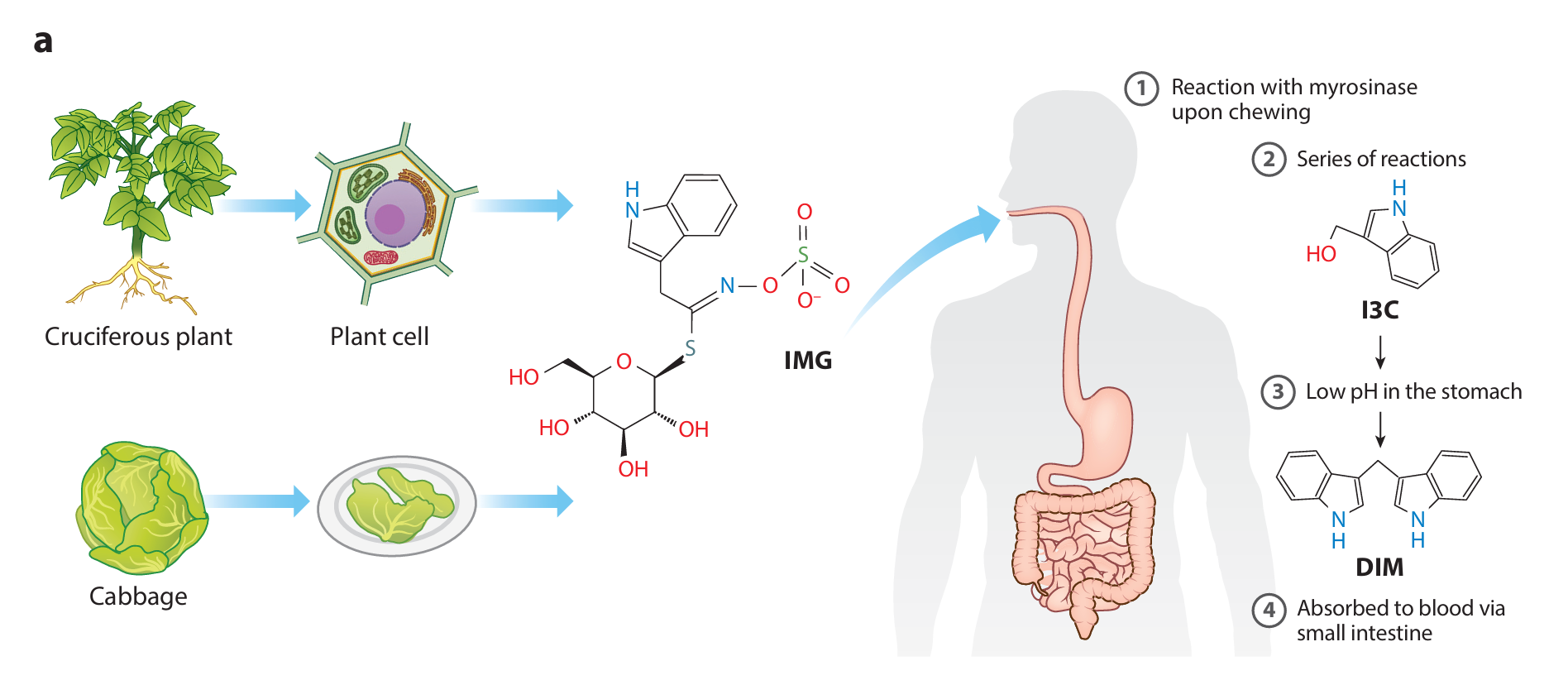
DIM works by binding one of the body's major chemical-sensing systems: the aryl hydrocarbon receptor (AhR). When activated, it switches on the CYP enzymes — the same detoxification proteins that first drew researchers to cruciferous vegetables decades earlier [7].
Importantly, these enzymes don’t just process environmental compounds. They also help metabolize estrogen. And that is where DIM benefits for perimenopause unfold.
How Does DIM Affect Estrogen Metabolism?
DIM affects estrogen metabolism by favoring the 2-hydroxylation pathway, producing estrogen metabolites with weaker estrogenic activity that are more readily processed for elimination. This shift is reflected by an increase in the 2:16 ratio (the ratio of 2-hydroxyestrone to 16α-hydroxyestrone), indicating that estrogen metabolism has moved away from the more persistently estrogenic 16α-hydroxylation pathway.
How the Body Breaks Down Estrogen
Once estrogen has done its signaling work, it has to be broken down and cleared. The first step is phase I hydroxylation, where a CYP enzyme adds a hydroxyl group (–OH) onto the estrogen molecule [8].
It's a tiny chemical edit. But where that hydroxyl group lands makes all the difference.
Estrogen's backbone is a chain of 18 carbons. Chemists number each one, giving every spot on the molecule its own street address. A CYP enzyme can drop the new –OH at several of these addresses.
If it lands at carbon #16, enough of estrogen's receptor-binding machinery stays intact that the hormone keeps behaving like estrogen — technically metabolized, but still sending the signal [9].
In other words, instead of resolving a hormonal surge, this route gives it an afterlife. Not ideal.
Meanwhile, carbon #2 is a totally different story.
An –OH here forms a catechol, which is sort of like adding a molecular off-switch. The enzyme COMT recognizes catechols and effectively flips that switch, helping move the estrogen toward elimination [10].
And this is where DIM comes in.
DIM promotes the activity of enzymes involved in 2-hydroxylation (via the AhR–CYP1A signaling pathway), shifting estrogen metabolism toward metabolites with weaker estrogenic effects that can be further processed for elimination [7].*
Scientists measure this shift using the 2:16 ratio, which compares levels of 2-hydroxyestrone (2-OHE1) with 16α-hydroxyestrone (16α-OHE1) — the two estrogen metabolites that reflect those competing routes.
What Do Human Studies Show About DIM and Estrogen Metabolism?
In a study conducted by scientists at the University of Kansas Medical Center, 17 women took indole-3-carbinol, the precursor to DIM [11].
After just four weeks, CYP1A2 — one of the body’s key detoxification enzymes — increased in activity more than 4-fold on average.
As a result, estrogen metabolism moved in the direction you’d logically expect. The 2:16 ratio increased by 66%, with 14 of 17 women tilting decisively toward the 2-hydroxylation pathway.
Now, this was an indole-3-carbinol trial, not a DIM trial. But indole‑3‑carbinol is famously unstable. So the same research team set out to follow its fate in the human body.
In a follow‑up study, the Kansas researchers gave women I3C again. But this time, they tracked the compound and all of its downstream products [5].
Indole-3-carbinol never appeared in plasma. Not at any dose. Neither did any of the other theoretical products.
Only one I3C‑derived molecule circulated at appreciable levels: DIM.
What Are the Benefits of DIM for Perimenopause?
A DIM supplement may benefit women in perimenopause by shifting estrogen metabolism toward the 2-hydroxylation pathway. This increases the 2:16 ratio, favoring less estrogenic metabolites that can be more readily processed and eliminated.
Perimenopause is usually characterized as a period of declining estrogen.
But the reality is a whole lot messier.
As the ovaries begin running out of follicles, the brain compensates by ramping up signaling, which forces the remaining follicles to work even harder.
Instead of a fall in estrogen, this often leads to a surge. And large datasets suggest this volatility is more prevalent than you might suspect.
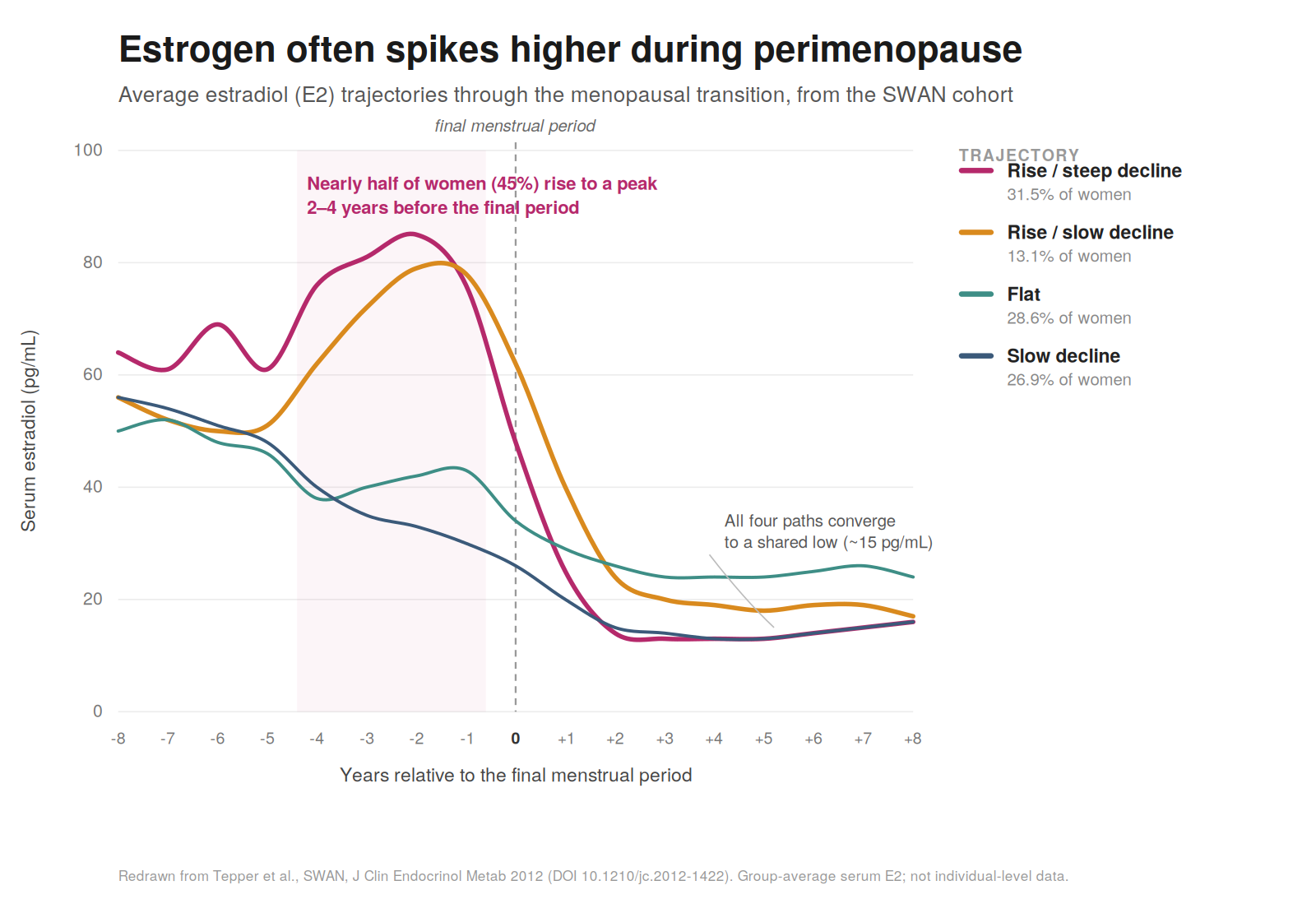
In one of the largest longitudinal studies of the menopausal transition, researchers identified several distinct hormonal trajectories.
Only one in four women followed the steady taper that most people picture. Another quarter stayed essentially flat, then collapsed late.
Meanwhile, nearly half of women showed a rise — sometimes a sharp rise — before levels eventually fell at menopause [12].
When scientists pooled data across seven comparative studies, they found that follicular phase estradiol was on average ~30% higher in perimenopausal women compared to premenopausal counterparts (225 ± 98 vs. 175 ± 57 pmol/L).
Indeed, it is now thought that higher estradiol — accompanied by lower progesterone levels — may explain a great deal of the perimenopausal experience [13].
DIM doesn't stop the ovaries from producing these volatile surges. But it can change what happens to that estrogen afterward.*
Once estrogen completes its job, CYP enzymes hydroxylate it, directing metabolism down competing pathways.*
By boosting CYP1A1 activity, DIM pushes estrogen down the 2-hydroxylation pathway — which produces less estrogenic metabolites and moves them further along the clearance pathway.*
Now, we still don't have a ton of studies that test DIM for estrogen directly. But the available evidence looks promising.*
For instance, in a 2024 real-world analysis of premenopausal women, those who started taking a DIM supplement saw their 2:16 ratio climb 188%, from 5.7 to 18.2 [14].
Accelerating this metabolic turnover should help blunt the intensity of perimenopausal hormonal peaks. Not by preventing the estrogen surge, but by dismantling it faster, reducing the time each spike spends reverberating through the system.*
This unique role makes DIM a truly indispensable component in all of the best perimenopause supplements.*
Frequently Asked Questions
When should you take a DIM supplement?
Take DIM daily with a meal to reduce the risk of nausea or digestive discomfort.
The exact time of day — morning vs evening — is less important than taking it consistently. DIM enters circulation within a few hours, but its influence on estrogen metabolism depends on steady use, so it’s most effective when taken every day rather than occasionally.*
How long does it take DIM to start working?
DIM reaches peak levels in the bloodstream within about two hours, but DIM benefits in estrogen metabolism take longer [15].*
In clinical studies, changes in estrogen metabolites were observed after four weeks of daily supplementation [11, 16].*
Give a DIM supplement at least a month of consistent daily use before assessing how it's working for you.*
What are the side effects of DIM supplements?
DIM supplements are generally well tolerated.
Potential side effects include:
Nausea
Headache
Digestive upset
Orange discoloration of urine (weird but harmless)
Most clinical studies reporting these effects used higher doses — like 108 mg or more [15, 17].
Nausea is more likely when a DIM supplement is taken on an empty stomach, so taking it with food may help [16].
Is DIM safe to take daily?
Yes, DIM is generally safe to take daily for most healthy adults. Clinical studies using daily DIM for estrogen for four weeks or longer have found it to be well tolerated, with side effects generally mild and self-limiting.*
If you're on hormone therapy, talk to your healthcare provider before starting. DIM changes how the body processes estrogen and could interact with it. The same goes if you're pregnant or breastfeeding [18].
If you are taking any prescription medications, you should also consult a physician, since a DIM supplement can affect the enzymes that clear certain drugs [15].
*These statements have not been evaluated by the Food and Drug Administration. These products are not intended to diagnose, treat, cure or prevent any disease.