Written by
Chlorella benefits unfold from a paradox: your body can’t break it down.
Most supplements are engineered for maximal absorption. But chlorella's outer wall evolved as biological armor — durable enough to survive the human digestive tract.
So, instead of disappearing into circulation, chlorella shuttles through the intestinal environment, capturing toxins along the way.
And it doesn’t complete that journey unnoticed.
That stubborn wall is studded with surface structures that register as foreign to your innate immune system, priming it for future threats long after the initial exposure.*
In this article, we’ll examine how chlorella detox works at the cellular level, how its alien biology modulates the gut and immunity, and why it pairs so well with complementary binders like activated charcoal.*
What Is Chlorella?
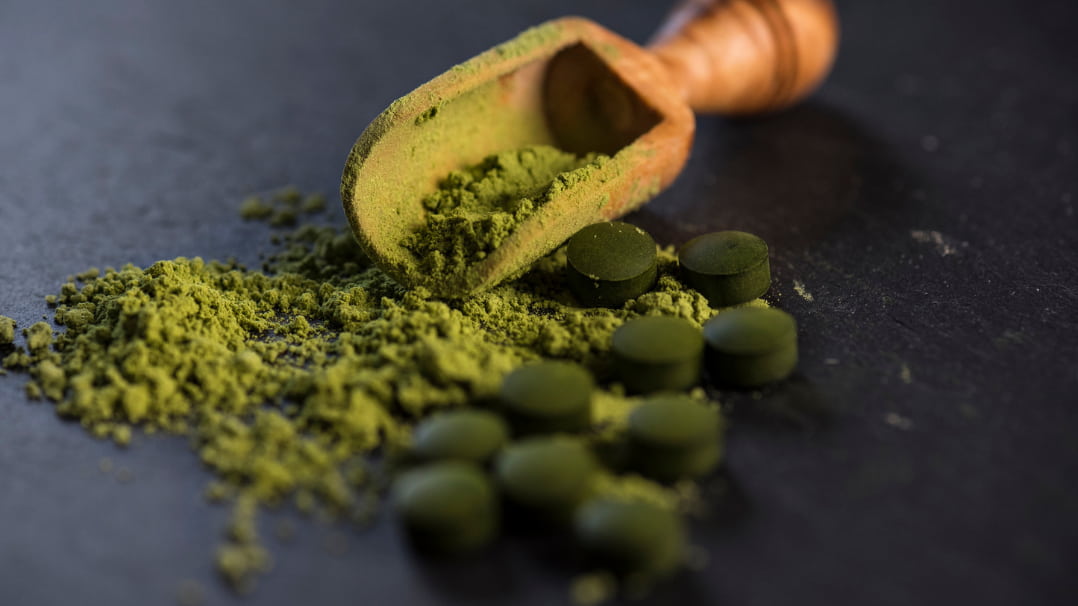
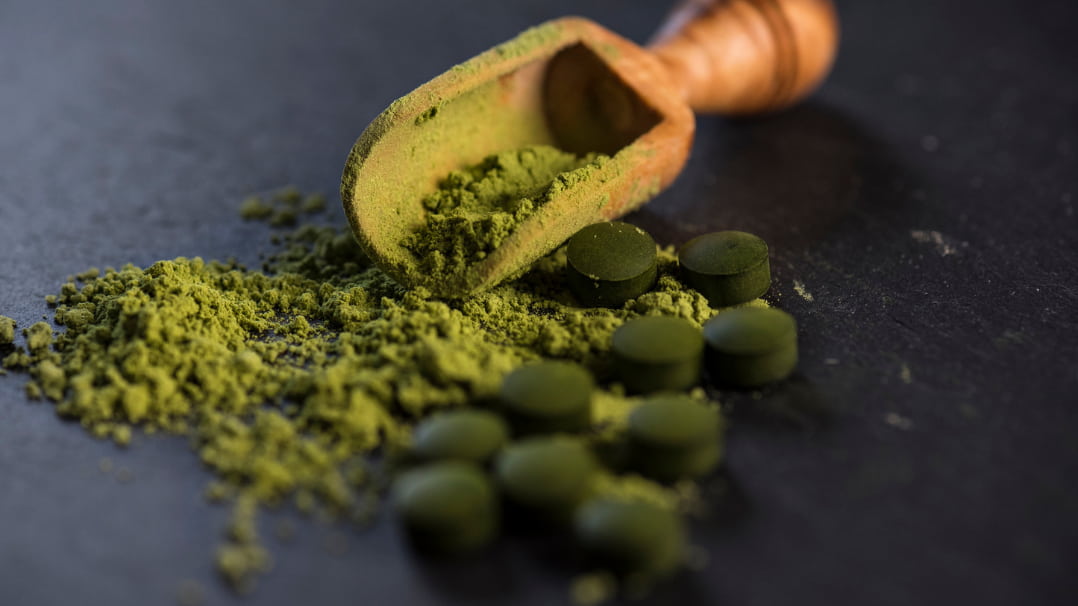
Chlorella is a single-celled freshwater green algae used as a supplement for its nutrient density and detox-binding properties. Each microscopic cell is surrounded by a recalcitrant outer wall that human digestive enzymes cannot dismantle, and this trait is central to chlorella’s detox capabilities.*
Chlorella is one of the oldest organisms on Earth — predating plants and animals, even predating most of biology as we know it [1].
Its name comes from the Greek chloros (green) and the Latin -ella (small), which is exactly what it is: microscopic and intensely green.
Individual chlorella cells are just a few micrometers across, or about one-twentieth the width of a human hair [2]. In aggregate, they form the deep emerald powders that you see in supplements.
But chlorella benefits come less from its pigments than from the cell wall surrounding them.*
How Chlorella Works as a Detox Agent: Heavy Metals, Gut, and Beyond
Chlorella detox works through its durable, chemically reactive cell wall. The wall survives transit through the digestive tract, while reactive functional chemical groups embedded on its surface bind toxins and carry them out through elimination before they can be reabsorbed into circulation.*
How Chlorella Intercepts Toxins
Most supplements are designed to break down in the digestive tract. Chlorella evolved to survive it.
In its natural environment, chlorella is constantly being preyed upon by zooplankton. They have adapted by building armor: a heavily reinforced outer wall resistant to digestive enzymes [3].
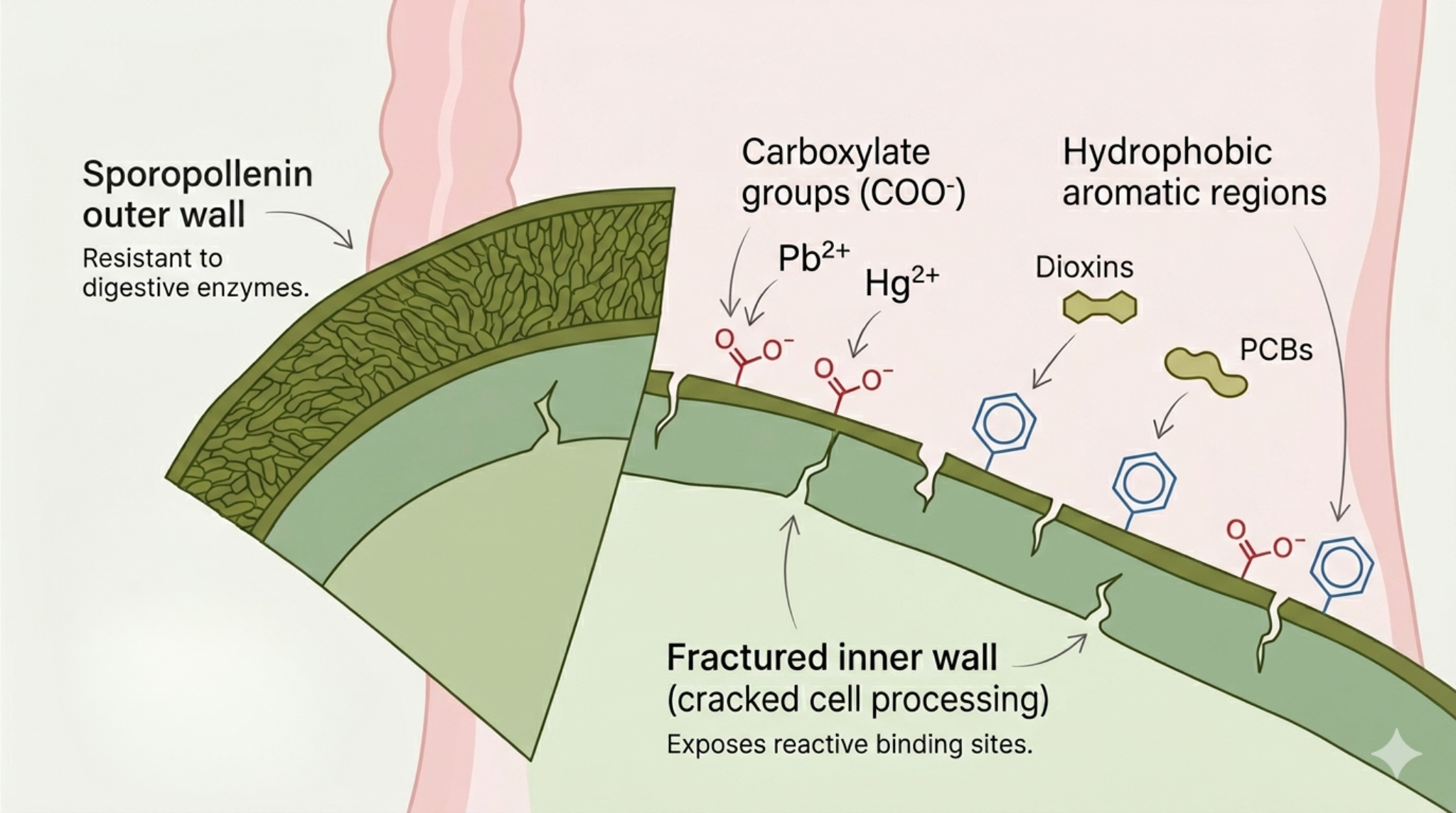
Part of that armor is an outer layer of sporopollenin, perhaps the toughest of all biological materials. It is known as the “diamond of the plant world” because almost nothing can break it down [4–5].
But durability alone is not the whole story.
Commercial chlorella supplements are usually cracked open, just enough to expose the inner layers of the walls [3]. And that underlying structure is chemically sticky.
Embedded throughout the surface is a dense patchwork of reactive chemical groups, each of which has affinity for different toxins. For example, negatively charged chemical groups like carboxylates interact with positively charged metal ions, like lead or mercury. Meanwhile, hydrophobic aromatic regions lock onto fat-soluble pollutants like dioxins and PCBs [6–7].
Together, these properties turn chlorella’s wall into a remarkably effective interception system: tough enough to survive the digestive tract and chemically grabby enough to accumulate toxins all the way down.*
When Toxins Refuse to Leave
Up until recently, we had little idea why some substances seemed to lodge themselves permanently in the body. Lead from old pipes, mercury from contaminated fish, dioxins from industrial accidents. These compounds got into people and lingered for years.
Researchers became acutely aware of this problem after the Yusho rice oil poisoning, where thousands of people were exposed to dioxins through contaminated cooking oil. Decades later, victims still carried heavy body burdens [8].
Japanese scientists started experimenting with ways to detox the body. They exposed rats to contaminated rice oil,accompanied by various dietary interventions. One of the things that they tried was chlorella.
And it worked.
Rats fed chlorella excreted dramatically larger amounts of dioxins in their feces than controls — in some cases more than 10-fold greater [9].
Since then, similar findings have appeared with a plethora of other toxic compounds.*
For instance, in mice, chlorella nearly doubled fecal mercury excretion [10].
In another animal model, chlorella was shown to dramatically decrease accumulation of lead in the body, as well as preserve memory function [11].
Human evidence related to detox function is limited, but early data points in the same direction. In a 90-day study involving patients with dental amalgam fillings, a chlorella-containing formulation reduced hair mercury concentrations by ~40% [12].*
Other Chlorella Benefits: Nutrient Density, Gut Health, & Immunity
Beyond its detox effects, chlorella benefits come from its roles as a concentrated nutrient source and a biologically active prebiotic. Its cracked interior delivers chlorophyll, carotenoids, iron, folate, and vitamin B12, while the remaining cell-wall fragments feed beneficial gut bacteria and interact with the immune system through β-glucans and other microbial polysaccharides.*
Nutrient Density
Once that armored wall is mechanically processed, it exposes one of the most concentrated nutritional payloads found in any whole food.
Chlorella fully lives up to its name. It is one of the most chlorophyll-dense dietary substances known, even eclipsing green leafy vegetables. The pigment gives chlorella its deep green color and powers the photosynthetic machinery packed inside each microscopic cell [13].
But that pigmentation is somewhat misleading. While it looks the part, chlorella is evolutionarily distinct from land plants and that difference shows up in its nutrient profile.
Plants, generally speaking, do not produce vitamin B12 or vitamin D. Chlorella does both, accumulating B12 from environmental bacteria and converting ergosterol into vitamin D2 under sunlight [14].
At the same time, it boasts iron at a concentration rare outside of organ meats. Folate content rivals leafy greens by weight [15]. And it hosts an array of bioavailable carotenoids, including zeaxanthin, β-carotene, and lutein [16]. One human trial found that a single 6-gram dose raised circulating lutein levels by 66%, a response comparable to what we see after consuming a serving of spinach [17].
Chlorella Nutrient Density
Values compiled from Bito et al. 2020 and Sandgruber et al. 2021; carotenoid bioavailability from Serra et al. 2021.
Gut Health
The fragments of that tough cell wall, which makes chlorella such a potent detox agent, continue the journey through the digestive tract, where they take on a second role as a prebiotic.*
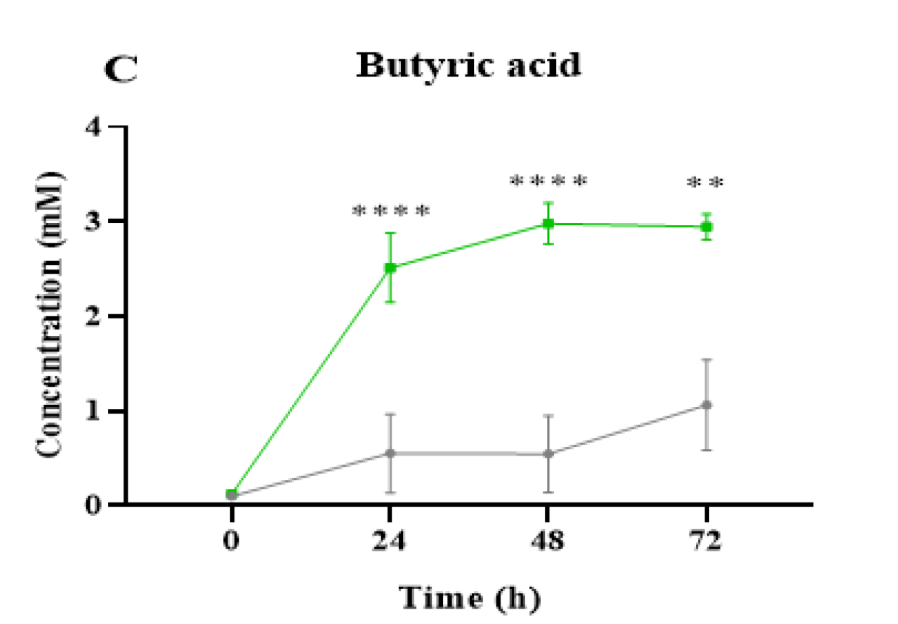
While the wall material resists digestive enzymes, gut microbes can metabolize it. The remaining fragments become substrate for bacteria residing deep in the colon, which ferment the material into short-chain fatty acids, including butyrate.
And chlorella is really good at driving this fermentation process. Like, maybe even the best at it.
In a recent experiment simulating human digestion, researchers compared chlorella head-to-head with inulin, the benchmark prebiotic in gut health supplements.
After 24 hours of fermentation, chlorella produced more than four times as much butyrate as inulin [18].
At the same time, it reshaped the microbial ecosystem itself, boosting Akkermansia muciniphila, a microbe associated with gut barrier integrity as well as leanness [19].
And these microbial changes reverberate far beyond gut health.*
The gut wall is not merely a digestive surface. It is the body’s largest immune interface, holding around 70% of immune cells [20].
Chlorella’s wall fragments do not pass through this environment unnoticed.*
Immunity
Your innate immune system is fundamentally a pattern recognition machine. It doesn't memorize specific pathogens, the way the adaptive immune system does. Instead, it scans for broader molecular signatures. Basically, patterns that distinguish something as "not self," and potentially a foreign invader [21].
These features appear on bacterial cell walls, fungal cell walls, and viral envelopes. And algal cell walls, including that of chlorella, contain them as well. Chlorella's wall is dense with surface structures that human cells just don't make. To the innate immune system those molecules read as biologically unfamiliar — enough to elicit a state of heightened surveillance.*
One such feature is a polysaccharide called β-glucan. β-glucans are such recurrent signatures of foreign life that our immune cells evolved dedicated receptors to detect them [22].
When β-glucans bind to these receptors, they don't merely activate the cells in the moment. They elicit permanent changes in how the immune cells work. Through epigenetic reprogramming, the cell enters a more vigilant state that persists for weeks or months after the exposure ends, a phenomenon known as trained immunity [23].
The impact ripples outward through the immune system. Activation of β-glucan receptors has been shown to stimulate natural killer (NK) cells, your immune system’s fastest responders. They're autonomous surveillance cells that identify and destroy abnormal or infected cells before the adaptive immune system has fully mobilized.
And this is the immune revamp we see when healthy people are supplemented with chlorella.*
After 8 weeks, participants showed significantly increased natural killer cell activity. Three key signaling molecules climbed in parallel: interferon-γ, IL-1β, and IL-12. These are the cytokines the immune system uses to coordinate a response to recognizable foreign patterns [24].
So rather than generally “boosting immunity,” chlorella appears to make the immune system better prepared for future external challenges.*
What to Look for in a Quality Chlorella Supplement
A quality chlorella supplement should use cracked cell wall chlorella, clearly disclose the amount per serving, and undergo contaminant testing. Chlorella’s wall is extraordinarily durable, which is great for interception in the gut, but terrible for nutrient absorption unless the wall has been mechanically fractured first.*
Cracked Cell Wall Processing
Remember what I said about sporopollenin and biological armor?
Well, that toughness cuts both ways.
An intact chlorella wall is so resistant to digestion that the nutrient content will just go right through you [25].
That’s why modern chlorella supplements typically employ some form of mechanical cracking or pulverization to fracture the wall open (while still preserving the polymer fragments that drive detox and prebiotic effects) [14].
Look for terms like:
“cracked cell wall”
“broken cell wall”
“pulverized”
or “cell wall fractured”
If a label says nothing about processing, that’s not a great sign.
Clear Dosing > “Detox Blends”
A good supplement tells you exactly how much chlorella you’re getting per serving, in milligrams.
What you do not want is a vague “detox complex” or proprietary blend where chlorella disappears into a laundry list of ingredients under one combined weight.
If the company won’t disclose the dose, it becomes impossible to evaluate the product against the actual research.
Contaminant Testing Matters
Chlorella’s tremendous binding capacity is a double-edged sword.
That chemically reactive wall, which can bind heavy metals and environmental pollutants in the gut, can also accumulate contaminants during growth [26–27]. Algae is not super selective about when it binds things.
And because chlorella grows suspended directly in water, cultivation conditions matter a whole lot.
A high-quality supplement will be grown in controlled conditions and tested for heavy metals. USDA Organic certification is a useful signal, but third-party contaminant testing is arguably even more important, more so than for many other supplements.
How Chlorella Fits Into a Detox Binder Protocol
Chlorella detox works even better as part of a multi-detox binder approach, paired with activated charcoal, because they bind different classes of compounds in the digestive tract. Chlorella’s advantage is in heavy metals, while activated charcoal excels at trapping small organic molecules like mycotoxins and environmental chemicals. Used together as part of a whole-body detox, they cover a broader substrate range than either alone.*
Chlorella is a capable binder. But it has some blind spots.
Its cell wall is covered in reactive chemical groups that are great at grabbing things with electrical charge, like heavy metals [28].
But a lot of modern chemicals are built differently. Think plastic-derived chemicals and pesticides. These molecules are oily with little electrical charge, so chlorella's wall can't get a firm grip on them.
These compounds share a different vulnerability: they're hydrophobic. They'd rather retreat to a carbon-rich surface than remain suspended in the watery environment of the gut. So binding them just takes carbon, and surface area. A lot of it.
That's precisely what activated charcoal brings to the table.*
Activated charcoal is basically pure carbon engineered into a microscopic pore labyrinth. A single gram contains up to 3,000 square meters of internal surface area, giving oily organic molecules a remarkable volume of carbon surface to stick to [29].
Which is why Qualia 2-Day Detox pairs chlorella with activated charcoal, along with additional binders like chitosan and chlorophyllin. No single binder is especially effective against every class of compound. Metals, bile-associated metabolites, microbial byproducts, and hydrophobic organic molecules all behave differently chemically. Pairing complementary binders expands the range of compounds that can be intercepted inside the gut.*
*These statements have not been evaluated by the Food and Drug Administration. These products are not intended to diagnose, treat, cure or prevent any disease.