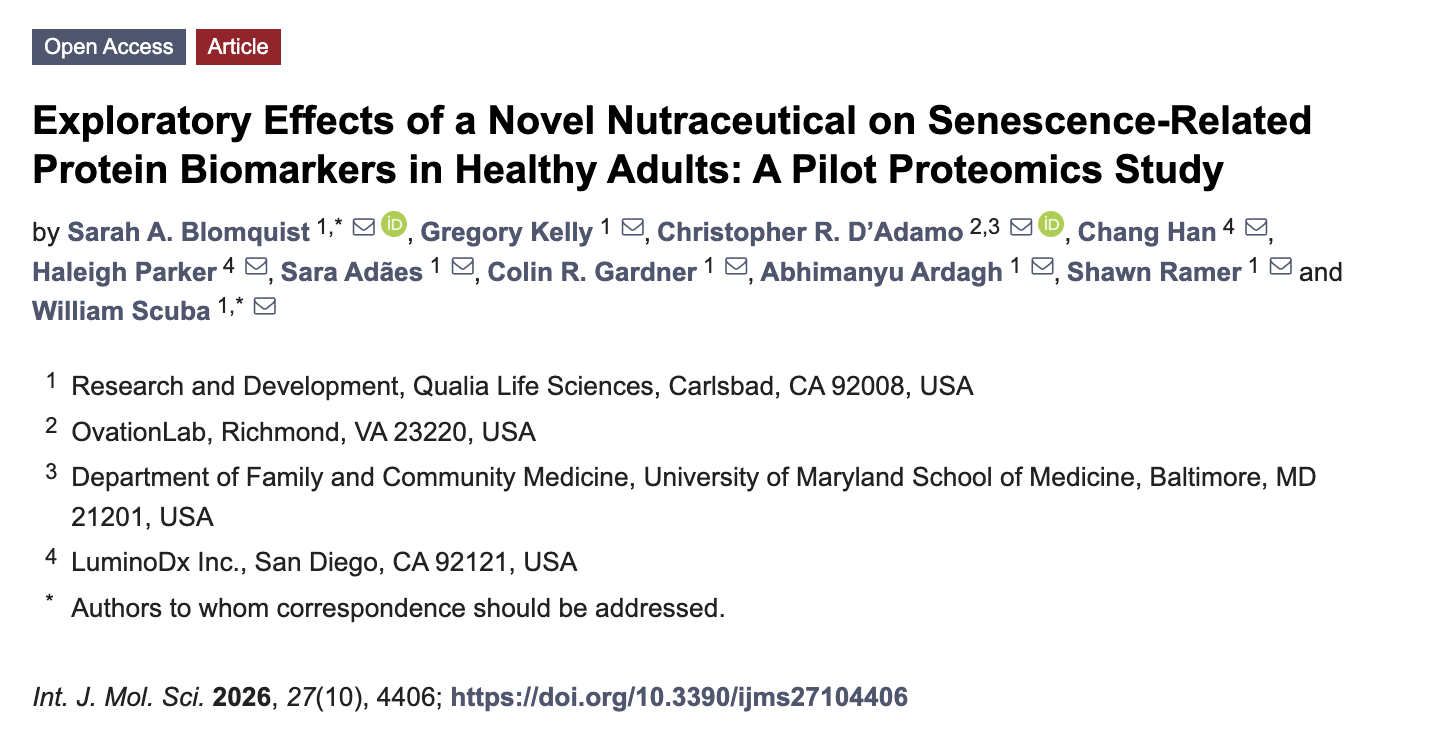
This study was recently published in a peer-reviewed journal: The International Journal of Molecular Sciences, and is titled “Exploratory Effects of a Novel Nutraceutical on Senescence-Related Protein Biomarkers in Healthy Adults: A Pilot Proteomics Study.”
The full study can be found here: https://www.mdpi.com/1422-0067/27/10/4406. This is the first study Qualia Life Sciences has published in a journal, which represents a new milestone for our company and scientific team.
HOW THE QUALIA SENOLYTIC PILOT STUDY WORKED
In this proteomics pilot study, 53 participants aged 45 - 78 (males n = 24, females n = 29) were included. Proteomics is a method of analyzing all of the proteins that cells have made. Proteins can be thought of as the molecules that actually carry out the “work” in the body. This type of analysis actually reflects how cells are responding in real time - or how genetic information is being translated into cellular action. Proteomics (as well as other ‘omics’ technologies like metabolomics, transcriptomics, epigenomics) are now being used as an emerging method to investigate biomarkers and signatures of cellular senescence.*
All participants completed a blood spot test to assess their baseline levels of selected circulating proteins. From Days 1 - 2, participants consumed Qualia Senolytic daily as indicated on the packaging (6 capsules daily). On Day 7, five days after completing supplementation, participants completed another blood spot test. The blood spot test is a panel that measures 48 common cytokines. Cytokines are small signaling proteins released by cells that act as chemical messengers: they help cells communicate with one another and coordinate responses. While not all of them play major roles in senescence, over a dozen were more strongly implicated. Note that this research is exploratory, and not evidence that the product treats or prevents any condition.*
We also administered surveys at the beginning and end of the study to examine changes in quality-of-life due to the short intervention, including the following: validated assessments for quality of life (Rand-36), a physical function index (FIFE), a mental well-being scale (DASS-21), and a modified, gender-neutral aging symptom scale (AMFS). Due to the short term nature of this study and lack of placebo group, the results should be interpreted cautiously [full results can be found in the published study].*
RESULT HIGHLIGHTS
Qualia Senolytic exhibits exploratory signals in key biomarkers related to cellular senescence†*
After one round of Qualia Senolytic and prior to statistical adjustments that account for multiple comparisons, study participants showed significant reductions (p < 0.05) in four signaling molecules - CCL8, CXCL9, CXCL10, and CXCL11 - that are part of the “senescence associated secretory phenotype” (SASP), a collection of cytokines released by stressed and aging cells. The SASP can influence nearby tissues and can drive healthy cells to become senescent, thus lower levels of these molecules may indicate a shift toward a healthier cellular environment. Notably, the SASP molecules are emerging biomarkers of cellular senescence in humans and have even been recognized by the research community [1–3].*
Several other identified biomarkers of cellular senescence in humans were also observed to change after one round of Qualia Senolytic, and although they did not reach conventional statistical significance (0.1 < p < 0.05), the trends are still informative. CCL2 is another SASP cytokine and it showed a downward trend. Meanwhile, VEGFA, CSF2 and HGF trended upward. These molecules have complex, context-dependent roles in biology, and are cytokines typically associated with tissue repair and renewal. These exploratory signals provide early signs that may reflect shifts in healing-related pathways that warrant further study.*
Qualia Senolytic exhibits exploratory signals related to immune balance and tissue renewal†*
After one round of Qualia Senolytic and prior to statistical adjustments that account for multiple comparisons, the study participants also exhibited significant (p < 0.05) increases in IL-17F and OSM. The biological significance of these increases is unclear. These two molecules are often involved in supporting immune activity and tissue renewal. In some contexts, transient rises in these markers may reflect healthy immune adaptation and rebalancing or early stages of tissue healing, but their roles can differ with ongoing, long-term elevations. More research is needed to validate these exploratory signals, and to determine the duration of these changes and their role in cellular cascades associated with cellular senescence.*
DISCUSSION
This pilot proteomics study explored how a single course of Qualia Senolytic may influence circulating proteins that are associated with cellular senescence. Unadjusted, exploratory results showed that several senescence associated secretory phenotype (SASP)-related cytokines decreased after supplementation, while other molecules associated with tissue renewal and immune balance increased. These findings serve as a proxy for cellular senescence and tissue renewal and do not establish causal effects, but they are biological patterns that can help guide future scientific exploration into how the body responds to interventions targeting cellular aging pathways. Larger, longer term studies with subjective symptom surveys will be important for future research to understand the effects of these changes and what they mean for cellular health, healthy aging and overall wellbeing.*
REFERENCES
[1] T. Singh Rai, S.M. Lynch, T. McLarnon, E. Cooper, D. McDaid, G. Guo, J. McLaughlin, V.E. McGilligan, S. Watterson, P. Shukla, S.-D. Zhang, M. Bucholc, A. English, L. Freeman, R.E. Irwin, A.Peace, M. O’Kane, M. Kelly, M. Bhavsar, E.K. Murray, D.S. Gibson, C.P. Walsh, A.J. Bjourson, AgingBio 2 (2024) 20240035.
[2] L.H.A. Ventura, L. Torres, G.C. Camatta, J. Zamame, M.M. Coelho, C.H. Ramalho-Pinto, J. Gervazio, F. Caixeta, L. Nascimento, M.A. Oliveira, V.D. Martins, M.F. Oliveira, M.S. Costa, H.I. Sato, H.C. Guimarães, R.C. Barbuto, A.P.R. Veiga, N. Ataíde, G.P. Caetano, S. Rangon, M.L.O. Júnior, F.C. Fortes, L. Zuccherato, E. Speziali, O.A. Martins-Filho, V. Coelho, R. Avritchir, R. Souza, M. Ayupe, C. Loureiro, M.E. Passos, A.C.M. Neves, P. Leite, S.M.R. Teixeira, U. Tupinambás, L.F. Felicori, G. Silveira-Nunes, T.U. Maioli, D.M. Fonseca, A. Teixeira-Carvalho, A.M.C. Faria, Aging Cell 24 (2025) e70077.
[3] A. Picca, N.V. Nguyen, R. Calvani, M. Dale, C. Fredolini, E. Marzetti, A. Calderón-Larrañaga, D.L. Vetrano, GeroScience 47 (2025) 6411–6427.
†Disclaimer: Although these results are highly encouraging, they are not statistically significant after adjustment for multiple comparisons, and the study was not placebo-controlled. Larger, controlled studies will be required to confirm the findings.
*These statements have not been evaluated by the Food and Drug Administration. The products and information on this website are not intended to diagnose, treat, cure or prevent any disease. The information on this site is for educational purposes only and should not be considered medical advice. Please speak with an appropriate healthcare professional when evaluating any wellness related therapy. Please read the full medical disclaimer before taking any of the products offered on this site.