Written by
If you've heard of nattokinase, you've probably filed it under heart health.
That filing isn't wrong. Yet it is incomplete.
Most research on nattokinase supplements does focus on blood flow and vascular function.
But circulation does more than move oxygen and nutrients. It also moves toxins.
Every day, your blood vessels collect metabolic by‑products, cellular debris, and xenobiotics. Before the liver and kidneys can clear anything, the circulatory system has to bring it to them.
This is an aspect of detox that is rarely addressed. And it may represent an underappreciated mechanism behind nattokinase benefits.*
In this article, we’ll examine how nattokinase supplements work, what the research actually shows, how nattokinase 2,000 FU became the benchmark dose, and why circulation is the most overlooked lever in how to detox your body.*
What Is Nattokinase?
Nattokinase is a fermented soy-derived enzyme best known for its fibrinolytic activity — its ability to help break down fibrin, a structural protein involved in circulatory dynamics and vascular remodeling.
Because circulation plays a central role in tissue exchange and the transport of metabolic waste, standardized nattokinase supplements, like NSK-SD® (nattokinase 2,000 FU) have emerged as a distinctive component of detox-support formulations.*
In 1980, researchers at the University of Chicago Medical School were searching for substances capable of degrading fibrin, the protein mesh that forms the structural backbone of blood clotting [1].
They screened 173 foods, smearing samples onto artificial fibrin to see if anything dissolved them. One of the scientists, Japanese researcher Hiroyuki Sumi, wondered if natto might be a suitable candidate.
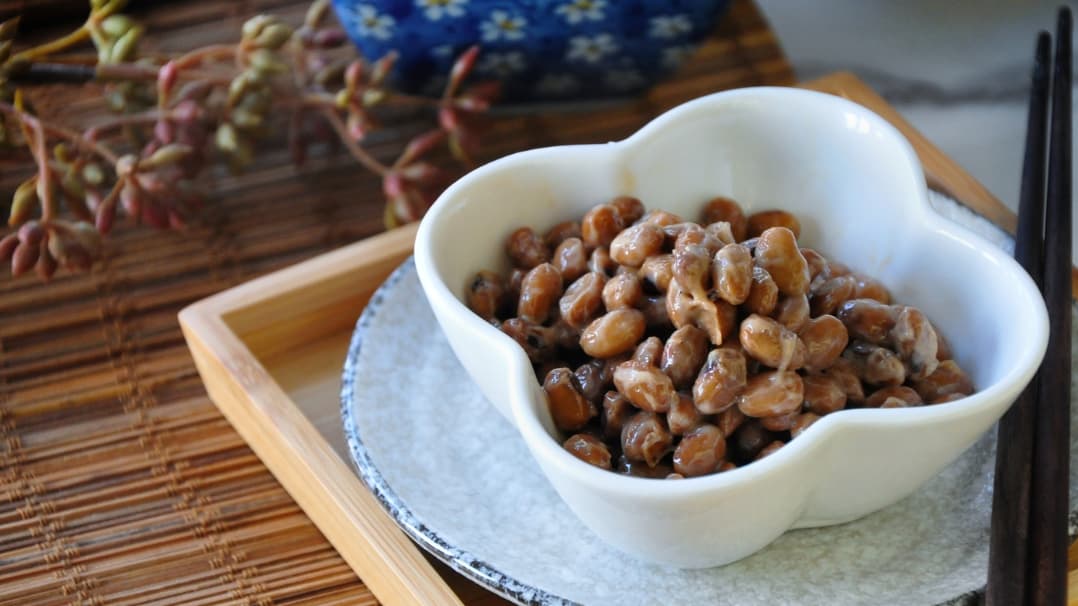
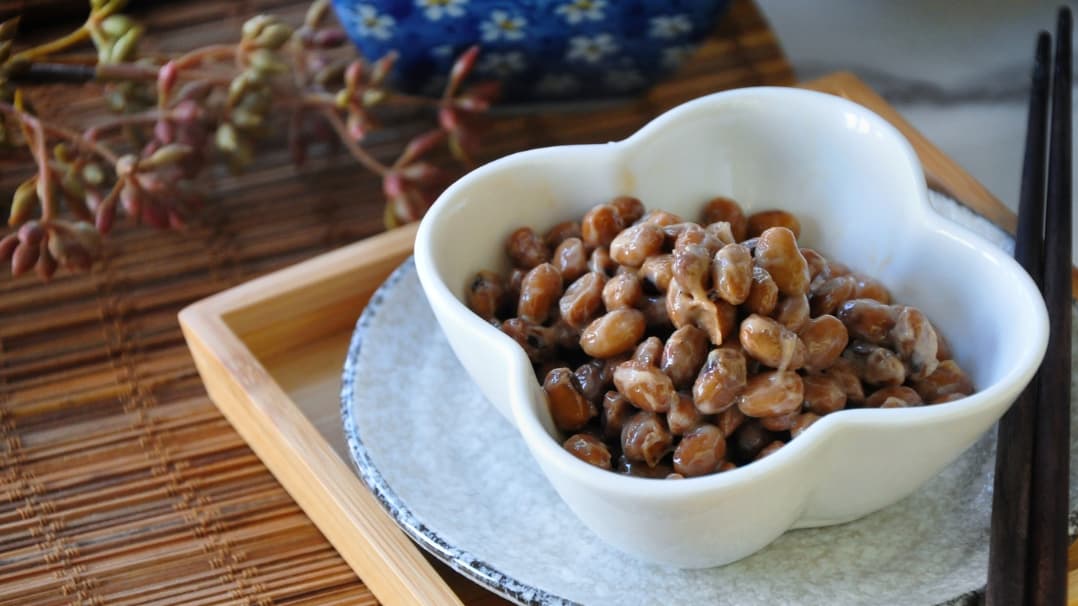
Natto is a traditional Japanese food produced by inoculating soybeans with bacteria and allowing the mixture to ferment. And it has long been known to be associated with vascular health.
For example, in a study of 652 Japanese men, those eating the most fermented soy — including natto — had significantly less arterial stiffness [2].
So, Sumi tried natto. And within three hours, the artificial fibrin had shrunk by two centimeters.
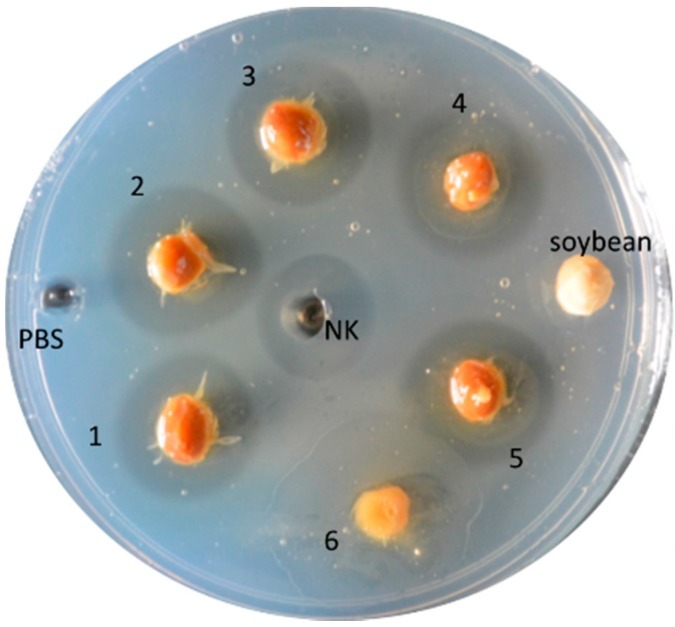
The researchers compared it to urokinase, a thrombolytic agent used of the era. Urokinase required nearly two days to achieve comparable fibrin dissolution.
The scientists ultimately isolated the enzyme responsible and dubbed it nattokinase.
Nattokinase is a protease — an enzyme that breaks down proteins — produced during the fermentation process. As Bacillus subtilis grows on the soybeans, it secretes enzymes that dismantle dense soybean proteins into smaller peptides and amino acids. Basically, the bacteria are digesting the soybean externally.
Many of the defining (and divisive) characteristics of natto emerge from this breakdown process: sticky strings, soft texture, and pungent smell.
And it just so happens that this soybean-digesting bacterial enzyme also cleaves fibrin remarkably well.
That overlap is fortuitous, because healthy circulation — as well as the clearance of unwanted compounds — depends on the continuous turnover of fibrin. And that clearance is seldom optimized, especially as we get older [3].
How Does Nattokinase Support Circulation and Detoxification?
Nattokinase benefits trace back to fibrinolysis, the body's natural process for clearing fibrin. By helping maintain the circulatory systems responsible for transporting compounds from tissues to the liver and kidneys, nattokinase supplements support the upstream foundational processes upon which detoxification depends.
Detoxification Starts With Transport
Most detox conversations focus on the liver.
Which is understandable, since the liver is where the chemistry of biotransformation happens. But detoxification is a whole-body process. Before a compound can be processed, it has to get there first.
That job belongs to the circulatory system, comprising blood as well as the lymphatic system.
We think of circulation as a delivery network, transporting oxygen and nutrients to tissues. But it also performs the opposite task. Every day, blood vessels collect carbon dioxide, metabolic by-products, cellular debris, and compounds destined for elimination.
In that sense, circulation is as much a collection network as a distribution system.
Fibrin Turnover Keeps Circulation Dynamic
Fibrin is usually characterized as an emergency response protein. You get hurt, fibrin clots, the bleeding stops.
But small amounts of fibrin are constantly being formed and cleared throughout the circulatory system as part of normal vascular maintenance.
The body manages this balance through a process known as fibrinolysis [4].
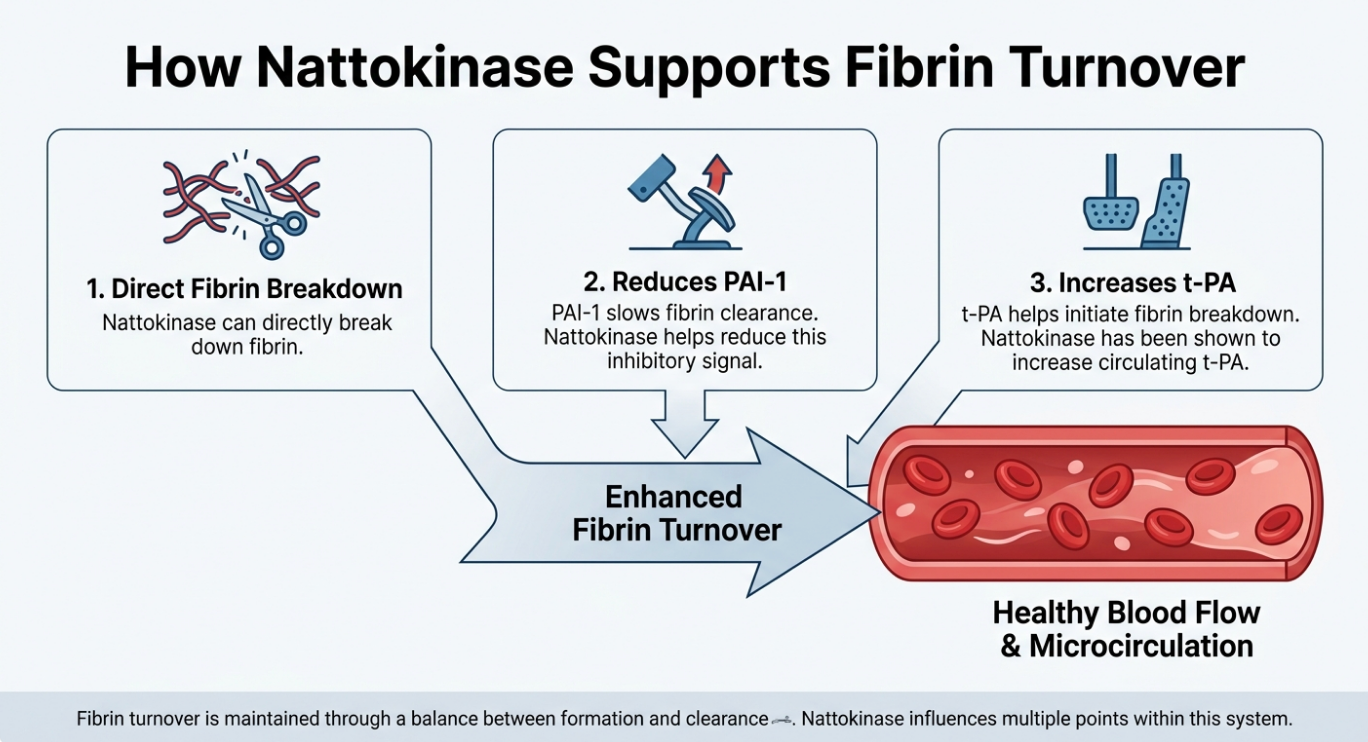
At the center of the system are two opposing forces. Tissue plasminogen activator (t-PA) helps initiate fibrin breakdown. Plasminogen activator inhibitor-1 (PAI-1) slows that process by inhibiting t-PA. Together, they determine how efficiently fibrin is removed once its job is done [5].
In healthy individuals, these forces are in equilibrium. Fibrin forms when needed, disappears subsequently, and circulation remains dynamic and unobstructed.
But inactivity, body fat, and especially aging all push the fibrinolytic system toward less efficient fibrin turnover [6–7].
Aging Shifts the System Toward Stagnation
The system shifts on multiple fronts at once.
Fibrinogen, the precursor protein from which fibrin is made, gradually climbs with age. In the Framingham Offspring Study, adults over 70 had fibrinogen levels ~15-20% higher than adults under 40. More fibrinogen means more raw material for fibrin formation [8].
At the same time, the body's ability to clear fibrin becomes less robust. Older men release ~35% less t-PA than younger counterparts, reducing their capacity to initiate fibrin breakdown [9].
Meanwhile, levels of PAI-1 — the primary brake on fibrinolysis — steadily climb with age. This is driven, in large part, by the accumulation of senescent cells, also known as zombie cells, which secrete PAI-1 as part of the senescence-associated secretory phenotype (SASP) [10–11].
The net result is a system that shifts toward stagnation rather than turnover.
The good news is that this system is not fixed. And all three of these mechanisms are influenced by nattokinase. More on that shortly.
Why this matters for detox
Your liver and kidneys can only clear what reaches them, and that depends on circulation.
We know this because age-related reductions in perfusion to the liver are associated with worsening clearance of xenobiotic compounds [12].
Hepatic clearance declines by about 0.8% per year after age 40, and that change tracks directly with blood flow [13].
The kidneys show a similar dependence, with renal blood flow falling by ~10% per decade after midlife — with flow per unit kidney mass dropping in parallel [14].
So, the efficiency of elimination hinges not only on the biochemical machinery inside the liver and kidneys but also on circulatory systems responsible for delivering compounds to them.
And a growing body of evidence shows that nattokinase benefits could be connected to this upstream transport system.
What Does the Research Say About Nattokinase?
Research suggests that nattokinase supplements promote fibrinolysis through multiple complementary mechanisms. Studies show that it can directly degrade fibrin, reduce PAI-1 activity, increase t-PA, and enhance markers of fibrin breakdown in healthy adults. Human trials have also linked nattokinase supplements to improved microcirculation and reductions in fibrinogen, supporting its role in maintaining healthy blood flow.
First, nattokinase acts directly on fibrin. As a protease, nattokinase can cleave the protein itself. This is the same phenomenon that Hiroyuki Sumi saw when he put natto extract on a fibrin plate and watched the fibrin disintegrate.
But nattokinase also targets PAI-1, and this is critical to its fibrinolytic ability.
Researchers demonstrated this by comparing nattokinase's activity in two different fibrin experiments: one imbued with PAI-1 and one devoid of it. In the presence of PAI-1, fibrin dissolution increased significantly [15].
So nattokinase was not only breaking down fibrin. It was also disabling the system's primary brakes.
Finally, nattokinase has been shown to double circulating t-PA — likely indirectly through its impact on PAI-1 [16].
With less PAI-1 available to sequester t-PA, more t-PA remains free to promote fibrin clearance [17].
Does this translate to enhanced blood flow in healthy humans?
The available evidence certainly seems to suggest so.
In a double-blind crossover trial, twelve healthy men took a single dose of nattokinase. Within hours, their blood showed the unmistakable signature of fibrin breakdown. D-dimer, a direct marker of fibrin being dissolved, rose 44% by the six-hour mark, while fibrin degradation products climbed 21% [18].
Importantly, every value remained within the normal physiological range. In other words, nattokinase wasn't pushing the system into dangerous bleeding territory. It was shifting a healthy fibrinolytic system toward turnover rather than buildup.
The same lab then ran a harsher test. Nine men swallowed a single dose of nattokinase or placebo, waited two hours...and then plunged both hands into 50°F water.
Thirty minutes later, finger temperatures were 6–7°F warmer when the men took nattokinase, compared to placebo [19].
Which is exactly what you'd expect if blood is moving more freely through tissue.
Long-term, this may produce sustained improvements in blood flow. After two months of nattokinase supplements, healthy adults saw a reduction in fibrinogen, the precursor protein from which fibrin is made. Two clotting proteins involved in the coagulation cascade — Factors VII and VIII — also declined [20].
How Much Nattokinase Should You Take?
The standard nattokinase dose is 2,000 FU (fibrinolytic units) per day. Nattokinase 2,000 FU is the activity level used in most published human studies and the dose recommended by the Japan Nattokinase Association. In supplement form, 2,000 FU is typically equivalent to 100 mg of nattokinase, though potency is measured by FU rather than mass.
Nattokinase is measured in fibrinolytic units (FU), rather than milligrams, because enzyme activity matters a lot more than weight. Two capsules can contain the same number of milligrams while delivering totally different levels of fibrinolytic activity. With nattokinase, the FU number is what you're really buying. And you shouldn’t buy any nattokinase supplement that doesn’t provide it.
The standard nattokinase dose is 2,000 FU per day. This number traces back to the estimated FU activity of a single serving of natto, but has since been validated in human research [21].
Finally, quality matters as much as the number.
Nattokinase is produced through fermentation, and enzyme activity can vary a lot depending on how the soybeans are fermented and processed. That's why most clinical research has relied on standardized extracts.
The best-known version is NSK-SD™, the ingredient used in many of the human studies we’ve discussed throughout. NSK-SD is standardized to a defined level of activity and produced with vitamin K2 removed, helping ensure that researchers are measuring nattokinase benefits by itself.
For those reasons, Qualia 2-Day Detox delivers nattokinase 2,000 FU in the form of NSK-SD™ — matching what has been used throughout much of the published human research.
And nattokinase is not acting alone.
The formula pairs nattokinase with other ingredients that support circulation through complementary mechanisms, including cayenne pepper, building a broader approach to the transport systems that move compounds throughout the body.
*These statements have not been evaluated by the Food and Drug Administration. These products are not intended to diagnose, treat, cure or prevent any disease.