Written by
Shatavari benefits for women stem from one of the oldest tricks in biology: molecular mimicry.
Shatavari's active compounds don't contain estrogen, and they never turn into estrogen. But their molecular architecture resembles human steroid hormones enough to activate estrogen receptors.*
Those receptors are woven through the systems that are most disrupted during perimenopause: the thermoregulatory neurons behind hot flashes, the collagen‑building cells deep inside skin, and the osteoblast machinery that remodels the skeleton.*
Shatavari’s bioactive compounds also reach into the body’s stress‑response networks, giving it a parallel identity as an adaptogen. Through those pathways, shatavari influences the neurotransmitter systems that coordinate emotional regulation during the day and restorative sleep at night.*
In this article, we'll explore how these features give rise to shatavari benefits for women — including hot flashes, sleep, stress resilience, skin and hair appearance, and bone health.*
What is Shatavari?
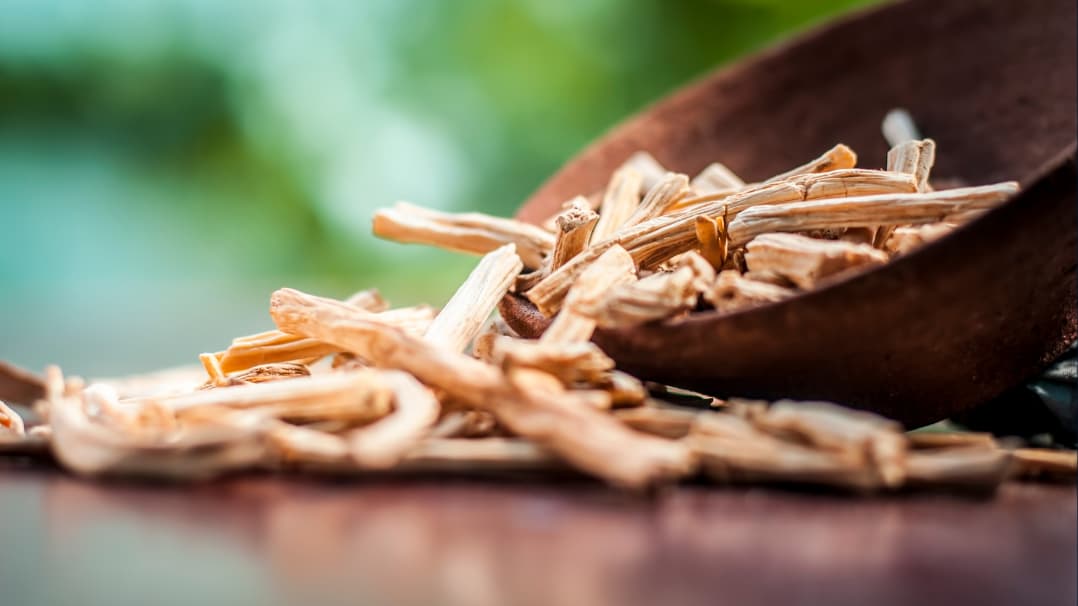
Shatavari (Asparagus racemosus) is an adaptogenic herb traditionally used to support women's hormonal balance during the menopausal transition.
For more than 2,000 years, practitioners of Ayurveda have turned to shatavari root as a tonic for women's health, especially during periods of hormonal turmoil [1].
The name itself translates roughly as "she who possesses a hundred husbands" — a slightly over-the-top metaphor that hints at its biological activity [2].
Only very recently has modern biology started to catch up.
Shatavari's chemistry is dominated by steroidal saponins. These plant compounds have a 27-carbon backbone that echoes the structure of human steroid hormones that shape female physiology [3].
Over the past decade, randomized clinical trials have begun putting those molecular features to the test.
How Does Shatavari Work in the Body?
Shatavari works by using steroidal saponins to activate estrogen receptors and modulate the body's stress-response systems [4]. These dual roles, as phytoestrogens and adaptogens, help explain shatavari benefits for women across the menopausal transition, including sleep, mood, and stress resistance.*
The steroidal saponins in shatavari, known as shatavarins, have a steroid-like core that resembles estrogen closely enough that estrogen receptors recognize it and respond [5].
Estrogen supports an extraordinary range of biological functions. It helps maintain bone density, regulates body temperature, supports deep sleep, and even preserves mood and cognition [6]. So when levels fall during the menopausal transition, all of these systems feel the impact.
But estrogen is a blunt instrument.
It doesn't just go where you want it to. It activates estrogen receptors throughout the body, including tissues where ongoing stimulation is not ideal.
That’s why the field has been focusing less on estrogen itself, and more on its receptors.
Estrogen signals mainly through two receptors: ERα and ERβ. ERβ is concentrated in the brain (particularly the hypothalamus and hippocampus), bone, vascular endothelium, and immune cells [7]. And much of what women experience during perimenopause is regulated through ERβ.
This is where phytoestrogens like shatavari may be advantageous. Shatavarins bind receptors more loosely in general, and they appear to have an affinity for ERβ [8].
Yet estrogen receptors aren't the whole story here.
Steroidal saponins also resemble other steroid signaling molecules that help the brain and body respond to stress. That's why shatavari belongs to a rarified group of botanicals known as adaptogens [9].
Adaptogens help the body stay closer to equilibrium when it's challenged by stress. In effect, making you more adaptable.
Shatavari accomplishes this via the HPA axis — the body's central stress-response system — as well as by modulating neurotransmitters, including serotonin, dopamine, norepinephrine, and GABA [10].*
What Are the Benefits of Shatavari for Women?
The benefits of shatavari for women stem from its ability to support systems normally regulated by estrogen during the menopausal transition.*
Key shatavari benefits include:
Easing hot flashes and night sweats by calming hyperactive temperature-regulating neurons [11].*
Improving sleep quality by supporting the serotonin circuitry that stabilizes sleep cycles [12].*
Building stress resilience by modulating the body's cortisol response [10].*
Preserving bone health by influencing the cells responsible for bone remodeling [13].*
Maintaining skin elasticity and hair thickness by promoting collagen production [14].*
Taken together, it’s little surprise that shatavari has emerged as one of the best perimenopause supplements on the market.*
What Does the Clinical Research on Shatavari Show?
Research shows that shatavari supports women through the menopausal transition without altering circulating hormone levels. Across multiple randomized trials, daily shatavari supplement use reduced hot flashes, lowered stress, improved sleep quality, preserved biomarkers of bone remodeling, and enhanced skin structure and hair vitality.*
Hormone-Free Support Through the Menopausal Transition
Let's start with the largest randomized clinical trial of shatavari for menopause.
This study enrolled 135 perimenopausal and menopausal women with irregular cycles who received either a standardized shatavari root extract or a placebo every day for eight weeks [15].
Researchers tracked how the women felt using the Menopause Rating Scale (MRS), the most widely used questionnaire for tracking menopause-related changes. Both groups started with near-identical scores of about 29 points, placing them solidly in the scale’s severe range.
Women taking shatavari saw their MRS scores significantly improve compared to the placebo group.
But let's zoom in on what the researchers didn't find, because that's just as valuable.
The scientists also measured serum estradiol, follicle-stimulating hormone (FSH), luteinizing hormone (LH), and testosterone. None of these hormones changed in the shatavari group.
And this is exactly what we should expect. Remember, shatavari does not boost estrogen. Instead, its phytoestrogens engage estrogen receptors in tissues where receptor activity is relevant to how women experience this transition.
Reduced Perceived Stress
Another randomized, placebo-controlled trial focused on 80 women in perimenopause. Like the previous study, participants took either a standardized shatavari extract or placebo daily for eight weeks [16].
Again, Menopause Rating Scale (MRS) scores fell significantly in the shatavari group, almost perfectly replicating the findings of the larger study.
However, this study zoomed in on something else: stress.
Researchers measured perceived stress using the validated PSS-10 questionnaire. Both groups entered the trial with nearly identical scores of about 24, placing them in the upper-moderate stress range.
Eight weeks later, the experimental group had fallen to about 17, while the placebo group had climbed to 28. So one group finished the study approaching the low-stress range, while the other ended it in the high-stress range.
An effect this large is pretty rare in the perceived stress literature. The best way to put it into perspective is to compare it to the most renowned adaptogen for stress.
Meta-analyses pooling clinical trials of ashwagandha find an average reduction in perceived stress of almost 5 points on the same scale, compared with placebo. Shatavari's 10-point swing over 8 weeks in perimenopausal women is roughly double the effect typically reported for ashwagandha [17, 18].
Longer-Term Shatavari Benefits for Hot Flashes, Skin, and Hair
The preceding trials followed women over a relatively short time-scale — just two months. But do the benefits of shatavari continue to build with longer use? The answer to that question appears to be yes.*
The next trial extended the shatavari supplement regimen to four months. Women entered the trial scoring around 36 on the Menopause Rating Scale [19]. By the end of 120 days, women taking shatavari had dropped significantly more than what was observed in the 8 week trial.
The researchers also tracked hot flashes. Over the course of the study, the supplement group saw their hot flash scores drop significantly. Meanwhile, the placebo group's hot flashes became slightly worse over the same period.
But here's where the study really separates itself. The researchers also looked at cosmetic effects. Meaning skin and hair.
Researchers tracked breakouts, self-assessed skin quality (radiance, smoothness, firmness, hydration), and hair quality (fall, texture, volume, scalp comfort).
The active group saw improvements across every measure. Most notably, composite skin quality scores doubled over the course of the study.
Improvements in Bone Remodeling Markers
Up to this point, these trials have largely been centered around how women felt.
This one looked at objective reality. Specifically, what was happening inside their bones.
Researchers enrolled 127 postmenopausal women and measured the molecular signals that determine whether bone is being built or broken down [13].
Chief among them was the RANKL/OPG ratio, a regulatory switch that dictates the balance between bone resorption and bone rebuilding.
Over 24 weeks, women taking shatavari saw that ratio fall. The resorption signal RANK dropped significantly, while its protective counterweight, osteoprotegerin (OPG), climbed.
Virtually every marker of bone activity in the panel tilted toward healthier bone metabolism.†
Better Sleep Quality
Last, but decidedly not least, this trial takes a closer look at sleep [20].
To rigorously assess this outcome, researchers relied on the RIS, a validated questionnaire that separately evaluates sleep depth, sleep quality, time to fall asleep, preoccupation with sleeplessness, and daytime functioning. In this tool, higher scores mean worse sleep.
Women taking shatavari significantly reduced their total sleep score over eight weeks. Meanwhile, the placebo group's scores climbed, indicating that sleep continued to deteriorate.
And the improvement wasn't confined to a single aspect of sleep.
Women reported sleeping more deeply, rating their sleep as higher quality, falling asleep more easily, spending less time preoccupied with sleeplessness, and functioning better during the day. Sleep duration was extended as well. Nearly every dimension of sleep on the RIS improved.
Finally, the scientists detected no significant change in serum estrogen levels in response to shatavari — reinforcing that shatavari works its magic by modulating receptors rather than directly elevating hormones.*
How Much Shatavari Should Women Take Daily?
Evidence suggests that 100 mg daily of shatavari powder standardized to 15% shatavarins provides strong support across a range of perimenopausal changes. Although trials have tested doses ranging from 50 to 300 mg, extracts differ substantially in concentration of active ingredients, making standardization just as important as the milligram dose.*
The biggest number on a supplement bottle doesn't always mean the greatest potency. And shatavari is no exception.
Shatavari's biological activity comes from its shatavarins, and commercial extracts vary immensely in concentration. A higher dose doesn’t do you any good if the extract is weak.
For example, you might assume, at a glance, that 200 mg of shatavari powder is stronger than 100 mg.
But 200 mg of shatavari powder standardized to 5% shatavarins provides only 10 mg of shatavarins, while 100 mg of an extract standardized to 15% provides 15 mg. So in this case, half the dose actually delivers 50% more active ingredient.
Okay, once we've controlled for concentration, what dose is best for perimenopause specifically?
Well, we do have a dose-response trial that used a shatavari root extract standardized to 15% total shatavarins, comparing 50 mg and 100 mg daily in perimenopausal women [19]. Both doses produced improvements, but the 100 mg dose produced markedly stronger results.
Frequently Asked Questions
How Long Does It Take Shatavari To Start Working?
Clinical trials show noticeable shatavari benefits emerging between 4 and 12 weeks of daily shatavari supplement use.*
Early effects — particularly on stress and sleep — often show up around the 4-week mark, with continued gains through 8 to 12 weeks.*
Structural changes, like bone remodeling and skin and hair quality, take longer, typically requiring 12 to 24 weeks of consistent supplementation.*
Who Should Avoid Taking Shatavari?
Shatavari is generally well-tolerated. However, you should consult your healthcare provider before taking shatavari, especially if you fall into any of the following categories:
Those with hormone-sensitive conditions: Shatavari interacts with the body's estrogen receptor pathways.
Women on hormone medications: This includes hormone replacement therapy (HRT) and hormonal birth control.
People with an asparagus allergy: Shatavari belongs to the asparagus family and can trigger a similar allergic response.
Pregnant or breastfeeding women: Safety data is limited for these groups, so professional guidance is required.
As with any new dietary supplement, anyone managing a chronic health condition or taking prescription medications should clear it with their healthcare provider before starting.
Can Shatavari Help with Perimenopause Changes?
Yes, shatavari benefits for women extend across multiple perimenopausal changes. Across randomized clinical trials, women taking shatavari observed:
Decreased hot flashes and night sweats*
Better sleep quality*
Steadier stress response and mood*
Enhanced skin elasticity and hair quality*
Shatavari works by engaging estrogen receptors at the tissue level, supporting the body's regulatory systems without raising circulating hormone levels.*
*These statements have not been evaluated by the Food and Drug Administration. These products are not intended to diagnose, treat, cure or prevent any disease.
† These molecular improvements did not translate into statistically significant changes in bone mineral density in this trial, but that's not super surprising. Bone density shifts pretty slowly, and 24 weeks is probably too short a window to detect those changes reliably.