Written by

Modern work has a unique failure mode: your body is awake, yet your mind is not.
You scan sentences without absorbing them. You overlook the details that matter.
You’re alert, but not engaged.
Most people try to brute-force their way through this with caffeine. But beyond a certain point, caffeine just makes you more awake — not more accurate.
This gap is exactly where L-theanine earns its reputation as caffeine’s quieter, more strategic counterpart, and why interest in the cognitive benefits of L-theanine has surged among people who need maximum brain performance.
L-theanine is not a stimulant. It works by changing how the brain handles information.
Among all of the benefits of L-theanine, the standout advantage lies in selective attention — the system that lets you lock onto the signal you need while suppressing the noise you don’t. It’s what helps you spot the one wrong number in a spreadsheet, or catch an important instruction buried in a long Slack thread.
Where caffeine boosts alertness, L-theanine improves precision. Together, they support two different layers of cognitive performance.
In this article, we’ll examine research-backed L-theanine benefits, explain how L-theanine works in the brain, and break down a new controlled study showing how L-theanine and caffeine work together to sharpen attention under cognitive stress.
What Is L-Theanine and How Does It Work in the Brain?
L-theanine is an amino acid found almost exclusively in tea leaves [1]. Unlike the amino acids you eat for protein, theanine doesn’t get chopped up and repurposed. It is absorbed intact and takes a direct route into the brain [2].
Most dietary compounds never make it past the blood–brain barrier. L-theanine is one of the rare exceptions. It crosses using the brain’s own amino acid transport system, reaching the hippocampus, cortex, and striatum within 30–45 minutes [3].
And once it’s inside, things get even more interesting. Its structure is similar enough to glutamate that it can dock at some of the same receptors, but not similar enough to behave like the neurotransmitter when it gets there [2].
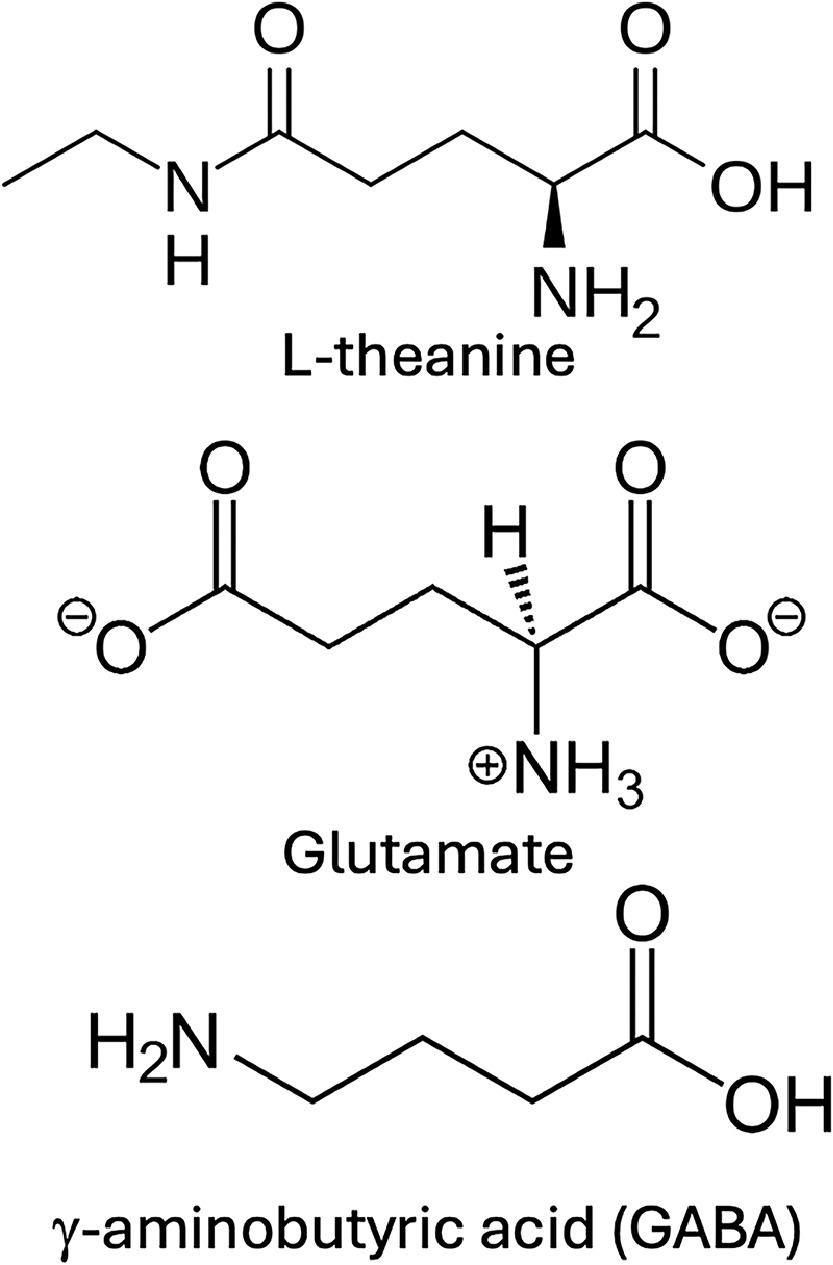
Structural comparison of L-theanine, glutamate, and GABA. L-theanine shares key structural features with glutamate, the brain’s primary excitatory neurotransmitter. GABA is shown for contrast. From: R. Dashwood, F. Visioli, Nutr. Res. 134 (2025) 39–48. Licensed under CC BY 4.0
That combination of direct brain access and molecular mimicry is foundational to the cognitive benefits of theanine, especially around focus and attention.
What Are the Best Sources of L-Theanine?
Tea.
That’s it. That’s the whole list.
A standard cup of green tea gives you 6–20 mg of L-theanine [4].
Tea constantly shows up in population studies linked to better health.
In a Japanese cohort of more than 12,000 older adults followed for six years, those who drank seven or more cups a day had a 66% lower risk of all-cause mortality and an 81% lower risk of cardiovascular death [5].
And tea also stands out when you zoom in on cognitive performance.
In a community study from Singapore, older adults completed a full neuropsychological battery — memory, executive function, processing speed. Regular tea drinkers scored higher across every domain, even after adjusting for age, education, health, and lifestyle factors [6].
Notably, coffee did not show the same cognitive advantage.
That suggests that the cognitive benefits of tea extend beyond caffeine, and instead from compounds that coffee lacks. Including, perhaps, l-theanine.
What Does L-theanine Do?
Once theanine crosses into the brain, it doesn’t just flip one switch. It tunes multiple systems that determine how clearly you process information and how long you can stay locked in.
1. It quiets the background. (GABA)
One of the first things that theanine does is raise GABA, the inhibitory neurotransmitter that keeps cortical activity from devolving into static [7].
GABA is often characterized as “calming,” but that is an oversimplification. Its real function is signal clarity [8]. When GABA tone is low, neural signals blur and the brain reacts to every stray input. When GABA activity rises in the circuits doing the work, incoming information separates more cleanly from background noise.
Human imaging studies back this up [9]. People with naturally higher GABA levels in task-relevant regions show sharper discrimination and better filtering of irrelevant inputs.
Theanine pushes the system in that direction.
2. It makes effort feel worthwhile. (Dopamine)
Theanine also shifts the motivational tone of the system.
In the striatum, GABA normally keeps dopamine neurons tightly regulated. When theanine nudges GABA upward, it eases that restraint, allowing dopamine neurons to fire more freely [3].
You can see this in rodent work: once theanine reaches the striatum, dopamine release jumps to nearly 300% of baseline [3].
Dopamine is what tells your brain, “Stay with this. Keep going.”
With the noise reduced and motivation elevated, the system shifts toward sustained engagement rather than drifting toward easier distractions.*
3. It restores contrast in the signals that matter. (Glutamate)
Selective attention — the ability to lock onto the right thing and ignore the rest — runs on glutamate, the brain’s main excitatory driver [10].
Under stress or sleep loss, glutamate fires too broadly. Circuits lose their priorities and attention widens instead of narrows.
Theanine is chemically built to counter that tendency.
Its structure is similar enough to glutamate to dock at glutamate receptors, but not similar enough to activate them fully [11]. Functionally, it works as a glutamate decoy.
With theanine present, excessive excitatory spikes are dampened [12]. The brain stays awake, but the noise floor drops. This is the backbone of precise attention: not more stimulation, but clearer contrast between signal and noise.
Together, these shifts create the conditions for deeper focus, something that caffeine alone cannot deliver.
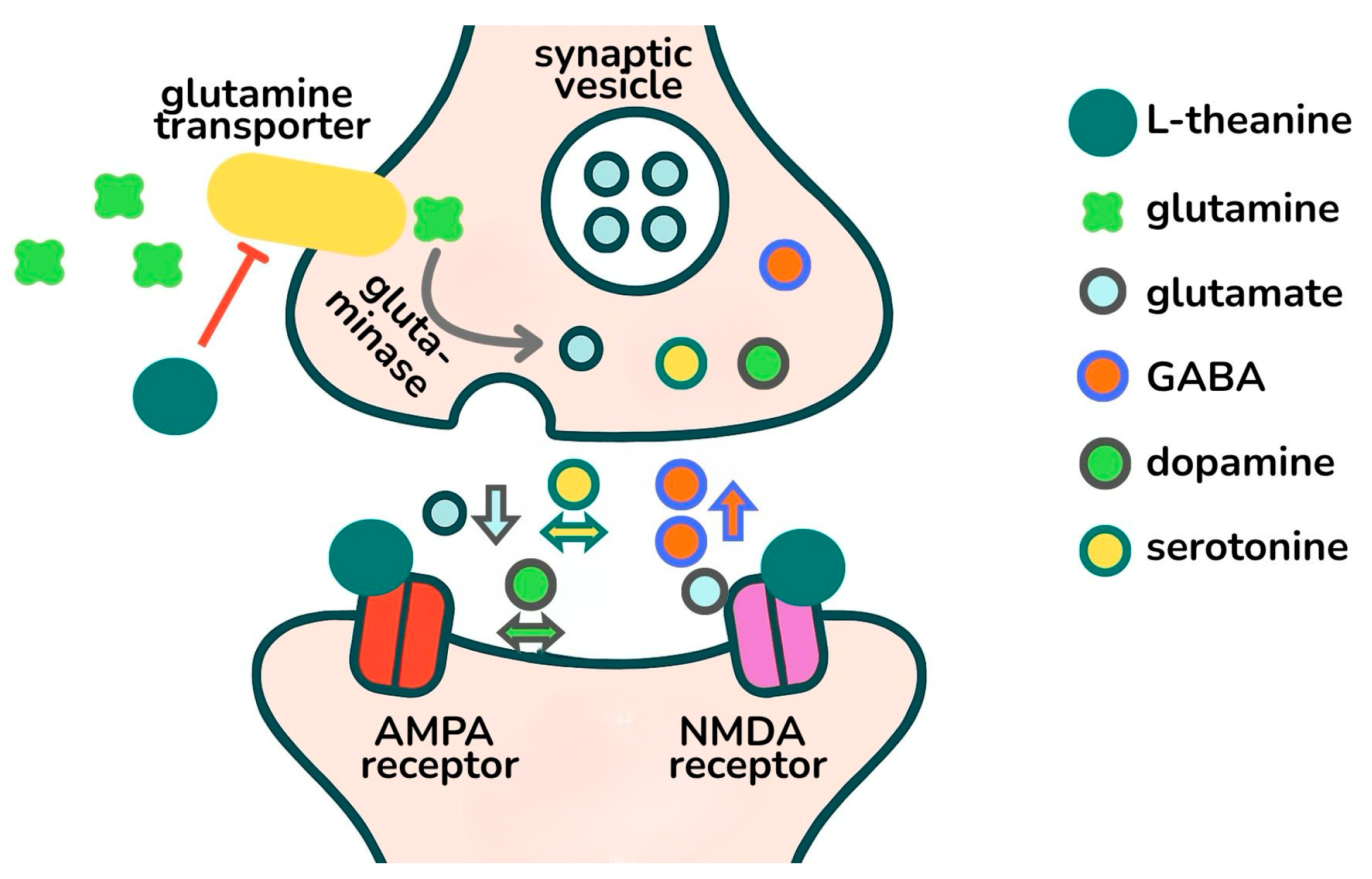
How L-theanine reshapes neural signaling to support focused attention. By tempering glutamate-driven excitation at AMPA and NMDA receptors and indirectly shifting GABA and dopamine tone, L-theanine reduces background noise while preserving alertness and motivation. From: R.O. Mátyus, Z. Szikora, D. Bodó, B. Vargáné Szabó, É. Csupor, D. Csupor, B. Tóth, J. Clin. Med. 14 (2025) 7710. Licensed under CC BY 4.0
How L-theanine Enhances Effects of Caffeine
Most people try to fix attention lapses with more caffeine. It helps…to a point. But the layers of attention that determine accuracy need something else.
Your brain tracks wakefulness with adenosine. As the day wears on and you burn ATP, adenosine accumulates and docks on its receptors, gradually applying the brakes [13].
Caffeine works because it quite literally impersonates adenosine.
Its molecular structure is close enough that adenosine receptors accept it. But when caffeine docks, it doesn’t activate anything [14]. It just blocks the receptor, like someone parking in your reserved spot with a fake permit. With those receptors jammed, adenosine can no longer transmit the “slow down” signal. Neurons fire more freely, and you feel more awake [15].
But “more awake” isn’t the same thing as more accurate [16].
Caffeine is excellent at making you faster. On simple reaction-time tasks — hit a button, detect a light — it reliably improves performance. The trouble shows up the moment a task requires selectivity instead of raw speed.
One of the best demonstrations comes from the Stroop task. You’ve seen it before: the word BLUE is printed in red ink, and you have to say the color, not the word.
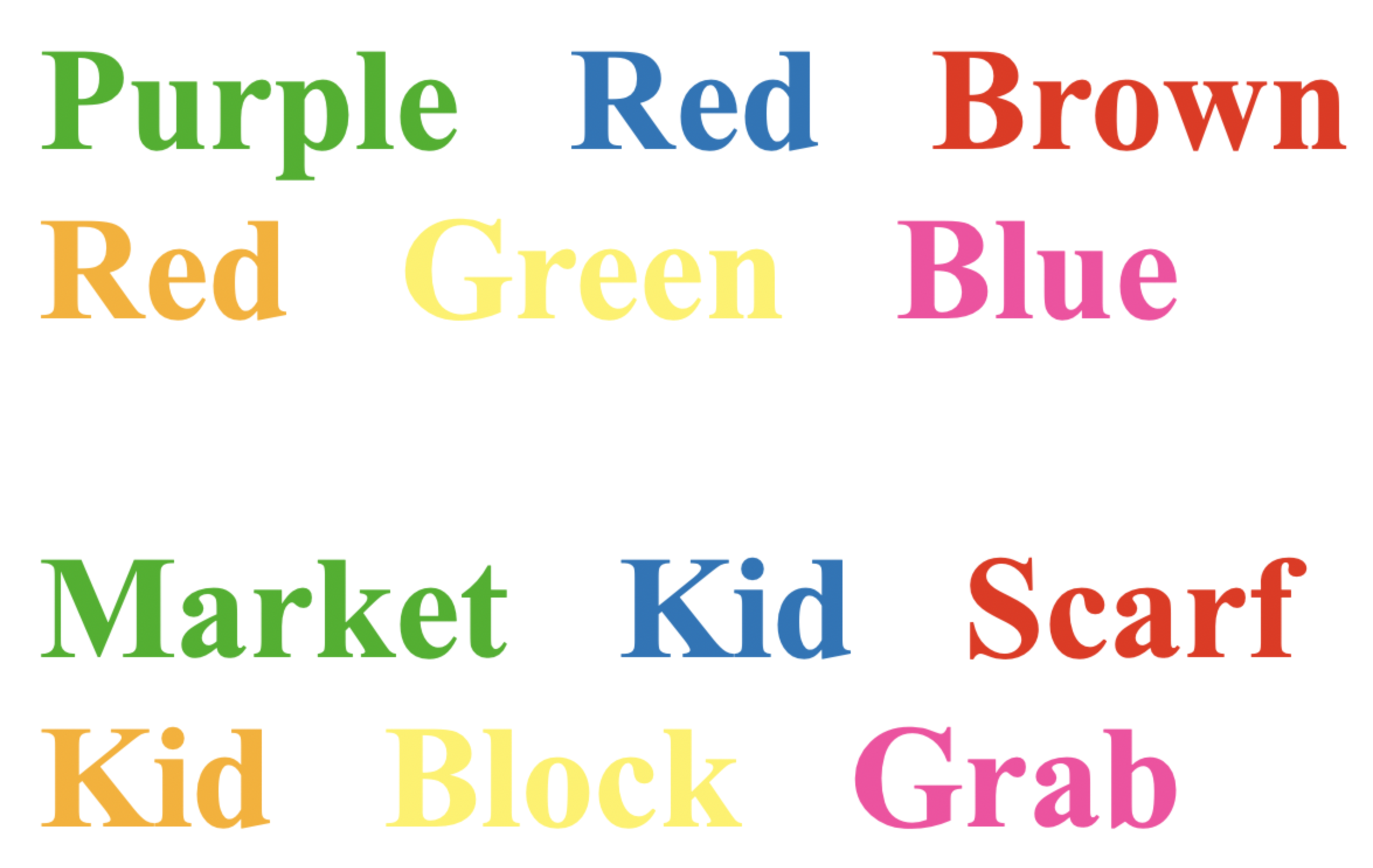
The Stroop task. Participants must name the color of the ink, not read the word itself — a test of selective attention, cognitive control, and resistance to distraction. Licensed under CC0 1.0 Universal
Here, the limits of caffeine start to show.
At higher doses — the range many people reach for when they’re tired — caffeine can actually slow reaction time and increase errors compared to placebo [17]!
In short, caffeine turns up the volume of neural activity, but it doesn’t help the brain decide what deserves attention.
And that bottleneck is exactly where theanine begins to matter.
L-Theanine Benefits Under Cognitive Stress
To test whether a combination of L-theanine and caffeine can sharpen selective attention, researchers engineered the one condition guaranteed to break it: sleep deprivation [18].
Healthy young adults showed up at the lab after staying awake for 20 hours straight. Ideal candidates for an attention rescue mission. Each person completed a total of four lab sessions, each one with a different treatment:
Placebo
L-theanine (200 mg)
Caffeine (160 mg)
Theanine (200 mg) + caffeine (160 mg)
After swallowing their assigned drink, participants waited one hour — long enough for both compounds to reliably peak.
Then, the testing began.
First came the behavioral test: a rapid-fire visual attention drill designed to punish even mild lapses in focus.
Then came the neural test: EEG recordings of P3b, the electrical signal that reveals when your brain has detected a meaningful stimulus and started allocating attention to it.
L-Theanine Benefits for Focus and Reaction Time
After 20 hours awake, the participants were operating on mental fumes.
The theanine–caffeine combination didn’t fully erase the effects of sleep loss — nothing can do that — but it consistently pushed performance back in the right direction. Across nearly every measure, the combination outperformed the individual ingredients, and often by a wide margin.
Faster Reaction Time With L-Theanine + Caffeine
The first improvement showed up in speed.
After taking theanine + caffeine, participants responded about 52 milliseconds faster than before. Placebo shaved off just 14 milliseconds, which is pretty much the kind of improvement you'd expect simply from repeating the task.
That translates to a 38-millisecond reaction time advantage with theanine + caffeine.
It doesn’t sound like much, but it matters.
At highway speeds, 40 milliseconds is four feet of stopping distance. In sports, it’s the difference between making the play or missing it.
And in the brain, where perceptual processing runs in 20–40 ms cycles, reacting 40 ms faster means you’re effectively operating one “brain frame” ahead.

Reaction time after theanine + caffeine relative to placebo. From: G.S. Nawarathna, D.I. Ariyasinghe, T.L. Dassanayake, Br. J. Nutr. 134 (2025) 195–204. Licensed under CC BY 4.0
L-Theanine Benefits for Accuracy and Signal Detection
Speed wasn’t the only thing that improved. The combination also made participants more accurate.
Participants got better at distinguishing real targets from look-alikes. Their hit rate rose — but the more important change was in A′, a metric that captures signal-versus-noise discrimination.
In this context, A′ is the difference between “I’m basically guessing” versus “I know exactly what I’m looking for.”
And only the combination improved it. Neither caffeine alone nor theanine alone made people more accurate.
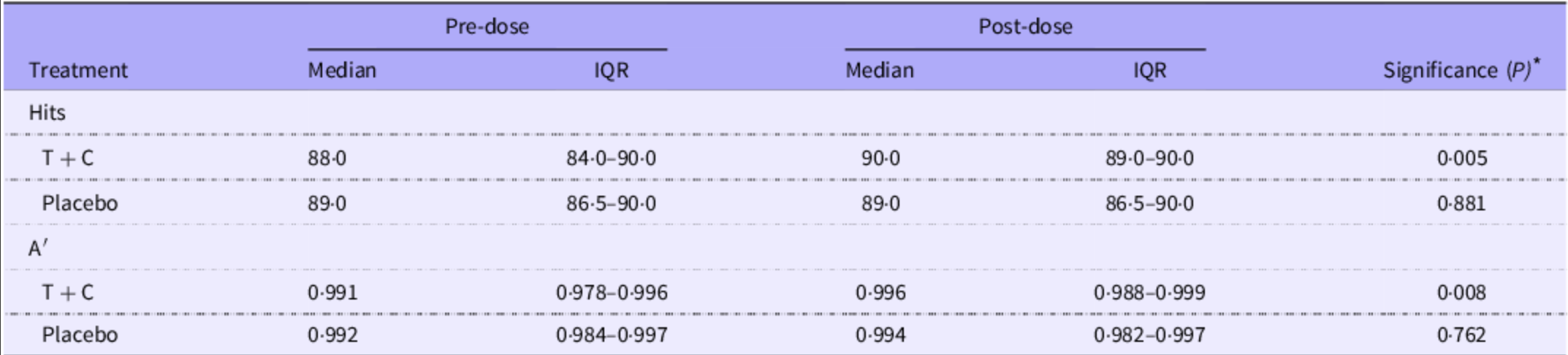
Accuracy and signal detection outcomes following theanine + caffeine compared with placebo. From: G.S. Nawarathna, D.I. Ariyasinghe, T.L. Dassanayake, Br. J. Nutr. 134 (2025) 195–204. Licensed under CC BY 4.0
Neural Evidence of L-Theanine’s Cognitive Benefits
The behavioral data told part of the story. EEG filled in the rest.
With theanine + caffeine, the brain didn’t just work faster, it worked smarter.
The key signal was P3b, which appears when the brain recognizes something meaningful and begins evaluating it. In healthy adults, P3b typically peaks around 300–350 ms after a stimulus [19].
With the combination, P3b peaked 30–35 ms earlier — roughly a 10% acceleration in the brain’s decision-making timeline. In neural terms, that’s huge. It means the brain started evaluating information earlier in the processing stream, as if an internal step had been moved forward.
The researchers also looked at P3b amplitude, which reflects how much mental effort the brain devotes to a target once it detects it.
P3b amplitude rose by 1.5–2.0 microvolts, a meaningful jump showing that more attentional resources were being deployed to each target. This is the difference between “I noticed that” versus “I am actively working on that.”
And again, neither caffeine alone nor theanine alone produced these neural shifts. Only the combination created a brain state that was both earlier to engage and deeper in its processing.
What stands out here is not just that the brain worked faster or more accurately. It committed sooner.
And that difference matters outside the lab.
When attention locks in earlier, the rest of your day unfolds differently. You spend less time re-reading, second-guessing, or undoing decisions made under partial focus. Those minutes might seem trivial in isolation. But over time, they’re the difference between steady progress and constant friction.
Frequently Asked Questions
When should I take L-theanine?
L-theanine kicks in pretty fast.
Blood levels peak about 45–60 minutes after you take l-theanine, and that’s exactly when cognitive effects tend to show up [20].
In a controlled trial, a single 100 mg dose of l-theanine improved selective attention and reduced working memory errors within that first hour. But long-term use doesn’t appear to “build up” benefits. After 12 weeks of daily L-theanine, researchers saw no shift in baseline cognition or brain biomarkers [21].
Bottom line: L-theanine works best as an on-demand tool taken 45–60 minutes before a cognitively demanding task. It enhances acute performance, not long-term cognitive capacity.
How much L-theanine in green tea?
One cup of green tea gives you about 6–20 mg of L-theanine.
Shaded Japanese teas, like gyokuro or matcha, are the outliers. They can contain two to four times more l-theanine because shading prevents the leaf from converting theanine into catechins [22].
Outside of tea, the food supply is basically barren. The one odd exception is the bay bolete mushroom, which contains roughly 20–25 mg per 100 g fresh [23]. Everything else is a trace amount at best.
Can I get enough L-theanine from tea?
Not if you’re trying to match what’s used in cognitive research.
Most controlled studies use 100–200 mg of pure L-theanine. To reliably match that with beverages, you would need 9-15 cups of tea per day.
If you love tea, great — you’ll get some L-theanine. But if you’re aiming for the doses that actually move the needle in attention studies, supplementation is the only reliable route.
Does L-theanine make you sleepy?
No. L-theanine does not act like a sedative. What it does increase is alpha-wave activity — the EEG signature of calm focus [24].
Even in the sleep-deprived participants in the study we discussed earlier, L-theanine didn’t slow them down or make them drowsy. At doses used for cognitive performance, it facilitates sustained attention during mentally demanding tasks [25].*
This is also why L-theanine fits so naturally with caffeine: one smooths the noise, the other boosts the signal.
How much L-theanine per day?
Human studies point to a clear sweet spot.
Cognitive benefits — faster reaction time, sharper selective attention, better working memory — reliably show up in the 100–200 mg range.
In one meta-analysis, 200 mg stood out as the dose that delivered the most consistent improvements, especially on attention-heavy tasks [26]. Lower doses rarely move the needle, and higher doses don’t add anything meaningful.
If you’re taking L-theanine specifically for focus, 200 mg is the most evidence-backed dose, particularly when paired with caffeine.
What is the ideal L-theanine and caffeine ratio for attention?
Across human studies, the most reliable improvements in attention come from a higher dose of L-theanine paired with a moderate dose of caffeine — roughly a 2:1 ratio [24, 27].
Across trials, ~200 mg of L-theanine reliably supports selective attention, while 80–120 mg of caffeine boosts alertness without increasing distraction [28]. Together, that 2:1 balance creates the clearest gains in focus.*
And that’s exactly why Qualia Mind pairs L-theanine and caffeine in that ratio.
Your best work doesn’t come from pushing harder. It comes from sustained clarity, the kind that L-theanine supports by reducing noise instead of forcing stimulation.
Qualia Mind supports the mental energy and focus that allow your best self to show up — not just once, but over the long arc of your life.*
*These statements have not been evaluated by the Food and Drug Administration. This product is not intended to diagnose, treat, cure, or prevent any disease.