 Written by
Even though we lose our peak form as we get older, there is no stopping us from doing everything we can to extend it. We do not strive to be immortal, but we simply want to get the most out of our time and make our later years more worthwhile. Dr. Dan Pardi joins the Kyle Kingsbury Podcast to share his expertise about human optimization through holistic health approaches. He discusses the importance of sleep, the role of stem cells and senescence in aging, and the benefits of taking various phytochemicals. Dr. Dan also talks about his work at Qualia, where they develop products designed to enhance healthspan amid the rapid changes of the modern world.
---
Listen to the podcast here
Advanced Stem Cell Supplements For Longevity
Welcome back to our show. We have Dr. Dan Pardi in the house. I’ve actually known Dan for a while now. I’ve been coaching his sons at Gracie Jiu-Jitsu. He had a lot of the same friends in the same arenas of health, wellness, and optimization. He was hired with the boys and girls at Qualia to do some cool stuff. I’m like, “We’ve got to get on the show.” I’ve had James Schmachtenberger on this show more than once, who was one of the founders of Qualia.
These guys famously created one of the best nootropics ever. They’re doing some cool things now. We talk about all things longevity, sleep, stem cells, and how to clear senescent cells and rejuvenate the body, not to necessarily extend life, but to make sure that our lives are optimal until we die. One big difference I have from the Ray Kurzweil and some of the transhumanists out there is that I do want to optimize, and I’ll use science to do it.
I’ll even use some technology to do it. That’s not in an effort to stay alive for 150 years or to become immortal. It’s simply to get the most out of my time here. A lot of people resonate with that. Share this far and wide. Leave us a five-star rating with one or two ways the show’s helped you out in life. Support our sponsors. Without further ado, my brother, Dr. Dan Pardi.
This is awesome. I’ve been so stoked to have you on. I was stoked when you got the job in the first place because I remember you coming in, and you’re like, “Do you know the Neurohacker guys?” I was like, “Yes, Dan Stickler, Schmachtenberger, and all the guys. That’s so cool.”
I met them back in 2016. They had just gotten started. I met Vanessa Hall and a guy, Darrell. They were two of the founding team. It was at this transhumanist conference that I did not go to, but there was an after-party with Wim Hof, Huberman, and others.
Transhumanist is a futurist or Yuval Noah Harari kind of deal, where we’re going to become the Borg.
Yes, a little bit of that. It is about all those ideas about the human digital interface and where it’s going to go. It seemed interesting, although it’s not totally my jam, but anyhow, I ended up meeting them. There were a lot of cool people at the party, but we just hit it off right away. That then led to Daniel Schmachtenberger coming onto my show. I interviewed him about nootropics. He had me on to talk about sleep for a few episodes. We got to know each other well and stayed in touch over the years. When they had new products, they would send them to me and check in. “How do you like it?”

James was in town and said, “We've grown a lot. We'd love for you to be our spokesperson.” I said, “That sounds interesting. I would love to do that, but why don’t we talk about something even more substantial?” I’m now their Chief Health Officer. I work with marketing a lot, which is trying to get a message out to people about what we do. I am interested in how we help with our messaging and with our content development, and educate people on the therapeutic areas that we work on, the products, but also what healthspan is and how we can address it in a way that’s effective. Where is the state of the union right now in that space? All of those things I’m interested in. It was a perfect fit.
Looking Back To Dr. Dan’s Personal And Professional Journey
I want to dive right into that. That’ll be the meat and potatoes of the show, but as I do with anybody, I want to know their personal background. Where did you grow up? What was life like? What was your education? What drew you into the space of human optimization and the betterment of man?
Isn’t it always interesting to know why people get into this space? We all have our different stories. I was an athlete growing up. I played soccer and basketball. I got injured. In a way, it was a gift because from a very early age, when we take that supreme health for granted, you don’t even have to think about it. I started to think, “How do I heal myself so I can get back into doing what I love?” That then led to me becoming the default performance coach for my team. My teammates would come to me to ask questions about supplements and training techniques, and I loved it. I would read about all that stuff all the time.
From there, that was the origin. When I think back, that’s probably where it all started. I went on to college. I went to USF. I didn’t know what to study and take, so I did a double major, double minor, all sports medicine, Exercise Physiology, just taking everything I could to try to see what hooked me the most. That led me to do a master’s in Exercise Physiology at Florida State. I went across the country because they had the only program in the country that was both Exercise Physiology and Sports Nutrition. I knew I wanted to do both.
Were you in the Bay Area before then? Why did you choose USF? What type of school did you get into?
I grew up in Marin County in Nevada, which is a little sleepy town. Most people think of Marin, they’re thinking of Sausalito, Tiburon, Mill Valley, and these bougie areas. Nevada is very blue-collar. It’s right between Napa Valley and Marin. It was a great upbringing. My mom and dad divorced when I was young. They stayed good friends. I was raised with this interesting mix. My dad was pretty successful, not crazy successful, but he was doing well. My mom struggled a bit. She had some Hallmark stores.
They went out of business when the mall that she was in decided to go from this beautiful outdoor space to creating a cover. She had no business for a year. I had this weird mixture of having resources, but also having scarcity. I had a sick sister, too. She was in the hospital thirteen times in a two-year period when she was thirteen or fourteen with asthma. It was always urgent. I remember being in the hospital until 2:00 or 3:00 in the morning, seemingly like every other weekend. It was a great upbringing. I had a great relationship with my mom and dad.
After I graduated with my master’s, I went to work at UCSF’s Preventive Medicine Research Institute. We were looking at how a multifactorial lifestyle program could influence the progression of prostate cancer. It was cool, diet and relationship counseling. These people would come in. A lot of men, when they quit their jobs, haven’t kept up with friends. Their friends and the relationships they had were through work. All of a sudden, they leave their job, and the only relationship they have is with their spouse, if they have one. If there are any stress or challenges with communication, that’s going to affect the internal milieu, which can certainly affect the progression of the disease.
The job loss in and of itself is going to create a pressure cooker at home.
All of a sudden, you’re spending a lot more time with this person. There is meditation and exercise physiology. It was a cool experience. Once a week, over 100 prostate cancer patients would come. They would have a seven-hour intervention where they would learn to cook. They would have relationship counseling, learn to meditate, talk about their exercise, and develop a program for the next week. It made a profound impact on me because if you think about how a lot of research is conducted, it’s reductionist. We try to limit all of the factors so that we can understand how one thing is having an impact on the thing that we care about.

I get it. The reason we do that is so that we have controls and we understand. Does this thing impact whatever outcome we’re looking at? You have to do it that way. Otherwise, there’s a lot of uncertainty. Ultimately, though, what we care about is how we tie together all the things that we know work to get the greatest outcome that we can for the patient. That type of work is not done. Unfortunately, Dr. Dean Ornish’s work was criticized. We’re like, “How do you know it’s working?” At some point, you have to say, “I don’t care what's working. What I care about is that these people are doing better than anyone else we’re seeing with just single interventions.
That made a big impact on how I thought about the world. After that, I worked in a genomic company, which was cool work. We’re in the race to try to mine the human genome for the first time. We had these very high-tech clustering alignment tools that were sequencing the genome and figuring it out. We were trying to create products for the pharmaceutical industry so they could make more targeted meds. All 33 companies in the space went out of business. All the talent was brought up into pharmaceutical companies. I made that jump. I worked for a company, Orphan Medical, which was a great experience. They were working with rare disorders. Two hundred thousand people or fewer have it.
That’s typically not a big enough population for a pharmaceutical company to say, “We’re not going to get the financial remuneration to invest in this.” There are special programs from the FDA that say, “These people still need help. Let’s see if we can expedite the development process. Can we give some additional funding to help these people in need?”I knew nothing about narcolepsy. I knew nothing about sleep. I knew very little about GHB, but that was the drug.
Let's go. This is great. If this is a part of the conversation, this is great.
Falling In Love With Sleep And How To Do It Right
Isn't that fascinating? I stayed there for about a decade. I do not think I would have stayed in one place for that long if it weren't so interesting. All of it. I fell in love with sleep. At the time, there was one group of people saying, “We cannot launch GHB into the world as a pharmaceutical. It’s going to turn into another OxyContin.” There were definitely advocates who were trying to suppress its development. On the other side, you had narcoleptics who are saying, “I have had friends who have had a cataplectic attack,” which is a symptom of narcolepsy where you lose muscle control in response to emotion. While telling a joke, all of a sudden, you go paralyzed.
They are telling emotional stories where friends would fall downstairs and die because they had hit their head, or of having to avoid emotional contact, like a grandfather seeing their nephew or their niece and not wanting to pick them up because they don’t want to fall over. They’re telling these emotional stories about how this medication, which is how they viewed it, was more helpful than anything else that was available.
It’s the only one that works, correct? At the time, at least, it was the only thing that worked. I fell in love with GHB in college, not for nefarious purposes, because it can be used nefariously, but for the fact that I was looking for better ways to get high. Alcohol would destroy my cardio and my muscle gains. I’m trying to put on as much muscle as I can playing football at ASU. I learned Valium doesn’t have many negative effects on the body.
It always has a bit of addictive qualities and other negative effects. GHB was used by bodybuilders as well because, uniquely, both these two compounds would put you into a deeper sleep. There’s no real sleep medication out there that puts you into actual sleep. That’s the big fault of Ambien and all these other things. I’d love to dive into that with you. You’re not actually sleeping there.
It’s a pseudo-sleep, just like when you pass out when you’re drunk. It’s not the real deal. GHB puts you in such a deep sleep that you get a huge dump of natural growth hormone, which increases recovery, recycling the brain tissue, and all that. The quality of sleep improves as such that you actually don’t even have to do eight hours to get a good, full night’s sleep with a product like GHB. Is that correct?
Yes. That is the unique aspect of this very simple short-chain fatty acid. In fact, what’s popular now is beta-hydroxybutyrate and gamma-hydroxybutyrate. They are similar molecules. There are just a few carbon differences between the two. They have different effects, but they also have some overlapping effects. You’re right. You used to be able to buy this GHB off the shelf at GNC. It was touted as a growth hormone promoter and sleep facilitator.

When you take any of the Z drugs, which they call the non-benzodiazepine drugs, they will help you fall asleep a little bit sooner, not that much sooner. They will suppress the amount of deep sleep that you get. We go through different stages of sleep over the night. We have various stages of non-REM, and then we have REM, which is also called paradoxical sleep. It’s also considered the gateway to waking. If you wake up right out of REM, you feel great.
What’s so challenging about addressing sleep from either a pharmaceutical or supplement is that we’re dealing with such distinct stages as you go through the night. During the day, you want to be awake, so you want to facilitate that state. You’re alert. You’re sharp. You have enough central nervous system arousal where you can then do all sorts of cognitive activities, like alertness. Alertness means being able to stay aware of your surroundings so that you can monitor for something that's happening.
People who have ADHD have trouble with that. Their tired mind cannot filter out all the information that’s coming in their perceptual field, so they’re over-responsive to information that’s coming into them. They are reactive. They’re hyperactive because their tired mind is overreacting to too many things. They have a very difficult time with impulse control. During the day, we want to create this unified state that helps you perform well in cognitive, task-oriented activities.
At night, slow-wave sleep and REM sleep are almost very different in terms of their neurochemistry. What you see is that when you promote one, it’s usually at the expense of the other. That’s challenging. What’s unique about GHB is that with all the Z-drugs, they will put you to sleep, but you’ll get into stage one or two, and you will not get very much slow-wave sleep. It suppresses slow-wave sleep. It is during those times, like you said, that you will release growth hormone. It’s the most restorative aspect of sleep. Because of these deep, slow-wave sleeps, your brain is synchronized to these rhythms. It’s an active process, even though we think of it as this quiescent process.
There are parts of the brain that are more active at night than they are at any time during a 24-hour period. Slow-wave sleep is important for growth and repair, and GHB will facilitate it. In narcoleptics, they would get about five times more slow-wave sleep than they would. As a result, their daytime quality of alertness and wakefulness was better than on 120 milligrams of dextroamphetamine the next day. You know that. A stimulant does not replace the need for good sleep. You’re taking these sleepy people. You’re stimulating them. It works for a couple of days.
No narcotic will power you out of a bad night’s sleep, especially when it’s chronic.
That’s right. It’s a temporary patch. Ultimately, it can facilitate an even worse problem. GHB is very special. In narcolepsy, it solves all sorts of problems. They have deeper, better sleep. They have a better quality of wakefulness the next day. They also have the suppression of that other symptom, where you have the bilateral loss of muscle tone that causes the paralysis. You see a bunch of animals in nature that express cataplexy. We see it in almost every domesticated species.
What Happens When You Get Narcolepsy
I wonder if that’s a fight-flight-freeze, or if it has to do with the nervous system overload, because if you’re not actually sleeping, and that's chronic, you have no nervous system repair. Our anabolic time is nighttime. If that’s deterred, then you’re 23 hours of catabolism. That would be a real issue for the nervous system. It would make sense that something seemingly small could throw someone over.
Narcolepsy is a loss of neurons in the brain called hypocretin neurons. You’ll also see it written as orexin, because two labs discovered the same area of the brain within six weeks apart. In perpetuity from now on, every paper either has to refer to hypocretin, also known as orexin, or orexin, also known as hypocretin. That is a special part of the nervous system. It’s in the hypothalamus, which overall has only 400,000 neurons. The way to think of hypocretin neurons is like a symphony conductor. They are telling other parts of your wake network when to be on.
They’ll communicate directly with the dorsal raphe, where you have serotonergic neurons, and with the pedunculopontine neurons, where you have dopaminergic neurons. All of our different neurotransmitter systems have specific areas that they come from. They emanate through pathways to the rest of the brain to keep it awake. There is the locus coeruleus, which is part of your norepinephrine. Hypocretin is saying, “It’s daytime. Be on. Play.” At night, that goes quiet. All those awake neurons quiet down. The sleep processes are allowed to occur. Narcoleptics, probably through autoimmunity, have their body attack those neurons, and so they’re missing.

You’re deleting receptor sites, in a sense.
Yes, those neurons become ablated because the body attacks them, thinking that they’re foreign. We don’t exactly know why. Emmanuel Mignot had been hunting this down for twenty years. He’s at Stanford. They finally felt that they had enough conclusive evidence to say that this is indeed an autoimmune issue. At the time when I was working in this space, there was a 10 to 13-year delay in the onset of symptoms with diagnoses.
There was no smoking gun. You couldn’t tell what was going on. All you knew was that this person now had this neurological condition. That was a fascinating bit of work. While I was there, I learned a lot about sleep, too, which is, by itself, super interesting stuff. I decided to go on and do my PhD. I did it at Leiden University, one of the oldest universities in the world, and then at Stanford. I had two people at Stanford and two people in the Netherlands who were my mentors. It was an incredible crew. They were so supportive.
I knew from the beginning that I didn’t want to become a sleep researcher. I knew I wanted to go back and work in public health, hearkening back to my time with Dean Ornish and thinking about how we actually get people to adopt and sustain health practices for all the different determinants of health that you talk about and know of. How do we get people to adjust their pattern of living in a way that is going to help support their own health over the course of a lifetime? That is what inspired me, but I also had specific sleep questions that I wanted to get into.
I’m like, “I’m going to use this to sharpen my writing skills and my analytical skills.” The first six months of my program, my professors were very supportive. I said, “If I’m ultimately going to try to affect human behavior, I need to understand it.” I dissected several well-known behavior models, and then I built up my own behavior model called the Loop Model to sustain health behaviors. It’s very simple. The idea is, for us to pick up a new idea and make it a part of our life, we should know why we’re doing it, how to do it, if we’re doing it, and if it’s working.
You can see that those four discrete buckets are all mutually reinforcing, but a person can’t understand if they’re doing the behavior or not just by giving them more information about why they should do it. They're all independent. A behavior model can describe why behavior changes. It can predict when we think behavior will change, or it can serve as a model. This model that I created became the basis of my work in humanOS.
Writing A Book And Putting Everything In His Children
I was trying to use that idea to operationalize, almost like a digital health coach, to then get people more aware. The more that we live in a modern environment, askew from the natural setting, we have to learn about why these things are helpful, so we can figure out sometimes strange ways, like a red light machine, because we're not out in the sun enough, to fulfill those requirements that keep our body working closer to our peak. That has been an interest of mine for a long time. I started to work on a book a couple of years ago, which I'm about 15 out of 25 chapters into now.
I got to have you back on when it's done.
Thank you. It’s a book on health. There are so many different health books out there. This is a book about understanding what health is. I’m offering a new definition. I’m going to talk about what human health means and a bit about evolution. How does health work as a complex network? What does health look like in society? What does our healthcare system look like? What should it look like? The whole idea is to, within maybe 3,000 words per chapter, unlock some of these valuable ideas that are behind either jargon or complexity, so that they’re very intuitive. You’re like, “I get that.” Every chapter starts with a story that illustrates that concept, where you’re like, “I totally get that.” I talk a little bit about the science. That is the arc of the book. I love working on it. It's fun.
That’s rad. Great job on it. I know how hard it is to write a book. You’ve got three awesome kids. Jamie Wheal wrote Stealing Fire with Kotler. He said he easily could have done it himself, but he had his two kids. He waited for Recapture the Rapture until he was an empty nester, and then he put that out, knowing how much effort that was going to take. That’s awesome that you’re putting all that work in with three little ones.
I appreciate that. I get so much joy from just being around my kids, but I joke, too. I’ll wake up on a Saturday morning, and I’ve got so much energy for them. It’s like, “Dad, look at this! Watch this! Look at this!” They can’t do anything without you having to watch them, as you know. By the afternoon, I’m like, “I need twenty minutes by myself.” I love the enthusiasm to involve you in what they’re doing. With children, the more you put in, the easier it is.
The longer that relationship stays that way. As old people say, “Enjoy it now. When they’re teenagers, they’re not going to care about you.” Maybe not. Maybe we’ll still have a good parent-child bond, and the attachment will still be there. Have you checked out Hold On to Your Kids by Gabor Maté and his son?
No.
It’s a good one, but he talks about the lack of parent-child attachment as what’s leading to peer-to-peer attachment. We see where that can go wrong in gangs or other things like that, but even to a lesser scale. Are you familiar with Leonard Sax?
Yes.
He’s great. He has a PhD in Psychology. He is a family medicine doctor. He has written a ton of books, The Collapse of Parenting being one of my favorites. He talks about that on a lower scale. You end up getting this peer-to-peer attachment, but the child knows inherently that it’s a fragile relationship. There’s no blood bond. There’s no familial bond, and so they behave differently. They don’t have a radical honesty with each other because they’re always nervous. “Becky could just cut me out, and then I’m done.”
That's something your kid would know. “I can talk about all kinds of things to my dad. He’s still going to love me.” He should hopefully know that. Hopefully, they don’t talk all kinds of things to you. That’s there because there’s a safety net of, “I’m never going to leave you. You’re mine. I love you forever. There’s nothing you can do that’ll change that.” As I think about that stuff, most people living in the modern world would say, “Enjoy it while it lasts.” I feel like it’s going to last. That is just a matter of how we work together, going through those things together, through that upbringing.
I feel the same. I give them a lot of respect. I try to guide them. I try to be somebody that they want to come to, versus someone who just tells them what to do. I’ve got a challenge in my life, or I’m working on this problem. There are times when, for their own safety or whatever, you have to step in and be a little more authoritative in what you expect from them in a moment. I reward them for doing it. My mom had an interesting style. She would reward me for being a good kid, and then she was harsh as hell if I did anything wrong.
She made being not a good kid painful, and doing the right thing the obvious choice. She also spoke to me in an interesting way. If my room were messy, she wouldn't say, “You’re a messy kid.” She said, “That’s unlike you. You’re such a clean kid. Your room is not looking like it would for such a clean child.” She always spoke to me in that positive way about who I was, even though I wasn’t being so in the moment. I was like, “I need to live into my identity and clean my room.”
Difference Between GHB And BHP
That’s great. I like that tactic. That’s a good one. You’ve mentioned a few things here, some of which are smaller. I want to tease out. First thing on my mind is GHB versus BHB. It’s a cool little rabbit hole we can break down quickly. I want to dive into some of the bigger schematics around Ornish and stuff like that, where you're at now, especially with NeuroHacker Collective, and trying to see things more holistically. First, let’s dive into this. BHB, beta-hydroxybutyrate, is one of the more commonly known ketone esters that many people are taking.
If you’re taking ketones, you’re likely taking beta-hydroxybutyrate. When this stuff first started coming up for me, it was 2014. I was listening to Tim Ferriss’s podcast. He had Dr. Peter Attia on. This is when Pete was going through his year or two stint with it. Dominic D’Agostino came on, and Dominic is awesome. I’m buddies with both those guys, but he cemented it for me. Retiring from fighting at that time, I was like, “I need to experiment with this if it can help heal the brain.” Having Bayer in 2015, a year after I retired, I remember Dominic D’Agostino saying, “If you’re going to have a lack of sleep, being in a natural ketogenic state can help mitigate some of the issues there.”
To this day, I don’t know why, but if GHB and BHB are similar in that way, that would make sense. I also remember hearing years later that when you’re in a nutritional ketogenic state, the microbiome shifts in a way that produces more gamma. If our gut second brain is producing all of our neurotransmitters, or a big chunk, 70% to 80% of them, then that higher production of gamma-hydroxubutyrate would make sense, why we’re going to get more of that sleepy, relaxed state when we go to bed at night, and maybe improve the quality of our sleep, even if it's lessened.
I’ve spoken with Dominic about that a few times. I don’t have as much experience with it as he does, but few people do. He is a world expert on ketones. There are different chemical formulations of beta-hydroxybutyrate. From his personal experience, he feels that not all versions of beta-hydroxybutyrate have an equivalent effect on sleep. Butyrate, in general, is something that both beta-hydroxybutyrate and gamma-hydroxybutyrate share. That is important for your gut health because butyrate is used by your enterocyte, which is a single cell lining of your intestinal system. It’s their food. It keeps them healthy.
Why You Should Pay More Attention To Your Aging Pace
We have butyrate-producing bacteria in our gut. However, because of the modern diets and things that are impairing, not everybody has the same complement of commensal bacteria, the bacteria that are actually keeping you healthy. Whether you have pathogenic microbes in your gut that are being harbored, they can interfere with your colony. If you did a lot of antibiotics when you were younger, then what you’ll see is a simplification of your gut biome. That will lead to a higher inflammatory state in the body because more things are making it through that protective barrier.
You get the leaky gut issues and inflammation at the sites.
If you think about it, that tube is outside of your body. It is guarding what gets into you and what doesn’t. It’s a weird way to think of it, but it is true. The good news is that when you eat a lot of fiber, if you have the right bacteria, you will start to produce more butyrate. The gut biome will consume that fiber. It’ll poop out butyrate and other short-chain fatty acids, which then have a broad range of health effects on the body.
You’re speaking about the differences of bacteria that are key here. You would get guys like the carnivore doc, Paul Saladino, saying, “You can live fine without fiber,” Shawn Baker, and all these. While that’s true, and it is helpful for some extreme circumstances, like Jordan Peterson’s daughter, who did very well, that is, to me, a form of fasting. It’s not meant to be done your whole life, but it can be a way to heal, in a sense, and then come back to reintroducing these things.
Environmentally, we want to have some degree of these foods coming in that are prebiotic and work in different ways. I’m not a fan of psyllium husk and things like that. Pounding Metamucil before bed just makes me gassy. It doesn’t work right, but if I eat cruciferous vegetables once or twice a week, we all do well. The first test is to see what my poop looks like. If it is solid, looks good, is uniform, and doesn’t smell foul, then I’m on the right track. If it smells like I’m at a truck stop, that’s something my body disagrees with.
This brings up a bigger conversation, but the conversation around what is ideal is challenging because humans are a complex system. What that means is that our bodies are always going to try to respond to the immediate circumstances to do the best job they can, so if you start eating fiber, there will be considerable changes to the gut biome that doesn’t automatically mean that it is going to be a huge problem, given our understanding of the importance of adequate fiber in supporting them because the gut biome itself will change. It’ll start to produce other compounds that ultimately will serve similar purposes, but in a different way.
The whole diet conversation is similar to that as well. You can now see people on a very high-fat diet. They’re about as healthy as one another. Those are diametrically opposed in terms of the thesis by which you would start doing them, yet a person can do comparably well. Going back to the gut biome, the nice thing about butyrate is that you can actually take things like tributyrin, which is a supplemental butyrate form. What you’re always concerned about when you’re doing anything to try to manipulate your own physiology is, are you shutting down your body's ability to do it itself, or is it restorative?
Are you facilitating restorative physiology, where once you actually start to make more butyrate in your gut, then your body starts to make more of it itself? You’re fueling the genesis of more butyrate production in your gut. That’s what we see with tributyrin and other butyrate supplements. If you’re not making a lot, if you feel like you’re having some gut issues, there are a couple of different things we’re dealing with.
Do you have too many pathogenic bacteria? Going back to something I said earlier, you’re more likely to have that if you did a lot of antibiotics when you were younger. You have a simplification of your colony, which means there are fewer species. When you have fewer species, it’s easier for a pathogenic grouping to get a foothold. You have the bad players, and then you have the good players. That’s why people will react quite differently. You take butyrate, and you’re like, “I feel good.” Other people take it, and they start to get gassy.
It’s not easy for a transition, but generally, substances like butyrate not only will affect the enteric lining, but they’ll also get into the body. They’ll affect blood pressure regulation, glucose regulation, and epigenetics. Those have an impact on inflammation through a variety of different types of signaling. I spoke with John Newman at the Buck about this. They are very interested in how butyrate might have a positive impact on how well we age.
He gave me a cool example. Typically, we think about age-related memory decline in humans as though that were an unavoidable part of getting older. He talked about how his mice were on a butyrate-fed diet. They were getting artificial sources of butyrate in their diet. Not only did they not have a decline in their memory, but there was an improvement in their memory across their lifespan, and they lived longer. That sounds amazing. What’s going on there? Was this always a fuel source that we had more present when we were on a more natural diet? Probably. More fasting, higher fiber diets.
Going back to fiber real quick, what we know about fiber is, at least from epidemiology, there seems to be the lowest mortality when you look at fiber’s impact on mortality when you are getting around 40 grams of fiber per day. The average US intake is around 15 grams per day. The recommended intake is closer to 30 or 35 grams, so a little bit above what is recommended. From the Institute of Medicine, we see that these levels have the best association with living longer. It’s both the gut. It’s also the postbiotics and the metabolites that the gut creates.
It is creating that environment. With what you just said there, I’ve already been thinking about the holistic thing. The people who are getting 15 grams a day, the average, are probably eating fast food, TV dinners, and things like that. To get 40 grams of fiber, you have to cook a decent amount or have raw veggies and things like that that are going to complement that. Your plates are always going to look different.
I follow How to Eat, Move, and Be Healthy, Paul Chek. Metabolic typing, Dr. William Wolcott, is a great place for people to start to figure out what their plate should look like. How much of things with eyes should I have? How much fat should I have? How many greens or other things should I have? That’s worked wonders for my family and me. That said, these things over time can start to shift. That’s why it’s important to go back through and see what it looks like.
How do I test? Taking these questionnaires, I’ve done them a dozen times because over the years, I’m a different person now. My body is different. I’ve aged differently. My demand is different. All that influences that as well. In the 40 grams, it’s probably somebody who makes their own meals. I don’t know many places you go out to eat where you’re going to get a good amount of healthy sources.
Potentially, you could even get into the organic versus the inorganic argument of lower income. Going out to eat, you’re going to get glyphosate all over the place, which is going to get rid of the good guys, support the bad guys, and cause leaky gut. You got people making their own food. Hopefully, it's organic. They’re going to get less glyphosate load. It’s one spiraling up, one spiraling down.
You brought up some interesting points that we could go off on some very cool tangents. We should.
I’m in.
To go back to one very quotidian comment around fiber, it takes a long time to eat if you’re sitting down with a bowl of vegetables in the morning or at lunch, like protein. If you want to get an adequate amount of protein, you have to make sure that you’re getting protein at every meal. It’s the same thing with fiber, too. It’s hard to get 40 grams of fiber in one meal, so you have to be thinking about it for all your eating opportunities in the day. It doesn’t fit neatly into modern society because we’re in a rush, we’re trying to get to work, or whatever it is. I always have a lot of empathy for people.
Sometimes, we can put so much expectation on people to do all these things that are healthy. We’re causing a lot of stress. To me, optimization is about calibration. How do you calibrate? Be informed about what we know is healthy. How do you calibrate it to work into your life and not be stressed if you're not like Bryan Johnson, who spends all of his waking moments measuring and tending to his health? It is his hobby. He has the resources to do it. I’m not anti-Bryan Johnson, but nobody should feel like they need to be like him to be taking good care of themselves. If they’re not doing what he’s doing, they’re not doing enough. That’s not true.
How Genes Respond To Novelty Over Multiple Generations
You said some interesting things about how we change over the lifespan. That is incredibly true and more true than most people know. A person who is more of a mentor, Michael Rose, is one of the smartest people I’ve ever spoken with in my life. He’s got 175 IQ. He’s a distinguished professor of evolutionary biology. He retired. He’s probably the top living evolutionary biologist alive. His work looked at how recent forces can act on our genome in a way that makes us more adapted to things that are decades or hundreds of years old, or sometimes even 1,000 years, and not the Darwinian timescale, where you would have to have thousands of generations for that novelty to fully penetrate our genome. What he showed is that he did some work with fruit flies.
When you ever ask the question, it’s like, “How much do fruit flies apply to us?” Don't worry about the details of the diet they’re on. Think about how genes are responding to novelty over the course of multiple generations. Why do we study fruit flies? Two weeks is their lifespan. You can study them a lot. That is a great model to study evolution. What he showed is that the way to extrapolate the knowledge that he generated from his decades of work is the equivalent of what we do very well on an agricultural diet up until the average age of first reproduction in society, after which we start to do a lot better on what he would consider a paleo diet. When you’re young, you do equally well, if not even a little bit better, on an agricultural diet.
How many people have you spoken to? You’re like, “Right around 30 or 35, the same good stuff that I’ve eaten, all of a sudden, I’m starting to get gut issues, or I am getting a skin rash. All of a sudden, the body is not responding the same way as it had.” You’re not even changing your diet. You’ve just changed your age. You’re not doing as well as you were previously. That can throw you off. He argues that once we start, we make it past that average first age of reproduction, which is around 27 to 30. At an increasing rate up until mid-50s, we will do increasingly well on what he calls a modern Trader Joe’s version of the paleo diet.
Things that were healthy before, like grains and legumes, we’re not going to do quite as well with as we were previously. In my model of what health is, it’s not only how resilient and robust you are in the environment you inhabit, but also what age you are. Both of those are going to determine what environment is right for you. When I’m talking about the environment, I’m also talking about the food that you’re eating. As we get older, the closer we live to a natural setting, you’re going to get better feedback. One of the nice things about aging is that when you do things wrong, you will feel it, and when you do things right, you’ll feel it. You’re protected when you’re young. You can act like a jerk, and you’re going to be okay.
I’ve seen young athletes in jiu-jitsu and stuff like that, Gordon Ryan, different people. I’m forgetting the skinny guy. They were eating Big Macs on the competition day. They’re like, “I eat whatever I want. It doesn’t matter.” It’s like, “You’re 22. Talk to me in twenty years and see how that’s working for you.” I ate like a total jerk my whole life. There’s an argument you could make about when genetically modified foods came in and how big a difference that made. Instead of spraying, as Bobby Kennedy talked about that, glyphosate was used at the very beginning of the season to knock down weeds so that corn could get a head start, or we could get a head start.
Once it got the sunlight it needed, that was the only spraying. We’re going to modify the seed so it can take more. We’re getting five or six times that we’re spraying it through the course of his life cycle. If we spray it at the end, that’ll dry it, so we don’t have to worry about losing the harvest. Let’s give it one last good blast of toxins, which will help us make sure we get the maximum return on investment from this. It’s a totally different ballgame. It makes sense. I was talking with my son. I’m going to do a vision quest here. No food and water for four days. I’ve done two five-day water fasts and a bunch of fasting mimicking diets.
I feel like staying in long-term nutritional ketosis is not ancestral. It’s not certainly for me, maybe for the Inuit, but it’s also more of a hassle. I love carbohydrates. If I do once or twice a year a three-day water fast, a five-day water fast, or a five-day fasting mimicking diet, and I optimize metabolism, bring back insulin sensitivity, and all the things that I might take for granted when I’m twenty, my body is able to handle carbohydrates and everything perfectly.
There are different carbs that do better than others based on my personal body, but having a CGM helps you sort through all that. It’s like, “I can eat this. I can eat that.” It makes sense that as we age, we would come into this more ancestral type and need to recycle things. Fasting is such a huge button to push that helps with that, not only from a longevity standpoint, which is super important, but also for the fact that the foods that I’m eating, I’m going to process and deal with better if I have metabolic flexibility at least once a year.
It’s interesting to watch how almost every other health trend, fasting, burst onto the scene and became the next thing that was going to solve our health problems. It fell out of favor. The pendulum swings in an equal way. Usually, when something does have real efficacy, it lands back at the place it should have been in the first place. There’s overhype about it, then people push back on that too much, and then, should we do it?
I’ve played around with fasting mimicking diets myself quite a bit. It’s an interesting experience to see how you do across those couple of days, and your body makes instantaneous adjustments. You start to make more ketones. All of a sudden, you start to feel better. After that, it is how you respond to going back to your normal diet. I’ve also played around with narrowing your eating window. Unfortunately, what the research suggests, which is a little frustrating, is that the better way to diet with a shortened eating window is to have a huge breakfast and then stop eating around 2:00.
I remember Robb Wolf talking about that. I was like, “You’re a dad, father of two. You got a wife. That doesn’t feel like it fits correctly socially.” Even Leonard Sax shows retroactively, looking back on families who had six nights a week of dinner or more together had better outcomes than even 3 to 5. That was better outcomes than the 1 to 2. If you’re eating dinner at a friend’s house or whatever, and you’re all over the place, those kids don’t do as well as all the way up to six or seven times a week, it being that important for dinner. It’s funny to think. I’m going to load up on breakfast, and then I’ll just sit and watch you guys eat and talk. How does that work?
You nailed the main point in my mind. Breakfast is an independent act. Usually, we just grab something as we’re getting started with our day. Dinner is a social event. You don’t want to miss that social event. So much of life and health is about trade-offs. You can’t do everything right all the time. You have to make trade-offs. You have to be okay with those. Let’s say you do believe that a shortened eating window is good for you, but all the benefits seem to be on an eating window that is an early time-restricted feeding.
You want to have dinner with your family. You want to go out to friends and not sit there and drink water. That’s okay. There are other things you can do to maintain your health. That’s where I’ve landed. I’m very interested in fasting mimicking ingredients and how that might stimulate certain pathways so that you might get more benefit with a little bit less extreme effort. I’ve also noticed that when I was changing up my diet a lot, I felt like I was in a little bit of a worse-off place versus now having more regularity around my meals, maintaining my energy.
Another trade-off that we have to make is the one between longevity and vitality. Those who try to employ calorie deprivation, which to this day is what extends lifespan more than anything else, a lot of science is trying to manipulate those pathways. However, we hear the science about how something like fasting might increase lifespan in a mouse or rodent model by 20% to 30%. In humans, at best, we might get a year or three. Is it worth it to spend your life grinning and bearing hunger all day long? Maybe you just want to accept that. Pursue vitality.
How To Measure Your Biological Age
How robust can I feel every day? Everybody gets to make their own choice on this. I would rather feel robust and die earlier than feel not as robust and have a couple more years of life. I say that now. I’m in a privileged position. I’m not closer to the end. Morgan Levine is a Yale scientist. She wrote a book about aging and measuring it. She does a lot with epigenetic aging. She created the PhenoAge, which essentially looks at common blood biomarkers as a way that corresponds very closely with what you’ve got.
There are telomeres and things like that. Explain some of those because it goes around which things are most important to look at. I would love to hear your take on that.
Elizabeth Blackburn won a Nobel Prize through her work on telomeres, mostly at UCSF. There are a lot of ways to measure biological age. What is biological? Thomas Kirkwood came up with this idea, probably in the late ‘80s. Some of his works you could see earlier than that were illustrating this concept, or talking about it, but not naming it. The idea is how much you’re aging in the years that you’ve lived. You can imagine there are models now that will look at somebody who is 35, but there’s a version of that person who is ten years older, and there’s a version of that person that’s ten years younger.
It’s striking to see what those predictive models look like when you’re looking at the 25-year-old version and the 45-year-old version. This person is 35 years old. That is their chronological age, but the amount that their body and their cells have aged in that time is not the same. That is the concept. It is a latent variable, like IQ. You can't measure it directly. What you can do is look at creating a model that is predictive of whatever outcome you care about. You might say time to death. How well is our model predicting when this cohort will die?
The way that they usually test these models is they will grab a bunch of data. We’re going to start here in 1990, but we have data all the way up until 2020. We know when people got diseased. We know when they died. We’re going to apply our model in a blinded fashion to the early data to see how well it predicts what happens. That’s how those models work. Now, they’re being applied clinically. You can go get an epigenetic age test where they look at these markers in your epigenome. It’ll say, “You’re 50 years old, but 48 is your biological age,” or 52. It’ll give you an estimate of your biological age.
That has been a good trend because with all these aging therapies that are out there, we can’t wait for everybody to live a full life. It’s going to take hundreds of years to try to figure out what works. We need to figure out what some predictive biomarkers are so we can assess what’s working now, so that we can take part in those things that actually are slowing our aging pace or reversing biological age. Those are two different ideas.
I did the TeloYears. It was a company I did early on when I got to Onnit. It was three years after I had retired. I put my body through the grinder, not just from fighting and football, but through all the parting of the issue and staying up until 5:00 or 6:00 AM, watching the sunrise on bad drugs. That for sure took more of a toll on my interior than getting punched did. I know what getting punched did. Factoring all that in, when I first took TeloYears, I was 35. It said I was 43.
I was eight years older from a telomere standpoint. I was like, “That’s a tough pill to swallow.” Greenfield is a buddy. He had said that he was older as well from the Ironman stuff. He wasn’t beating himself up with alcohol and drugs like I was, but the Ironman stuff alone was taking its toll. I started rethinking. He rethought it as well. This is another company that I used. Let me see if I can find it. It’s right over here. I got a second one.
It doesn’t matter. If it comes up, I’ll talk about it just because I want people to be able to try it. This other company was a different one. It was a home blood test. Telomere would have been the saliva test, if I’m remembering correctly. This was blood. One of the cool things that they did that was different was they’re looking at DNA snippets via blood, and so they could supposedly tell the aging of each system. There is the heart, the lungs, the liver, the kidneys, the brain, your endocrine system, your reproductive system, your skin, and your bones.
They could look at all those different pieces and categorically see where you’re at biologically versus chronologically. I was pleased to know I was much better. Overall, I was only 1.7 years over biologically. The interior story was that my heart is close to seven years older than it should be. The reason why it’s skewed only a little bit is that my liver and kidneys are reversing my age. They are the only thing that was blue in my body. They’re like 30-year-old liver and kidneys, which is awesome considering what I put them through in college.
That is the trend. Telomeres were sexy for a while. It turns out it’s a noisy measurement. What you do is you measure the telomere length, which I’ll explain what telomeres are, from leukocytes or white blood cells. You get a little spot of blood, and then you can see. A telomere is an end cap in your DNA. Every time your cell replicates, the telomeres shorten a little bit. Leonard Hayflick, in 1961, with a colleague, at the time, thought cells in a Petri dish were immortal. They would live forever.
What he found is that they would actually replicate around 40 to 60 times. They would go into replicated senescence. That’s called the Hayflick limit. Cells can only replicate a certain number of times, and then they can’t do it any longer. They’re not immortal. One of the things that’s happening every time they replicate is that those telomeres are shortening. Telomeres are these repeats. I think it’s like AATTGGG. It’s a sequence that repeats.
We also have an enzyme called telomerase that can add them back. I’ll go on a quick tangent. Cells have their lifespan. If you keep them alive for too long, you might cause more problems than you’re solving. Some compounds will amplify telomerase. Cells die for a reason because they’re usually accreting. They’re building up over time, causing damage to them. You actually don’t want those cells to continue to survive because bad things can happen.
Telomeres fell out of fashion. From the mid-1910s to 2020, there was a line of work. The person whose name is most associated with it is Steve Horvath from UCLA. He did this brilliant math looking at epigenetic sites and found that there were, in his first assessment, maybe 241 sites that were predictive of aging, highly predictive of what your biological age was. It means that it’s highly predictive of when you are likely to get a disease, or all sorts of markers of how healthy you are. He also created one called GrimAge, which is predictive of the time of death. It’s a time of death clock. It was scary accurate.
So many people claim they don’t want it. They wouldn’t want to know about them. I bet there’s a whole market for that where they’re like, “I want to know. Tell me.”
A cool thing about it is that it is maybe predictive of what you look like now, but it doesn’t mean you couldn’t change things.
It’s not set in stone. You know this, too. For all the benefits of Western medicine and Western science, it is comical how many people still tell you the story of your genes. Your genes are like your prison. No, dude. I did my 23andMe years ago and outsourced the raw data to Rhonda Patrick, FoundMyFitness.com. She had run it through her algorithm thing and spit back out what 23 me would originally tell you before the FDA shut them down and said, “Stop telling people too much information here.” Now, you can find out so much freaking information. There are plenty of other sites that do it, but at the time, it was a $10 donation to her website.
It was a steal. I found that my wife, Tosh, and I, who are incredibly fit, and Aubrey Marcus, one of my best buds from Onnit, had the same polymorphisms for type 2 diabetes. We’re almost guaranteed to be diabetic and guaranteed to be obese. I was like, “I’m never going to see that.” My body's genetics tell me I am fully capable of experiencing that if I let myself fall into a disease state, but I’m never even going to sniff being close to that. At first, I was in such disbelief. I was like, “How is that possible?” I’m thinking of all my family. I started thinking of all my relatives. I’m like, “It must be there. It has to be there.” It is true in the sense that this is a possibility, but so many doctors talk about that as your death sentence.
If you look at even the most consequential SNPs that are predicting risk for diabetes, it’s less than 5%. That’s the most impactful one. If you have the FTO gene, you’re going to be obese. No, you’re increasing your risk by 5%. It’s tiny. The estimates were that genes were contributing 25% to how long you live. An interesting study was done by Graham Ruby at Calico, which is Google’s company on aging. He assessed 400 million ancestry records. The data crunching alone was a story unto itself. The main idea from his work is that your genes account for less than 7% of how long a person lives.
It’s the environment and how we are interacting with our environment. You’re being a great example of that. You have examples in your family of people who are overweight. You’re probably not living in the same environment as them. You’ve chosen a different path in terms of all the different factors that you’re on top of that are going to help keep your body healthy, and you're totally lean. Everybody gets to decide how much information they want. I like information, particularly when there’s something you can do about it. Was it TruDiagnostic? Was that the measurement company?
TruDiagnostic sounds familiar. Let me see here. I don’t want to lose the cord here. I’m positive I have another box here. I remembered an X being on it. I know I have a second one here.
It’s funny because I remember the name TruDiagnostic, but I thought I had a giant X on it. It’s in this room somewhere. It’s going to drive me nuts. I will find it. Here it is, Generation Lab.
I’m less familiar with them.
I’ll show you the box after. You can pick it apart if you want. I’ll send you my PDF, so you can take a look and see what that is. Things are changeable. Something that I appreciate is seeing that my heart, of all things, was the oldest. I was like, “What do I know about the heart? Zone two exercise is going to be good there. I’m already doing the recommended weight training, high-intensity intervals, and all that. I’m hitting those boxes every week. That’s not a problem. What am I missing? I don’t do any jogging. I don’t do any zone two stuff. Let me get some zone two stuff. I’m doing that daily.” I’ve run at least 2 miles a day. I enjoy it. It helps my brain. Have you ever read ChiRunning?
No.
The basic concept is that you do a workout that leaves you with more energy than when you started.
I love this concept.
I appreciated that because I don’t want to wear myself out first thing in the morning and slug through work and the kids later. I need it to raise me. Let’s get my brain on point and allow me to build off that. If I need to hammer myself in the early afternoon or something, I can go do that. I appreciate that type of running doubled my EPA intake or quadrupled it. Thorne makes a good super EPA product that doesn’t cause me to burp or anything. Most fish oil supplements cause me to burp. It was nice having something like that, to get a little bit more of that in.
Get more sun. I am trying to do everything that I can to help mitigate that. I’m excited to see what the next round looks like. Also, this dry fast is an experiment in and of itself. There’s not a ton of scientific literature on vision quest, no food, no water. We’ve got plenty of data on waterfast and other things. Is this causing more harm than good? I don't know. I’m going to run it for four years. I’ll be able to see with testing after testing which direction I go with it. I’m excited for that as well.
That’s cool. The one problem with testing is when you test. It will employ a healthful technique that temporarily causes an aberration in your blood markers, making it seem like it was unhealthy. You test three weeks later. You actually see that you’re in a better place. That’s important. You said you lived hard when you were younger, like many people did. Biological age is different than aging pace. The most helpful one to focus on is the aging pace.
I gave a talk at the Institute for Human Machine Cognition. I talked about this exact thing. Imagine that you’re an EMT in your 20s and 30s. You smoke and drink. You’re working night shifts. That is causing you to age faster. In your mid-40s, you discovered health. You’re no longer doing that job. You’re living well, or you’re trying to. Let’s say you got a biological age test. You’re 48 years old, but it says you’re 52. That might take the wind out of your sails for your health routine because you’re like, “It's not working. I’m older.”
Both can be true. If you did an aging pace test, that shows how fast you are aging now. It gives you, “I’m aging ten months out of every twelve.” These two things can be true that yes, my biological age is measured by multi-omics, which means they’re looking at epigenetics, blood biomarkers, and metabolomics. The field is wide open. Who can create the most predictive model? Every year, the tests change because they’re upgraded. That’s not going to stop. That’s a cool thing. If you then see, “I’m older than my chronological age, but my aging pace is less than one year,” I’m going to stick with my routine.
That’s phenomenal. What do you recommend for the pace as far as tests?
DunedinPACE was a big study in Dunedin. It’s in New Zealand. That’s where they had all sorts of tests. They had a longitudinal assessment of people over 50 different biomarkers with twenty years or so. That became the standard by which the aging pace was utilized in the form of commercial tests. I have no relationship with TruDiagnostic, except that I’ve had them on my podcast before. I like the work that they’re doing. They do a lot of collaboration with Yale. They have been a part of over 120 different studies. They make the whole process pretty easy. You can get both your biological age test done and your aging paste done. They have some version where it’s one test, and you get both.
Why There Is No Perfect Human Diet
That’s awesome. There’s definitely something I want to test out. Getting back to this bigger picture and the work with Ornish, one reason I like How to Eat, Move and Be Healthy is that it’s a way to figure out what diet’s right for you at this time. There is no one-size-fits-all. I’ll constantly get people over the years who are like, “What about the blue zones? What about this? What about the French paradox?”
The first thing that pops into my mind is, how much are they walking? What does their community look like? Do they live multi-generationally or have giant dinners with all their cousins and everybody? All those things start to come into play. Even the Okinawans, you could say, are living on white rice, but they’re also eating more shellfish than most cultures. If you understand shellfish and oysters alone, there’s nothing. They’re not even liver. No organ meat can mess with the power of those bicuspids.
They are loaded with micronutrients we need for sex hormone management and all the other things. If you ate oysters twice a week, you’d have a leg up over most people touting organ meat and things like that. I love organs, too. There are so many factors there. You’re writing about it now. I’d love for you to break down holistically. What are those factors? If we were to understand our inner mechanics, like Inside Out, where you’ve got a keyboard here, and I’m going to pull this lever, I’m going to push this button, and I’m getting the most ROI back for the decisions I make and the time that it takes to do that, what would that look like?
There is no one perfect human diet. That sounds like platitudes or evasion. Even a paleo diet is not what the modern conception of the paleo diet was touted as. That was a version of it. My mentor, Hanno Pijl, who’s the Head of Diabetes at Leiden Hospital, wrote a paper on the paleolithic diet as a cure for modern obesity prior to its rise in popularity. It got me interested in it early on. It made a ton of sense. Tying in real quick, where we evolved was always by waterways, whether it was rivers or by the ocean, and the food sources that we would either hunt or gather. Oysters, mussels, and things like that were considered gathered foods in ethnographic studies.
They are remarkably useful for our health. You’re right. They’re loaded with zinc. They’re loaded with other nutrients. Seaweed has a bunch of bioactive compounds that are good for our health. Mussels and sea squirts, which are another gathered type of shellfish, are loaded with plasmalogens. You’re going to hear a lot more about those over the next couple of years. I spoke with a Cambridge scientist who said there is a remarkable correlation with plasmalogen consumption by the mother and later IQ of the child. What they do is stabilize neuronal membranes. That helps with connectivity, neurogenesis, and healthy brain tissue.
What we’ll probably be hearing more about is two things: the cognitive performance midlife, if you have an adequate consumption of plasmalogens, and then later on, the thwarting or delay of cognitive decline, because we’re keeping those neurons healthy. One of the problems when you have unhealthy cells is that they are subject to something called ferroptosis, which is like apoptosis. It is another form of cell death, but it’s iron-mediated. Women suffer from this less because of menstruation, but then during the postmenopausal period, they, just like men, can deal with hemochromatosis and excess iron overload. That can then drive these cell deaths in the brain and elsewhere.
You’re not feeling any of that. We don’t get great feedback on the disease. These are multi-decade processes. One day, you get a biomarker test, you might not feel anything, and you’re like, “I’m in this bad state.” Hopefully, the good news now is that a lot of health-conscious people, thinking health forward, are getting tests earlier. There is earlier detection. That means that that is just another opportunity to help people do what they should be doing anyway. You don’t have to have a diagnosis to start trying to do the things right. Going back, if you looked at it in a very analytical way, you want to make sure you have an adequate amount of micronutrients.
I love the protein leverage hypothesis from two Australian researchers, David Raubenheimer and Stephen Simpson. They talk about how we have a protein appetite in the brain. We will continue to eat food when we’re not getting enough protein. That causes overeating. They’ve demonstrated this in human trials multiple times. What’s probably even more compelling to me is they’ve shown this in crickets. They’ve shown it in other animals as well. We need protein to rebuild our structure. It makes a lot of sense. We’re now having an appreciation that the protein recommendations that had been given were less than they should be.
A lot of recommendations are the floor of fending off near-term health issues, but they’re nowhere near optimal. We’ve not done a great job assessing what optimal is. A great analogy is the National Guidelines for Exercise, which recommend 150 minutes of moderate activity or 75 minutes of vigorous activity a week. When you double that, you still see a linear increase in improvements in health. Yes, they’ve established a floor that everybody should try to target, even though only 22% of Americans are actually hitting those guidelines, but it doesn’t mean that the benefits stop there.
We see that with magnesium. The Institute of Medicine recommends 410 milligrams of magnesium for men and 320 for women. Some studies show 550 or 600 dramatically different rates of cognitive decline compared to an adequate amount. Yes, we still see a lot of benefit beyond. That’s why I love looking at hunter-gatherer estimations of what our nutrient loads were. Hunter-gatherers were taking in, for example, on average, 600 to 900 milligrams of magnesium per day.
When you get into farming and modern practices, that’s probably the single most depleted nutrient we have in our soil. People are like, “You just eat more of this and that.” When? Years ago, we had an adequate amount of magnesium we needed. You talk about testosterone drops. Our magnesium from our soil is nearly gone. There are supplements that I look at for optimization, and there are supplements I look at as modern living. You have to have it. Magnesium, you have to have it.
I do amazingly well when I take magnesium. I have a magnesium-rich diet, theoretically, because what you’re talking about with the depletion of our soils is real. We are probably not getting as much magnesium and other micronutrients as we think we are, given the estimates for how much magnesium would be in this batch of kale or whatever. We’re not getting as much as we used to. It depends on where you get your food, so it’s not uniform either. That is a real thing.
Supplementation is definitely an interesting necessity in modern life. When I take magnesium during the day, if I take it before working out, and we wrote an article on this for humanOS, 400 milligrams of magnesium citrate has a very profound impact on next-day soreness. I’ve experienced that after a hard workout. At night, you take different forms of magnesium. It can help with facilitating sleep.
I would wonder about that one. You guys may not have the answer to this. There’s a performance versus training effect. If I have a marathon to run, I can have baking soda or something that’s going to help me with that. There’s a company that makes a lotion that you can put on that gets into the skin without disrupting the GI. If I do that every workout, it takes away from the training effect, like high-dose vitamin C before a workout and non-steroidal anti-inflammatories.
If I pound ibuprofen before a workout, it might get rid of my pain so I can work out harder, but because there’s no inflammation, my body is not going to recognize having pushed hard and a need to get better. I’d wonder with the magnesium, it seems like that may be a benefit. Sauna after a workout is still going to benefit you without taking away the training effect. It seems like magnesium may fall in that category. What are the thoughts there?
I wrote a how-to guide on this exact subject, ergogenic aids. You’re right. Things like high-dose antioxidants might have a conditional benefit if you’re trying to mitigate the amount of damage that your body’s doing and you’re doing a three-day competition. Selective usage of it is smart. If you’re trying to train so that you can perform at your very best, you’re training hard to generate stress that is then going to facilitate the training effect and make you more fit.
Years ago, I spoke with a Swiss professor, Michael Ristow. He had done work showing 400 milligrams of vitamin E and a higher dose of vitamin C prior to doing a normal exercise training program. The placebo group during this Couch to 4K or whatever goes from their baseline. They measure their insulin sensitivity. The placebo group, after training for six weeks, had all the benefits that you would expect in their insulin sensitivity. The group that took the high doses of vitamin C and E squashed the reactive oxygen species, which then derived the benefit from the hard work. They were getting no benefit at all from the work that they were doing.
That’s wild and super important to know.
I am interested in things like creatine. Another topical that is interesting to me is LactiGo. Have you heard of that one?
No.
It’s a transdermal magnesium carnosine. Carnosine is less well-known. A lot of people think of carnitine. Carnitine helps to facilitate fatty acids into the mitochondria for energy usage. Carnosine does a ton of things. It’s in skincare products. You will have heard of beta-alanine. The reason you take beta-alanine is that you’re trying to increase your intermuscular stores of carnosine. Carnosine is an intercellular ion buffer.
When you’re working out really hard, you’re generating energy at a fast pace. Your body can’t keep up with it with oxidative phosphorylation, so it has to generate more energy from glycolytic mechanisms. Eventually, as a result of that, there is a buildup of lactic acid. The acid part is what’s problematic. When lactic acid separates into hydrogen and lactate, the lactate is just a fuel. That’s not a bad thing at all.
It gets recycled back in. Correct?
It’s probably one of the most efficient fuel sources that your heart can use. It’s a very efficient fuel source. The hydrogen raises the level of acidity, which then will do a couple of things to promote fatigue. It is interfering with the contractile apparatus of your muscle tissue. It’s actually interfering with actinomyosin, so you can’t flex your muscles. You can’t contract them. Even more importantly is the raising of acidity will then tell your brain to reduce the maximal voluntary contraction stimulus. Most fatigue is central fatigue, and you feel it.
Whether you’re taking beta-bicarbonate, that’s working more extracellularly, carnosine, or beta-alanine, that’s working more intracellularly, you essentially buffer that response. You can get another 20% fitness. Is that blunting the training effect? I’m not totally sure, but the positive case for that is because you’re blunting the hydrogen, you’re able to generate more lactate. That in itself is driving a type of fitness that helps you process lactate faster and also serves as an epigenetic regulator that helps to put on more muscle. Lactate itself will serve as a transcription factor that adds muscle, which is cool.
I had Dr. Mike DeBord on the show a few times. He is big into blood flow restriction. He talks so much about the science of that. Get in the burn. Stay in the burn. As a rule of thumb, if you get a ten-minute workout, make at least five of it where you’re on fire, then you’ll actually have a training effect. That’s mind-blowing to a lot of people, but most of the science is 22 minutes coming out of Japan. You want to have 22 minutes. You don't need to go past that. Through your warmup, throw them on and go. That’s recruiting fast-twitch and slow-twitch, but it’s also pushing the lactate threshold. Let’s get the pump. Let’s go for it. That’s a fun way to get to something very quickly without having the same volume of a workout that would normally be required to get there.
What population of scientists are excited about is older people. There was a study that came out that showed blood flow restriction training can facilitate hypertrophy in older people, which is hard to do when you get older. You can do it with a lot less training load. If you have achy or stiff joints, what you do is use a lighter weight. What the blood flow restriction does is you keep the pump, and you have a buildup of acid. You have a buildup of these metabolic products.
It burns, but that’s driving adaptations and facilitating strength and size without having to use heavy weights. It’s efficient and probably a little bit safer. There are cool ideas out there, but if people can’t do them, then it’s cool but not useful. People can stick with this. Older people can stick with this. It’s good for athletes. It’s good for older people. We’re going to see a lot more on blood flow restriction training.
The Power Of Stem Cells And Senescence
What else should we cover here? We touched on some of the pieces from a holistic standpoint in terms of things that can be shed. It’s rad. I didn’t realize you had that deep a sleep background because that is one of the most important bases to cover when you think about health and wellness. Most people who get into it are thinking, “Maybe I just need to work out better,” or “My diet is solid, but I eat a couple of things I need to get rid of.” They look at movement and diet as the main two, whereas this anabolic window is setting the table for everything the next day, not just from a fitness standpoint, but from a cognitive standpoint as well, and a longevity standpoint. It’s rad getting to dive deeply into that. Is there anything else you want to dive into on these topics of health?
I’ll mention this because you asked about diet. Getting a sufficient amount of micronutrients is one thing. What excites me is this pharmacopoeia of phytonutrients that are out there in the world. There are 80,000 edible plants. Hunter-gatherers would consume up to 700 different types of plants in a year, and 20 to 30 in a day. Even if you’re eating a plant-rich diet, we’re eating the same things, like cucumbers, carrots, and tomatoes.
It’s a limited pool of phytochemicals that are coming into the body. That world is fascinating. There are so many things that these plant compounds are doing. It’s one of the reasons I was excited to join Qualia, because it’s a perfect opportunity to help people add diversity of phytonutrients to even a good, healthy diet. The way that we look at it as a company, we’re always trying to complement the wisdom of the body.
Instead of finding one thing that we think is interesting and then overloading the body with that one thing, how does this system work? What is our goal? We’re going to try to affect this system in a particular way with a senolytic or a stem cell health. How do we do that? There’s the art of formulation. You look at all the science, and then you try to put that. You say, “Which ingredients and compounds have an impact on stem cell health, for instance?”
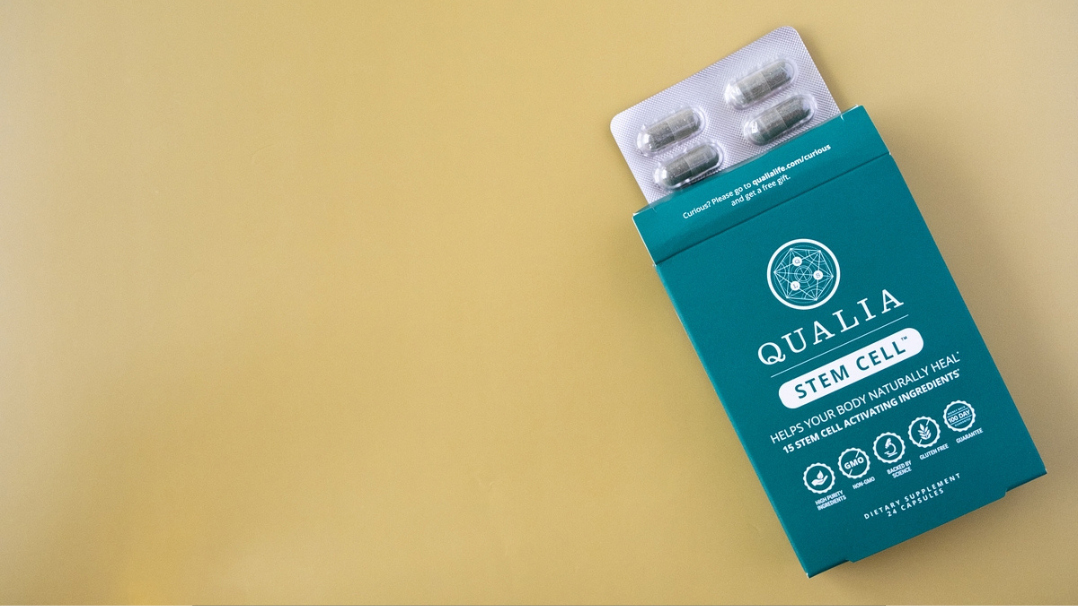
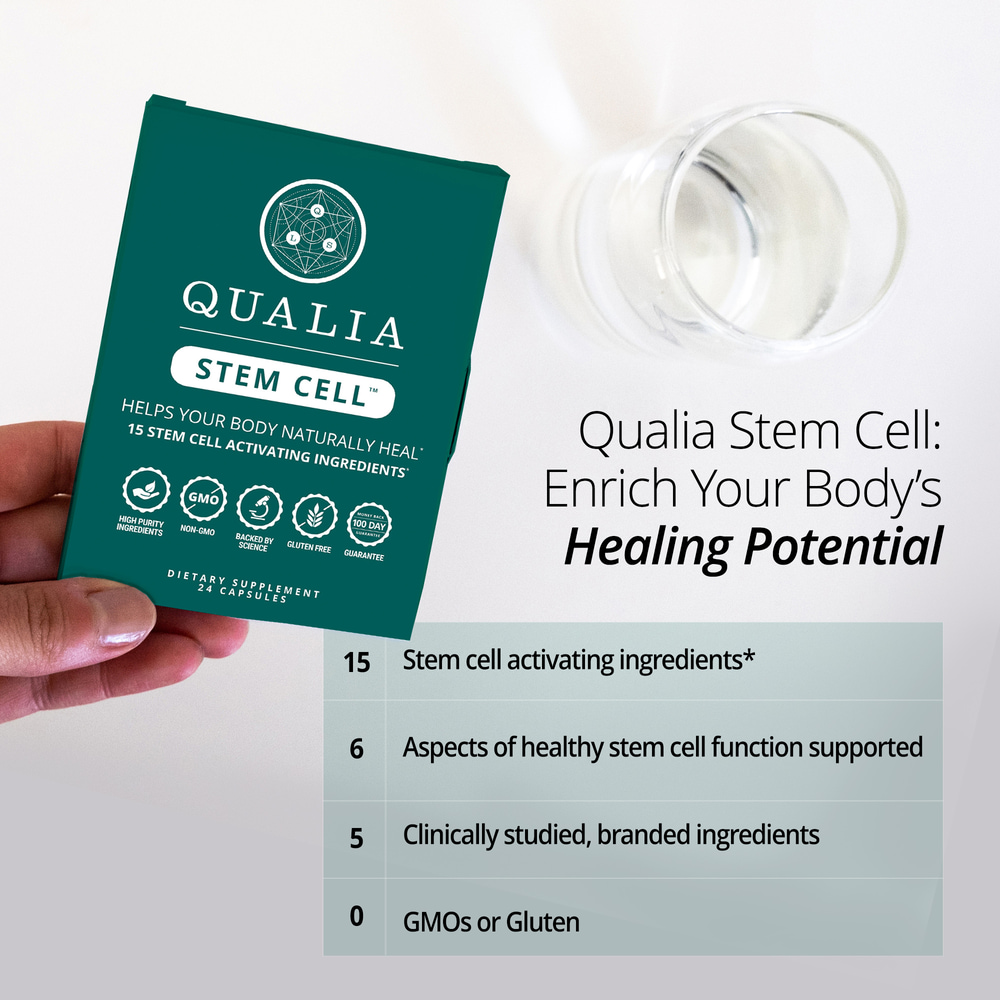
The art of it is putting it all together and saying, “We think that this is going to make an impact positively.” Stepping back to the main idea, what we’re doing is helping people get exposure to things that are good for them, but are not part of a common diet. We’re making it a lot more accessible. I could tell you to go eat Okinawan seaweed, and you probably would, but is it going to become a regular part of your diet? That’s one of the ingredients, for example, in the Stem Cell product. It does cool things in terms of helping to keep our stem cells healthy. There are fifteen different ingredients in that formula. People are not eating a lot of them regularly.
Let’s talk about that. First, let me just say one thing. I’ve had James Schmachtenberger on a couple of times, at least twice, but I appreciate this. When I was coming online as a speaker and somebody in the health and wellness space, speaking at Paleo f(x) and stuff like that, I remember Qualia coming. I remember looking at the booth. I’m working on it. I’m doing my own supplement formulation with those guys. I’ve got my head in that space.
I remember thinking about this. I talked to James. One of the things that I appreciated about Qualia was that, from a nootropic standpoint, it wasn’t just, “Let's get the brain to work better right now.” It’s, “What are the nutrients necessary to help the brain be extra healthy through longevity?” It was like a kitchen sink, but an incredibly well-formulated kitchen sink that was trying to cover all the bases. To me, uniquely, there was nothing else like that. It’s cool. Senolytic has now become Stem Cell. Is that correct? Are those two different things?
Those are two different things. I was at Mindshare Conference, which is a conference for doctors who are branching off of conventional medicine and trying to create their own practice, doing a lot of functional medicine, maybe longevity medicine. The purpose of the conference is to create a business. How do people find you? Do you want to do a podcast? What should your website look like? It’s useful for that community. When I was there, I was always talking about Senolytic and Stem Cells together as though it’s one product. Quickly, senescent cells are like the analogy we talk about with stem cells, a zombie.
Typically, when a cell is at the end of its life, it’ll undergo a programmed cell death called apoptosis. These cells evade that process. They have three different characteristics. They will release a lot of inflammatory molecules into the surrounding space. They resist cell death. Those two things are not quite dead. They’re still alive. They’re not contributing functionally. One senescent cell out of 10,000 healthy cells can still cause enough damage to facilitate or contribute to chronic inflammation, which is one of the hallmarks of aging. The way to think of inflammation is that we tend to think of it as a bad thing, but it’s another communication system in the body.
What happens when you have the level of inflammation rising in the body is that it’s harder for the body to hear those signals. It’s being in a room with a person who’s hard of hearing. If you were just to speak at the volume that we’re speaking now, the message isn’t getting through because they can’t hear it. The analogy is that now, I’m having to talk at a higher volume just to get the message across. That’s why inflammation rises. It’s trying to do its job. As a result, it’s also wreaking havoc in the body in terms of how effective all of our tissues are.
It bottlenecks the resources everywhere else. We’re exposed to germs all the time, but maybe you keep getting sick because the chronic inflammation is so high that your immune system is taxed to begin with.
Exactly. You don’t sleep as well. Because of inflammation, you’re not maintaining your blood glucose levels as well. You’re not fighting infections as well. All of those things have chronic inflammation as a contributor to that effect. We don’t want to prevent senescence because when a cell is getting older, we want it to actually flip into senescence so it doesn’t become cancerous. Preventing that would be problematic.
Once they’re there, we want to get rid of them. Their natural mechanism is to release all these inflammatory molecules, which then tells your immune system, “Come clear me out.” It’s their beacon. When you get older, you undergo what’s called thymic involution. Your immune system stops producing beta cells and T cells as effectively. Your immune system is not as effective, so it doesn’t clear them out as much.
When you’re younger, every time you make a senescent cell, you clear it. Your net senescent cells stay even until you’re in your 30s, at which point they start to rise a little bit. It goes up. It’s exponential. By the time you’re in your 70s or 80s, you might have quite a few senescent cells. Not only are they not contributing functionally, but they’re creating this internal stew that is going to make everything else harder to do.
If your immune system isn’t clearing them out, is there any other way to do that? In the mid-2010s, a couple of researchers started to look at what are called senolytics. Senolytic means compounds that actually destroy or kill senescent cells. One of the characteristics of senescent cells is that they have this upregulation of these survival pathways. With these targeted flavonoids, these beautiful natural compounds like fisetin, which you would see in cucumbers and strawberries, at a high dose, you’d have to eat a truckload, but high doses of that with quercetin, curcumin, and piperlongumine.
You’re targeting these receptor tyrosine kinases, or they’re on the cell. Because they’re upregulated, only those cells are affected. Your healthy cells are not affected. You’re not giving your healthy cells a die signal, only the ones that have dramatically upregulated systems that are promoting their survival. What we’ve seen is that you can kill those senescent cells, and all sorts of beneficial things happen. One study was fascinating. This is where I could set the world on fire for this topic.
There was a gentleman who was undergoing cancer treatment with something called navitoclax. He was an older gentleman with completely white hair. His hair completely turned black again. I’m certainly not promising that effect with people. I remember looking at that back in the early 2000s and seeing the before and after photos. They were not expecting that. That was not the purpose of the trial, but it certainly ignited the interest of the research community.
That’s what Senolytic does. You only take it for two days a month. You take these high doses of these natural compounds that are causing cellular stress, causing them to actually die. What I do is I put it in my calendar, I do a Saturday and Sunday, and then I wait. With our new Stem Cell product, it is a whole cool line. Essentially, it’s our body’s regeneration system. The way that stem cells work is that we have all these niches of stem cells in the body.
Stem cells can become different things. They are like a lump of clay. When they divide, they make these two daughter cells, one of which stays a stem cell. The other one is now destined to become some tissue in the body. We have what are called levels of potencies. If you have a pluripotent or totipotent stem cell, it can become anything in your body. If you have a multipotent cell, it can become a few things. It goes down only certain lineages.
The way that I think about it is an imperfect, but useful analogy. Think of a college freshman being a totipotent or pluripotent stem cell. You haven’t taken any classes. You haven’t declared any major. You could become anything. As you get into your junior and senior year, and you’ve taken a bunch of science classes, and you’re aiming towards Medicine, you’ve now gone down a lineage. You can become fewer things, but you can still become any kind of doctor.
For example, mesenchymal stem cells, which are used in medical therapies, can restore your blood. They can restore oxygen-carrying molecules in your blood or your immune system. They can become one of several different tissue types. Stem cells are typically quiescent. They’re quiet. They should be in their bed sleeping. If we overstimulate them, then we will facilitate one of the hallmarks of aging, which is stem cell exhaustion. You’ll tire down that system.
This is a fair point to bring up, because as fasting hit its high, you start to see even guys like Peter Attia doing a seven-day water fast quarterly. I was like, “That doesn’t pair well ancestrally.” We might have had it if you had white skin, and you’re closer to the poles. You probably had a harsh winter where you might have had to fast once or twice, maybe even a longer stretch during that time. Maybe you only had some leftover animal stuff to go with, and you were severely calorically restricted. You still had a good amount of fat. You were in nutritional ketosis most of that time. It doesn’t make sense, though, that in July. The quarterly thing was a question that I had. People became gung-ho about that. Can you overdo that? If so, maybe we only have a certain amount of stem cells.
You’re tapping into an idea that we’re discussing and leveraging. With several of our new supplements, you do them periodically. You do the Senolytic product once a month. It’s our most popular product. We weren’t sure if it was going to be a success at all. It took off. People get the idea. The fact that you get it on subscription, you take it for two days, and then you don't have to wait a month is helpful. With our stem cell supplements, it’s four days on, and then you wait until the next month.
If you look at the stem cell cycle, they’re sleeping in their bed. They’re quiescent. When they get the signal, you have to wake them up. Mom wakes them up out of their bed. They proliferate, so they duplicate and make more. They then get into the bloodstream. Through these different homing signals, they are able to figure out what tissues need to be repaired. We talked about the Hayflick limit. A cell can replicate, but eventually, it stops. We get to replace that tissue. It’s no longer replicating. We need to get in there and replace it with new tissue.
Aging can be defined in a lot of ways by the balance of your repair processes, going from always repairing and maintaining your full body to tilting in a way where you’re not regenerating as fully over time. One of the reasons why stem cells are exhausted is because of the inflammatory environment. They’re there, but they’re not hearing the signal. They can’t do their job. Over the four-day period, we’re modifying the inflammatory state. We’re stimulating more stem cell proliferation and activation. We’re helping them in their homing process, which is the process by which they find the tissues where they need to go.
Is that through the ingredients themselves or through dietary guidelines, while you’re doing? As James was telling me, it’s a good idea when you take Senolytic to have a fasting window, or if you can do a 24-hour dinner-to-dinner type thing, where you skip everything for 24 hours if you can. That’s great, too. As a periodic boom, I'm going to reset everything. That also seems like it could have been more of the case during the year when food is plentiful. There’s still like, “I’m going to take a day off and let my body reset.”
When I do Senolytic, I have very low protein the night before, and then fast the morning of. I’ll have low protein for the rest of the day for those two days. The reason is because of mTOR. The mechanistic target of rapamycin is stimulated by protein. That is going to protect. That is actually a growth signal. You’re now sending conflicting messages. We don’t want to help protect and strengthen the cells when we’re trying to kill them. We’re trying to damage them.
Another lifestyle accompaniment to the product would be to do a twenty-minute high-intensity training or blood flow restriction training. That is also going to send some stress signals that are going to amplify that process. What are all the things that we can do in that moment to get the best results? The supplement can play a part in that. Let’s not stop there. Let’s use it as a catalyst to get the best results that we can.
At the same time, let’s not complicate it too much so that only a few people can do it. Start with the supplement, but then do these extra things if you want to get the most out of it. That’s a great approach. I’m creating protocols on this now. This whole differentiation process is fascinating, too. You have this lump of clay that’s arrived at a muscle. How does it know to become that type of cell? We have all of our genetics.
We have our entire genome in every cell. It undergoes this very beautiful symphony where it’s hearing messages from the extracellular matrix and growth signals that will then activate ancient pathways that are 1.2 to 700 million years old. There are only 7 to 10 of them. When humans evolved into existence, we didn’t reinvent cells. We built on top of every layer that came before us. These layers are super old. What happens then is that the stem cells receive those messages.
It initiates this signaling cascade, which creates these transcription factors that say, “Make these proteins and not these.” It’s this reinforcing loop that locks in cell fate so that it becomes the right tissue. You don’t want a neuron in your muscle or a fat cell. You want a muscle cell. That process is so enamoring to me. It’s incredible that all this stuff is happening in the backdrop. During those four days, I’ll do more steady state, more zone two type of training.
I’m not trying to create more damage. I’m trying to facilitate blood flow. I’m eating before I was fasting. I am definitely taking our NAD product, which is helping with cellular energy. That is a fascinating conversation, but probably too much for this episode. Think of NAD as cabs in a city. As you get older, by the time you’re 50, you have half of the cabs that you did when you were younger. It’s harder to move people around the city.
The reason why NAD garnered a lot of attention is that with precursors and other types of nutrients that affect the enzymes that are involved in the regulation of NAD production, you can actually increase your NAD levels quite a bit and back towards youthful levels. That is going to help with the energy of the rebuilding process. We think that with healthspan, it’s extending the level of health farther into the lifespan.
We might be able to positively affect that. Ultimately, it’s going to come from a combination of products, not just one. You have to understand different mechanisms. You have to understand timing. You have to sequence them together. We’re looking at other products for other hallmarks of aging. That’s where the future is going to be. It is a multi-targeted approach to keeping our youth longer.
That’s it right there. I don’t want to live to 150. I don’t need to upload my consciousness to the machine. I do want to live well into my 90s. If I die at 90, but I’ve lived well all the way through my 80s, I want my 80s to be awesome. I don’t want to be bedridden or an old curmudgeon. I want to have use. I want to be able to use my body. The body is ultimate freedom, or it’s its own prison, depending on how you treat it.
Evolution favors. We still have a role when we get older. There’s less emphasis on maintaining our peak form, but we can do surprisingly well when we give it all the factors that it needs so that we can continue to contribute to the tribe and share our aggregated wisdom of living longer to help younger generations be more successful, steer clear of problems, and help them solve their problems. That is the evolutionary reason why we live as long as we do. Salmon die hours to a week after they mate. There is no aging. There’s maturation. There’s reproduction. We have a protracted aging period. Even though it happens, we don’t like a lot of it. We can also be grateful for it.
Get In Touch With Dr. Dan
Yes, especially if we have the opportunity to give back to people we love. It has been so awesome having you on the show. We will do this again for certain. Where can people find you online? We’ll link to all this stuff, too, with Qualia, Senolytic, Stem Cell, and all that good stuff.
We’re QualiaLife.com. Jenny is on my team. We’re at the health science department, a newer department. She’s working hard, writing blogs that go into one of the ingredients in detail. What is all the science that we know about the cyanobacteria that we use to stimulate stem cell proliferation? We cover both the science and the therapeutic areas of areas that we’re trying to make a positive impact in, and also other areas. The one she’s working on right now is the value of letting your mind wander, the attention restoration theory, going in nature, letting your thoughts just move through you without any task on, thinking about something, letting that default mode network clear out all your thoughts, and how valuable that is.
That’s a huge one for sleep. I tell a lot of people, if the first time you’re alone with yourself and thinking is right before you go to bed, good luck nodding off. You have to set aside time for the ability to ponder, let things move, reflect even on the day, and then not reflect and just let it go.
We’re going to discover that with cell phones and everything. It’s going to be another issue that we face, which is the lack of mind wandering. You’re right. So much of your day gets into the process, but we’re always getting information in, and we’re not processing it enough. I agree with you. We’ll talk about sleep at other times.
I can’t wait. We’ll go deep. Thank you, man.
Important Links
- Stealing Fire
- Recapture the Rapture
- Hold On to Your Kids
- The Collapse of Parenting
- How to Eat, Move, and Be Healthy
- TeloYears
- FoundMyFitness
- TruDiagnostic
- Index
- Generation Lab
- ChiRunning
- Qualia Stem Cell: Stem Cell Support for Renewal & Repair
- Qualia Senolytic: Eliminate Senescent Cells for Healthy Aging
- Qualia NAD+: Clinically Proven to Boost NAD+ Levels by 67%
- Qualia Life on Instagram
- Qualia Life on Facebook
- Qualia Life on YouTube
- Qualia Life on TikTok
- What Makes Qualia Stem Cell Different? - YouTube